Mustila Taina, Raitanen Jani, Keskinen Päivi, Luoto Riitta
Seinäjoki Central Hospital, Hanneksenrinne 7, 60220, Seinäjoki, Finland.
UKK Institute for Health Promotion, Tampere, Finland.
BMC Pediatr. 2018 Feb 27;18(1):89. doi: 10.1186/s12887-018-1065-3.
Obesity in childhood appears often during the toddler years. The prenatal environment influences obesity risk. Maternal gestational diabetes, the child's diet, and physical activity in the first few years have an important role in subsequent weight gain. A study was conducted to evaluate effectiveness of a primary health-care lifestyle counselling intervention in prevention of childhood obesity up to 6 years of age.
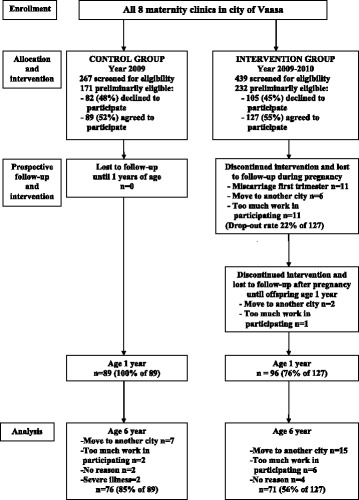
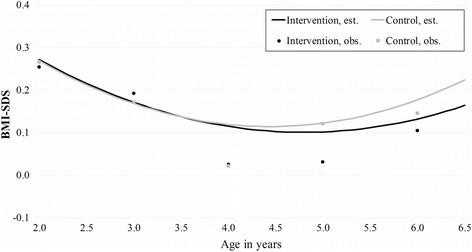
The study was a controlled pragmatic trial to prevent childhood obesity and was implemented at maternity and child health-care clinics. The participants (n = 185) were mothers at risk of gestational diabetes mellitus with their offspring born between 2008 and 2010. The prenatal intervention, started at the end of the first trimester of pregnancy, consisted of counselling on diet and physical activity by municipal health-care staff. The intervention continued at yearly appointments with a public health-nurse at child health-care clinics. The paper reports the offspring weight gain results for 2-6 years of age. Weight gain up to 6 years of age was assessed as BMI standard deviation scores (SDS) via a mixed-effect linear regression model. The proportion of children at 6 years with overweight/obesity was assessed as weight-for-height percentage and ISO-BMI. Priority was not given to power calculations, because of the study's pragmatic nature.
One hundred forty seven children's (control n = 76/85% and intervention n = 71/56%) weight and height scores were available for analysis at 6 years of age. There was no significant difference in weight gain or overweight/obesity proportions between the groups at 6 years of age, but the proportion of children with obesity in both groups was high (assessed as ISO-BMI 9.9% and 11.8%) relative to prevalence in this age group in Finland.
As the authors previously reported, the intervention-group mothers had lower prevalence of gestational diabetes mellitus, but a decrease in obesity incidence before school age among their offspring was not found. The authors believe that an effective intervention should start before conception, continuing during pregnancy and the postpartum period through the developmentally unique child's first years.
ClinicalTrials.gov NCT00970710 . Registered 1 September 2009. Retrospectively registered.
儿童肥胖往往出现在幼儿期。产前环境会影响肥胖风险。母亲妊娠期糖尿病、孩子的饮食以及头几年的身体活动对其随后的体重增加起着重要作用。开展了一项研究,以评估初级卫生保健生活方式咨询干预措施在预防6岁以下儿童肥胖方面的效果。
该研究是一项预防儿童肥胖的实用对照试验,在母婴保健诊所开展。参与者(n = 185)为有妊娠期糖尿病风险的母亲及其在2008年至2010年期间出生的后代。产前干预在妊娠早期第三个月末开始,由市政卫生保健人员提供饮食和身体活动方面的咨询。干预在儿童保健诊所与公共卫生护士的年度预约中持续进行。本文报告了后代2至6岁时的体重增加结果。通过混合效应线性回归模型将6岁时的体重增加评估为BMI标准差评分(SDS)。将6岁时超重/肥胖儿童的比例评估为身高体重百分比和国际标准化组织BMI。由于该研究的实用性,未优先进行功效计算。
147名儿童(对照组n = 76/85%,干预组n = 71/56%)6岁时的体重和身高评分可供分析。两组在6岁时的体重增加或超重/肥胖比例无显著差异,但相对于芬兰该年龄组的患病率,两组中肥胖儿童的比例都很高(评估为国际标准化组织BMI分别为9.9%和11.8%)。
正如作者之前所报告的,干预组母亲妊娠期糖尿病的患病率较低,但未发现其后代学龄前期肥胖发生率有所下降。作者认为,有效的干预应在受孕前开始,并在孕期及产后持续至儿童成长的头几年,这几年具有独特的发育特点。
ClinicalTrials.gov NCT00970710。2009年9月1日注册。回顾性注册。