Seinäjoki Central Hospital, Hanneksenrinne 7, 60220 Seinäjoki, Finland.
BMC Pediatr. 2013 May 20;13:80. doi: 10.1186/1471-2431-13-80.
According to current evidence, the prevention of obesity should start early in life. Even the prenatal environment may expose a child to unhealthy weight gain; maternal gestational diabetes is known to be among the prenatal risk factors conducive to obesity. Here we report the effects of antenatal dietary and physical activity counselling on pregnancy and infant weight gain outcomes.
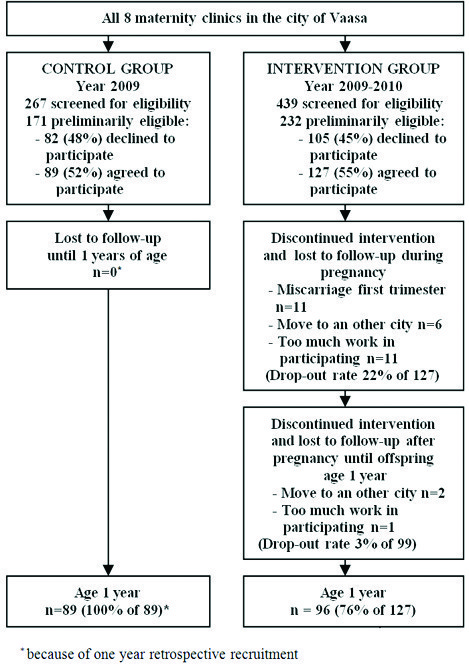
The study was a non-randomised controlled pragmatic trial aiming to prevent childhood obesity, the setting being municipal maternity health care clinics. The participants (n = 185) were mothers at risk of developing gestational diabetes mellitus and their offspring. The children of the intervention group mothers were born between 2009 and 2010, and children of the control group in 2008. The intervention started between 10-17 gestational weeks and consisted of individual counselling on diet and physical activity by a public health nurse, and two group counselling sessions by a dietician and a physiotherapist. The expectant mothers also received a written information leaflet to motivate them to breastfeed their offspring for at least 6 months. We report the proportion of mothers with pathological glucose tolerance at 26-28 weeks' gestation, the mother's gestational weight gain (GWG) and newborn anthropometry. Infant weight gain from 0 to 12 months of age was assessed as weight-for-length standard deviation scores (SDS) and mixed effect linear regression models.
Intervention group mothers had fewer pathological oral glucose tolerance test results (14.6% vs. 29.2%; 95% CI 8.9 to 23.0% vs. 20.8 to 39.4%; p-value 0.016) suggesting that the intervention improved gestational glucose tolerance. Mother's GWG, newborn anthropometry or infant weight gain did not differ significantly between the groups.
Since the intervention reduced the prevalence of gestational diabetes mellitus, it may have the potential to diminish obesity risk in offspring. However, results from earlier studies suggest that the possible effect on the offspring's weight gain may manifest only later in childhood.
Clinical Trials gov: NCT00970710.
根据现有证据,肥胖的预防应在生命早期开始。即使产前环境也可能使儿童面临不健康的体重增加;已知母体妊娠期糖尿病是促进肥胖的产前危险因素之一。在这里,我们报告产前饮食和体育活动咨询对妊娠和婴儿体重增加结果的影响。
该研究是一项非随机对照实用试验,旨在预防儿童肥胖,研究地点为市妇幼保健诊所。参与者(n=185)为有发展妊娠糖尿病风险的母亲及其后代。干预组母亲的孩子出生于 2009 年至 2010 年,对照组母亲的孩子出生于 2008 年。干预始于 10-17 孕周,由公共卫生护士对饮食和体育活动进行个体咨询,并由营养师和理疗师进行两次小组咨询。孕妇还收到了一份书面信息传单,以激励她们至少母乳喂养婴儿 6 个月。我们报告了 26-28 孕周病理性葡萄糖耐量的母亲比例、母亲的妊娠体重增加(GWG)和新生儿人体测量学。从 0 到 12 个月龄婴儿体重增加的评估为体重-长度标准差评分(SDS)和混合效应线性回归模型。
干预组母亲的病理性口服葡萄糖耐量试验结果较少(14.6% vs. 29.2%;95% CI 8.9 至 23.0% vs. 20.8 至 39.4%;p 值 0.016),这表明干预改善了妊娠葡萄糖耐量。两组间母亲的 GWG、新生儿人体测量学或婴儿体重增加无显著差异。
由于干预降低了妊娠期糖尿病的患病率,因此它可能有潜力降低后代肥胖的风险。然而,早期研究的结果表明,对后代体重增加的可能影响可能仅在儿童后期表现出来。
ClinicalTrials.gov:NCT00970710。