MRC Centre for Neuromuscular Diseases, Institute of Genetic Medicine, Newcastle University, Newcastle upon Tyne, UK.
Department of Neuropediatrics and Muscle Disorders, Medical Center-University of Freiburg, Faculty of Medicine, Freiburg, Germany.
Eur J Hum Genet. 2018 Jun;26(6):778-785. doi: 10.1038/s41431-018-0115-5. Epub 2018 Feb 27.
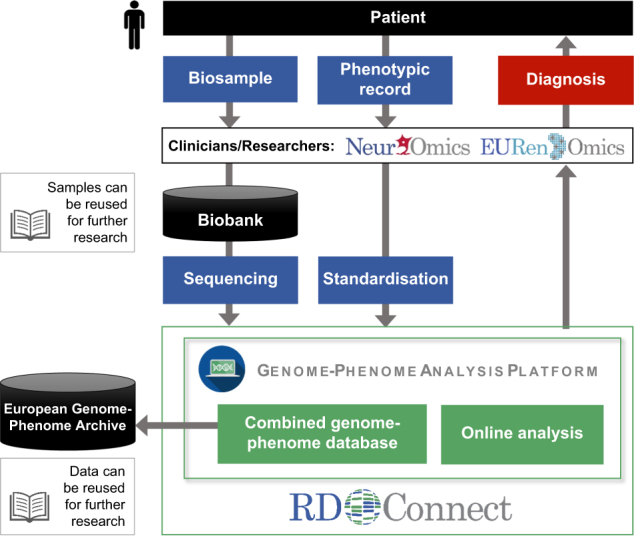
Although individually uncommon, rare diseases (RDs) collectively affect 6-8% of the population. The unmet need of the rare disease community was recognized by the European Commission which in 2012 funded three flagship projects, RD-Connect, NeurOmics, and EURenOmics, to help move the field forward with the ambition of advancing -omics research and data sharing at their core in line with the goals of IRDiRC (International Rare Disease Research Consortium). NeurOmics and EURenOmics generate -omics data and improve diagnosis and therapy in rare renal and neurological diseases, with RD-Connect developing an infrastructure to facilitate the sharing, systematic integration and analysis of these data. Here, we summarize the achievements of these three projects, their impact on the RD community and their vision for the future. We also report from the Joint Outreach Day organized by the three projects on the 3rd of May 2017 in Berlin. The workshop stimulated an open, multi-stakeholder discussion on the challenges of the rare diseases, and highlighted the cross-project cooperation and the common goal: the use of innovative genomic technologies in rare disease research.
虽然罕见病(RDs)在个体中并不常见,但它们共同影响着 6-8%的人口。欧洲委员会认识到罕见病社区的未满足需求,于 2012 年资助了三个旗舰项目,即 RD-Connect、NeurOmics 和 EURenOmics,以帮助推动该领域的发展,其目标是推进核心的组学研究和数据共享,以符合 IRDiRC(国际罕见病研究联合会)的目标。NeurOmics 和 EURenOmics 生成组学数据,并改善罕见肾脏和神经疾病的诊断和治疗,而 RD-Connect 则开发了一种基础设施,以促进这些数据的共享、系统集成和分析。在这里,我们总结了这三个项目的成就、它们对罕见病社区的影响以及它们对未来的展望。我们还报告了三个项目于 2017 年 5 月 3 日在柏林组织的联合推广日的情况。该研讨会激发了一场关于罕见疾病挑战的公开、多方利益相关者讨论,并强调了跨项目合作和共同目标:即利用创新的基因组技术进行罕见病研究。