Olatimehin Ayodele, Shittu Adebayo O, Onwugamba Francis C, Mellmann Alexander, Becker Karsten, Schaumburg Frieder
Department of Microbiology, Obafemi Awolowo University, Ile-Ife, Nigeria.
Institute of Medical Microbiology, University Hospital Münster, Münster, Germany.
Front Microbiol. 2018 Feb 13;9:162. doi: 10.3389/fmicb.2018.00162. eCollection 2018.
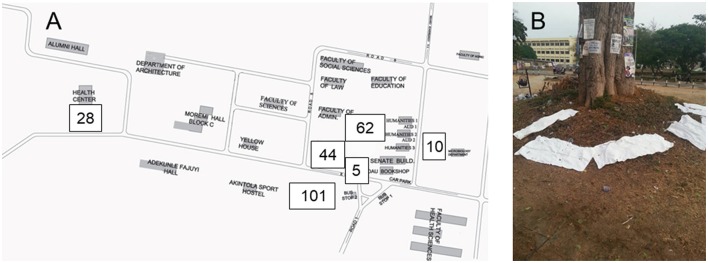
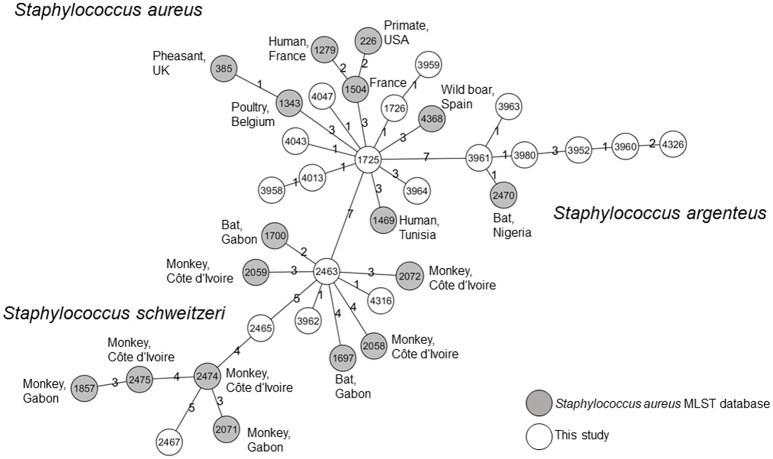
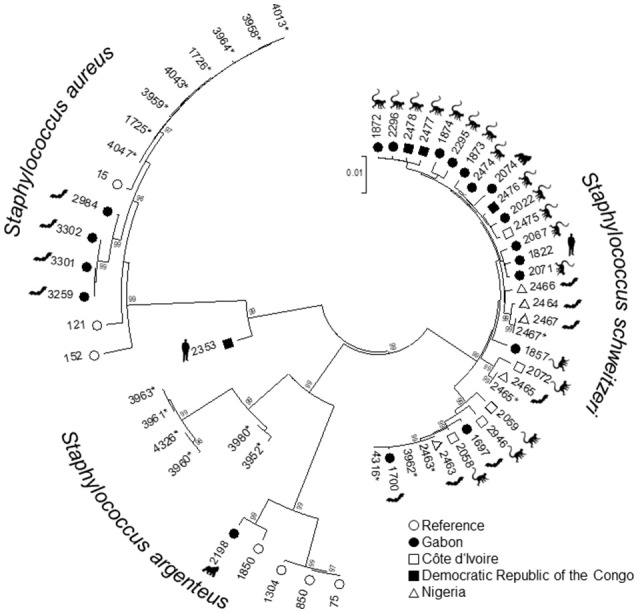
Bats are economically important animals and serve as food sources in some African regions. They can be colonized with the complex, which includes and . Fecal carriage of complex in the straw-colored fruit bat () has been described. However, data on their transmission and adaptation in animals and humans are limited. The aim of this study was to investigate the population structure of the complex in and to assess the geographical spread of complex among other animals and humans. Fecal samples were collected from in Obafemi Awolowo University, Ile-Ife, Nigeria. The isolates were characterized by antimicrobial susceptibility testing, typing and multilocus sequence typing (MLST). Isolates were screened for the presence of /-PV and the immune evasion cluster () which is frequently found in isolates adapted to the human host. A Neighbor-Joining tree was constructed using the concatenated sequences of the seven MLST genes. A total of 250 fecal samples were collected and 53 isolates were included in the final analysis. They were identified as ( = 28), ( = 11) and ( = 14). Only one was resistant to penicillin and another isolate was intermediately susceptible to tetracycline. The , and gene were not detected. Species-specific MLST clonal complexes (CC) were detected for (CC1725), (CC3960, CC3961), and (CC2463). STs of from this study were similar to STs from bats in Nigeria (ST2464) and Gabon (ST1700) or from monkey in Côte d'Ivoire (ST2058, ST2072). This suggests host adaptation of certain clones to wildlife mammals with a wide geographical spread in Africa. In conclusion, there is evidence of fecal carriage of members of complex in . from bats in Nigeria are closely related to those from bats and monkeys in West and Central Africa suggesting a cross-species transmission and wide geographical distribution. The low antimicrobial resistance rates and the absence of the immune evasion cluster suggests a limited exposure of these isolates to humans.
蝙蝠是具有重要经济意义的动物,在一些非洲地区作为食物来源。它们可能被该复合体定殖,该复合体包括[具体内容缺失]和[具体内容缺失]。已描述了稻草色果蝠([具体内容缺失])粪便中携带该复合体的情况。然而,关于它们在动物和人类中的传播及适应性的数据有限。本研究的目的是调查[具体内容缺失]中该复合体的种群结构,并评估该复合体在其他动物和人类中的地理分布。从尼日利亚伊费奥巴费米·阿沃洛沃大学的[具体内容缺失]收集粪便样本。通过抗菌药物敏感性试验、[具体内容缺失]分型和多位点序列分型(MLST)对分离株进行鉴定。筛选分离株中是否存在/-PV以及在适应人类宿主的分离株中经常发现的免疫逃避簇([具体内容缺失])。使用七个MLST基因的串联序列构建邻接树。共收集了250份粪便样本,最终分析纳入了53株分离株。它们被鉴定为[具体内容缺失](=28)、[具体内容缺失](=11)和[具体内容缺失](=14)。仅一株[具体内容缺失]对青霉素耐药,另一株分离株对四环素中介敏感。未检测到[具体内容缺失]、[具体内容缺失]和[具体内容缺失]基因。检测到了针对[具体内容缺失](CC1725)、[具体内容缺失](CC3960、CC3961)和[具体内容缺失](CC2463)的物种特异性MLST克隆复合体(CC)。本研究中[具体内容缺失]的序列类型与尼日利亚蝙蝠(ST2464)、加蓬蝙蝠(ST1700)或科特迪瓦猴子(ST2058、ST2072)的序列类型相似。这表明某些克隆对非洲地理分布广泛的野生哺乳动物具有宿主适应性。总之,有证据表明[具体内容缺失]中存在该复合体成员的粪便携带情况。尼日利亚蝙蝠中的[具体内容缺失]与西非和中非蝙蝠及猴子中的[具体内容缺失]密切相关,表明存在跨物种传播和广泛的地理分布。抗菌药物耐药率低且不存在免疫逃避簇表明这些分离株与人类的接触有限。