
靶向VEGFR药物治疗晚期或转移性胃癌的疗效与安全性:一项系统评价和荟萃分析
Efficacy and safety of targeting VEGFR drugs in treatment for advanced or metastatic gastric cancer: a systemic review and meta-analysis.
作者信息
Liu Duanrui, Ma Xiaoli, Xiao Dongjie, Jia Yanfei, Wang Yunshan
机构信息
Central Laboratory, Jinan Central Hospital Affiliated to Shandong University, Jinan 250013, People's Republic of China.
Shandong Province Key Lab of Tumor Target Molecule, Jinan Central Hospital Affiliated to Shandong University, Jinan 250013, People's Republic of China.
出版信息
Oncotarget. 2017 Dec 19;9(8):8120-8132. doi: 10.18632/oncotarget.23429. eCollection 2018 Jan 30.
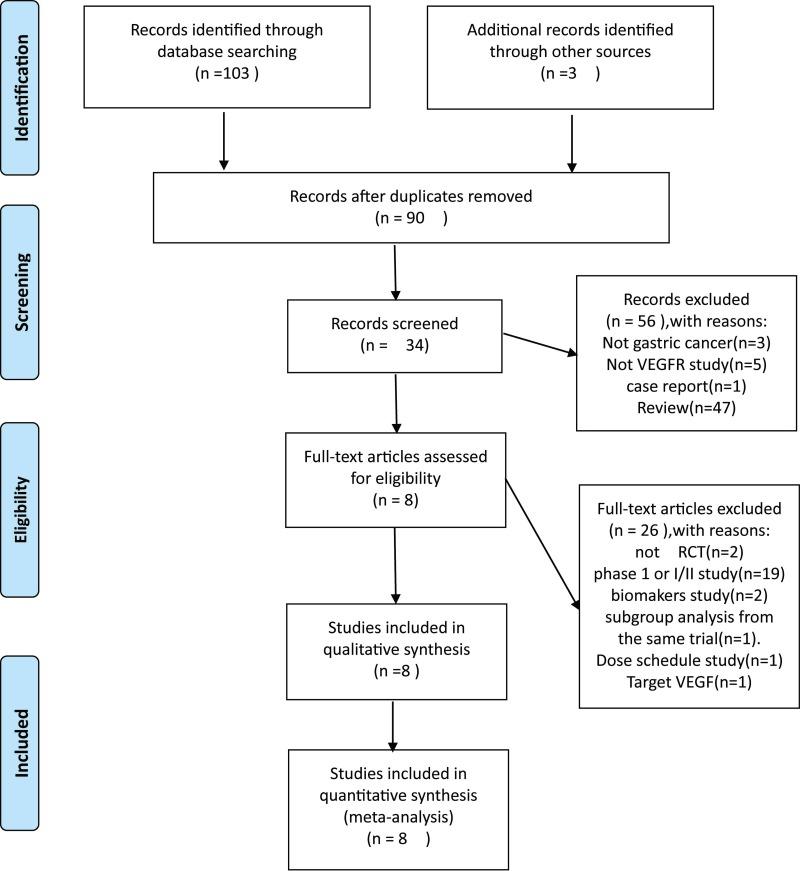
The value of targeting VEGFR (vascular endothelial growth factor receptor) drugs has demonstrated encouraging anti-cancer activity in advanced solid tumors within current clinical trials. This study aimed to serve as the first systemic review to assess their safety and efficacy according to biochemical characteristics of targeting VEGFR drugs in gastric cancer. We analyzed eight clinical trials on targeting VEGFR drugs in gastric cancer. Results showed that targeting VEGFR drugs significantly improved overall survival (OS) [Hazard Ratio (HR) 0.69, 95% confidence interval (CI) (0.55, 0.83), 0.001], progression free survival (PFS) [HR 0.50, 95% CI (0.34, 0.66), 0.001], disease control rate (DCR) [Odds Ratio (OR) 3.83, 95% CI (2.39, 6.15), 0.001] and significantly decreased the progressive disease rate(PDR)[OR 0.45, 95% CI (0.34, 0.59), 0.001], but not objective response rate (ORR) [OR 1.46, 95% CI (0.93, 2.29), = 0.098]. Further subgroup revealed that VEGFR antibody (VEGFR-Ab) drugs were superior to VEGFR tyrosine kinase inhibitor (VEGFR-TKI) drugs in terms of the OS, PFS and PDR. To determine the toxic effect of targeting VEGFR drugs, the relative risk of adverse events (grade ≥ 3) of special interest(AESIs) were estimated. Most of these were predictable and manageable. Furthermore, less AESIs were observed in the VEGFR-Ab than the VEGFR-TKI drugs. In conclusion, VEGFR drugs were effective targeted therapy in advanced or metastatic gastric cancer, and its toxicity is within a controllable range. VEGFR-Ab drugs were more effective than VEGFR-TKI drugs in terms of the OS, PFS and PDR of gastric cancer patients with little toxicity.
在当前的临床试验中,靶向血管内皮生长因子受体(VEGFR)药物在晚期实体瘤中已显示出令人鼓舞的抗癌活性。本研究旨在作为首个系统性综述,根据靶向VEGFR药物在胃癌中的生化特性评估其安全性和疗效。我们分析了八项关于靶向VEGFR药物治疗胃癌的临床试验。结果显示,靶向VEGFR药物显著改善了总生存期(OS)[风险比(HR)0.69,95%置信区间(CI)(0.55,0.83),P = 0.001]、无进展生存期(PFS)[HR 0.50,95% CI(0.34,0.66),P = 0.001]、疾病控制率(DCR)[优势比(OR)3.83,95% CI(2.39,6.15),P = 0.001],并显著降低了疾病进展率(PDR)[OR 0.45,95% CI(0.34,0.59),P = 0.001],但未提高客观缓解率(ORR)[OR 1.46,95% CI(0.93,2.29),P = 0.098]。进一步的亚组分析显示,在OS、PFS和PDR方面,VEGFR抗体(VEGFR-Ab)药物优于VEGFR酪氨酸激酶抑制剂(VEGFR-TKI)药物。为确定靶向VEGFR药物的毒性作用,我们估计了特别关注的不良事件(≥3级)的相对风险(AESIs)。其中大多数是可预测和可管理的。此外,与VEGFR-TKI药物相比,VEGFR-Ab药物引起的AESIs更少。总之,VEGFR药物是晚期或转移性胃癌有效的靶向治疗药物,其毒性在可控范围内。在胃癌患者的OS、PFS和PDR方面,VEGFR-Ab药物比VEGFR-TKI药物更有效且毒性更小。



 Zotero 插件