Liu Xin, Hong Xiumei, Tsai Hui-Ju, Mestan Karen K, Shi Min, Kefi Amira, Hao Ke, Chen Qi, Wang Guoying, Caruso Deanna, Geng Hua, Gao Yufeng, He Jianlin, Kumar Rajesh, Wang Hongjian, Yu Yunxian, Bartell Tami, Tan Xiao-Di, Schleimer Robert P, Weeks Daniel E, Pongracic Jacqueline A, Wang Xiaobin
Key Laboratory of Genomic and Precision Medicine, China Gastrointestinal Cancer Research Center, Beijing Institute of Genomics, Chinese Academy of Sciences, Beijing, China Mary Ann and J. Milburn Smith Child Health Research Program, Stanley Manne Children's Research Institute, Ann and Robert H. Lurie Children's Hospital of Chicago Department of Pediatrics Department of Preventive Medicine, Northwestern University Feinberg School of Medicine, Chicago, IL University of Chinese Academy of Sciences, Beijing, China Department of Population, Family and Reproductive Health, Center on the Early Life Origins of Disease, Johns Hopkins University Bloomberg School of Public Health, Baltimore, MD Division of Biostatistics and Bioinformatics, Institute of Population Health Sciences, National Health Research Institutes, Zhunan Department of Public Health, China Medical University, Taichung, Taiwan Division of Neonatology, Ann and Robert H. Lurie Children's Hospital of Chicago, Chicago, IL Biostatistics Branch, NIEHS, NIH, DHHS, Research Triangle Park, NC Department of Bioinformatics, the University of Illinois at Chicago, Chicago, IL Department of Genetics and Genomic Sciences, Icahn School of Medicine at Mount Sinai, New York, NY Center for Intestinal and Liver Inflammation Research, Stanley Manne Children's Research Institute Division of Allergy and Immunology, Ann and Robert H. Lurie Children's Hospital of Chicago, Chicago, IL Department of Cardiovascular Internal Medicine, State Key Laboratory of Cardiovascular Disease, Fuwai Hospital, National Center for Cardiovascular Disease, Chinese Academy of Medical Sciences and Peking Union Medical College, Beijing Department of Epidemiology and Health Statistics, School of Public Health, Zhejiang University, Hangzhou, Zhejiang, China Division of Allergy-Immunology, Northwestern University Feinberg School of Medicine, Chicago, IL Departments of Human Genetics and Biostatistics, Graduate School of Public Health, University of Pittsburgh, Pittsburgh, PA Division of General Pediatrics and Adolescent Medicine, Department of Pediatrics, Johns Hopkins University School of Medicine, Baltimore, MD.
Medicine (Baltimore). 2018 Mar;97(9):e0043. doi: 10.1097/MD.0000000000010043.
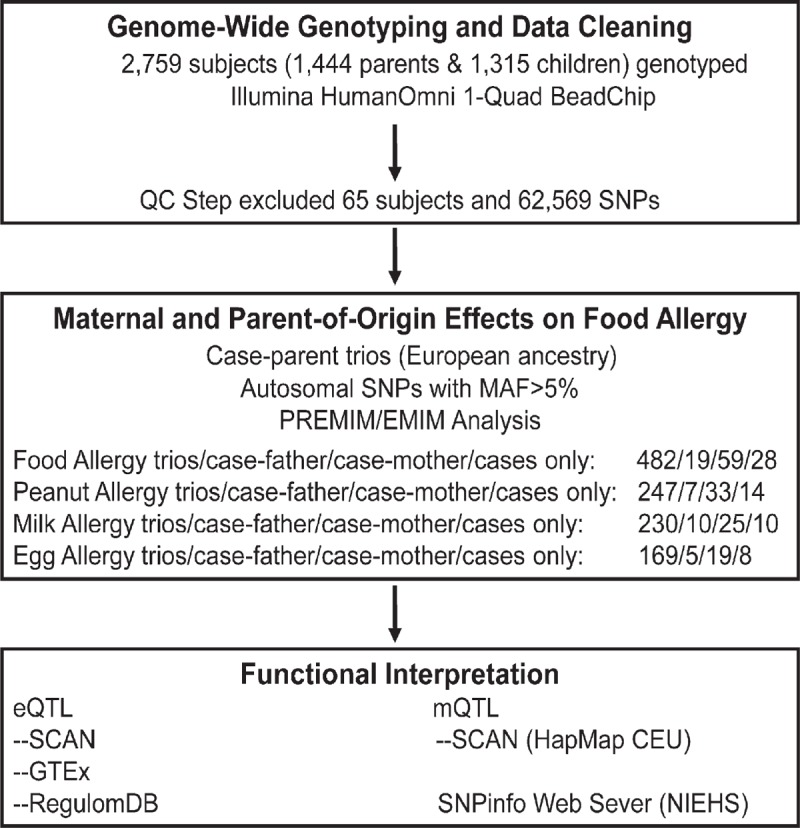
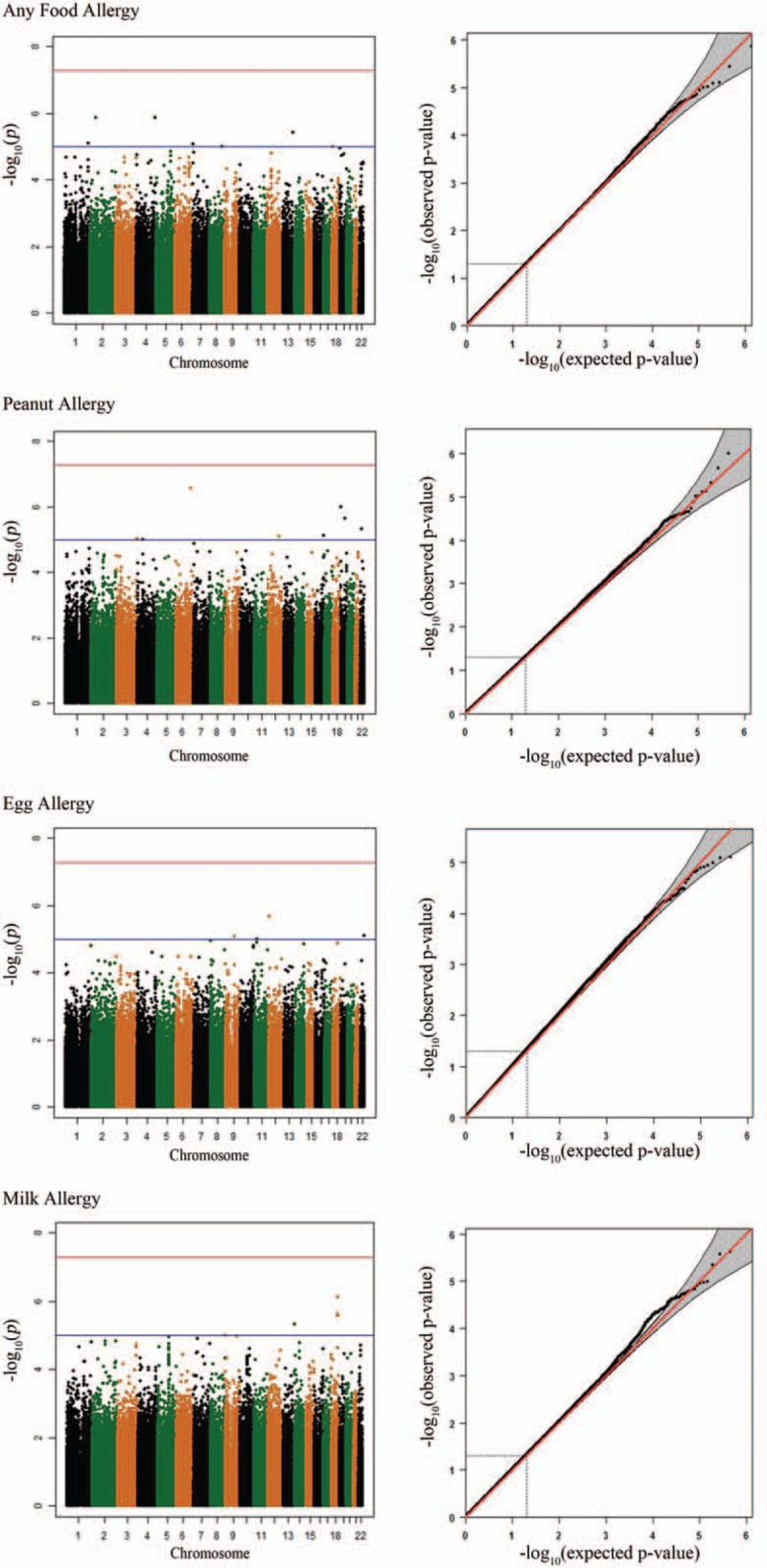
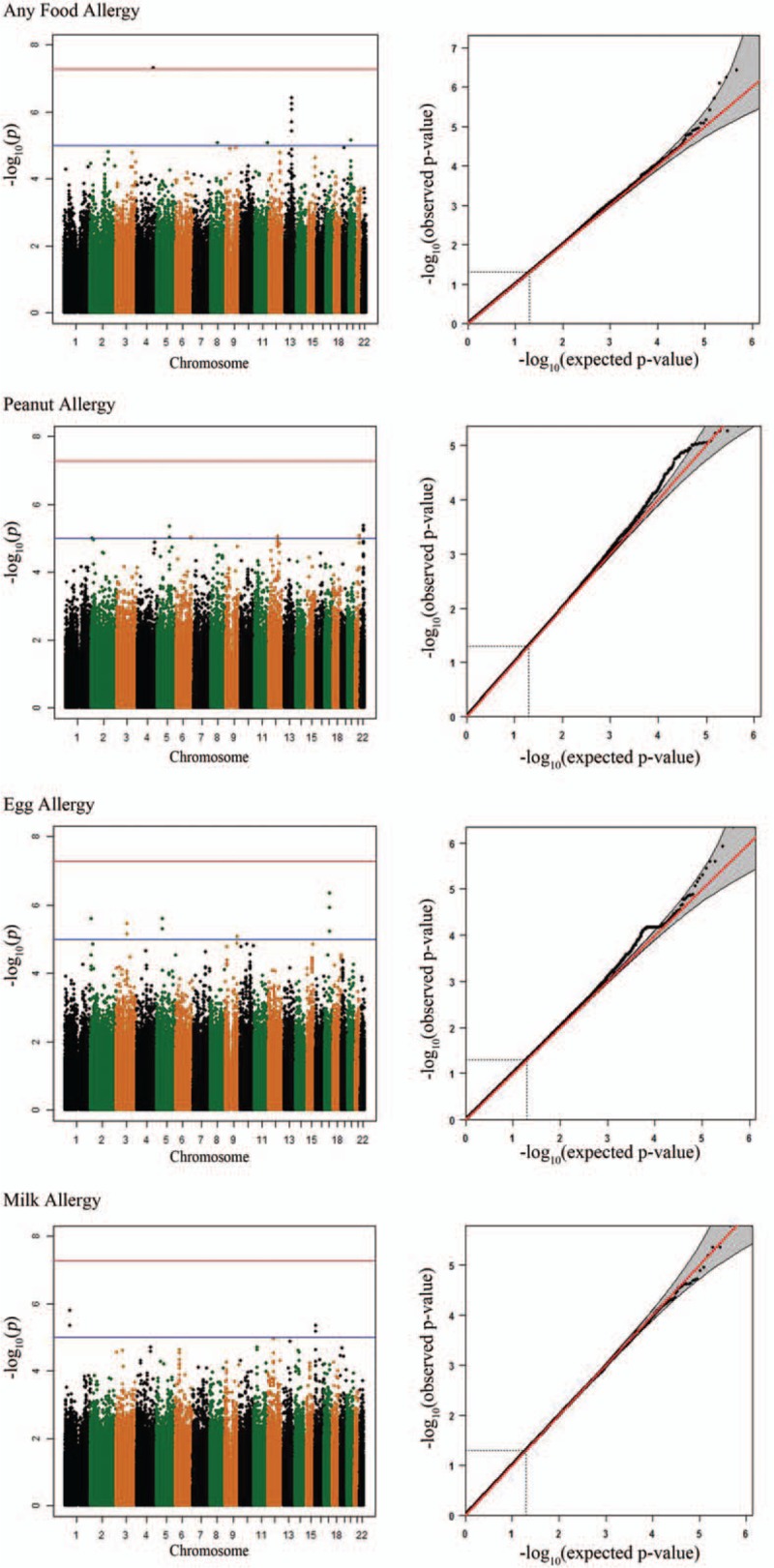
Previous genetic studies of food allergy (FA) have mainly focused on inherited genotypic effects. The role of parental genotypic effects remains largely unexplored. Leveraging existing genome-wide association study (GWAS) data generated from the Chicago Food Allergy Study, we examined maternal genotypic and parent-of-origin (PO) effects using multinomial likelihood ratio tests in 588 complete and incomplete Caucasian FA trios. We identified 1 single nucleotide polymorphism with significant (P < 5×10) maternal effect on any FA (rs4235235), which is located in a noncoding RNA (LOC101927947) with unknown function. We also identified 3 suggestive (P < 5×10) loci with maternal genetic effects: 1 for any FA (rs976078, in a gene desert region on 13q31.1) and 2 for egg allergy (rs1343795 and rs4572450, in the ZNF652 gene, where genetic variants have been associated with atopic dermatitis). Three suggestive loci with PO effect were observed: 1 for peanut allergy (rs4896888 in the ADGB gene) and 2 for any FA in boys only (rs1036504 and rs2917750 in the IQCE gene). Findings from this family-based GWAS of FA provided some preliminary evidence on maternal genotypic or PO effects on FA. Additional family-based studies are needed to confirm our findings and gain new insight into maternal and paternal genetic contribution to FA.
以往对食物过敏(FA)的遗传学研究主要集中在遗传基因型效应上。父母基因型效应的作用在很大程度上仍未得到探索。利用芝加哥食物过敏研究产生的现有全基因组关联研究(GWAS)数据,我们在588个完整和不完整的白种人FA三联体中使用多项似然比检验来研究母亲的基因型和起源亲本(PO)效应。我们鉴定出1个对任何FA有显著(P<5×10)母亲效应的单核苷酸多态性(rs4235235),其位于一个功能未知的非编码RNA(LOC101927947)中。我们还鉴定出3个有母亲遗传效应的提示性(P<5×10)位点:1个对任何FA(rs976078,位于13q31.1的基因荒漠区域),2个对鸡蛋过敏(rs1343795和rs4572450,位于ZNF652基因,其中遗传变异与特应性皮炎有关)。观察到3个有PO效应的提示性位点:1个对花生过敏(ADGB基因中的rs4896888),2个仅对男孩的任何FA(IQCE基因中的rs1036504和rs2917750)。这项基于家庭的FA的GWAS研究结果为母亲基因型或PO对FA的效应提供了一些初步证据。需要更多基于家庭的研究来证实我们的发现,并深入了解母亲和父亲对FA的遗传贡献。