Experimental Trauma Surgery, Justus-Liebig-University Giessen, Giessen, Germany.
Leibniz Institute for Solid State and Materials Research Dresden, Dresden, Germany.
PLoS One. 2018 Feb 28;13(2):e0193468. doi: 10.1371/journal.pone.0193468. eCollection 2018.
Treatment of osteoporotic fractures is still challenging and an urgent need exists for new materials, better adapted to osteoporotic bone by adjusted Young's modulus, appropriate surface modification and pharmaceuticals.
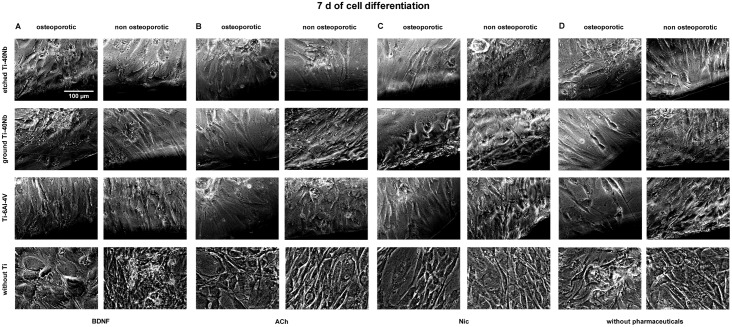
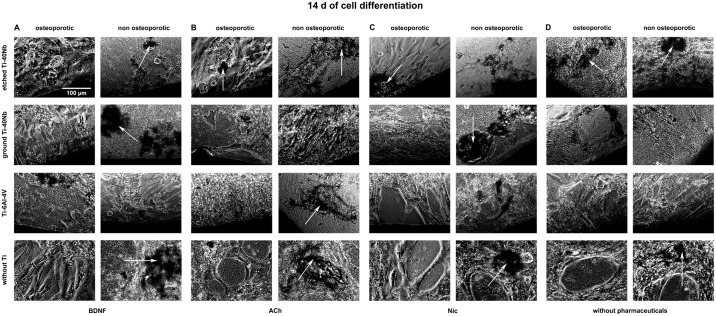
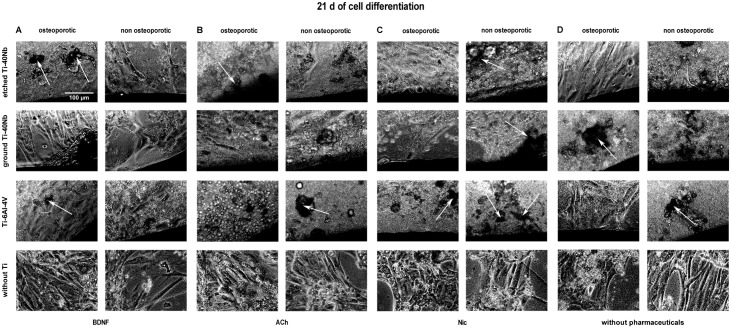
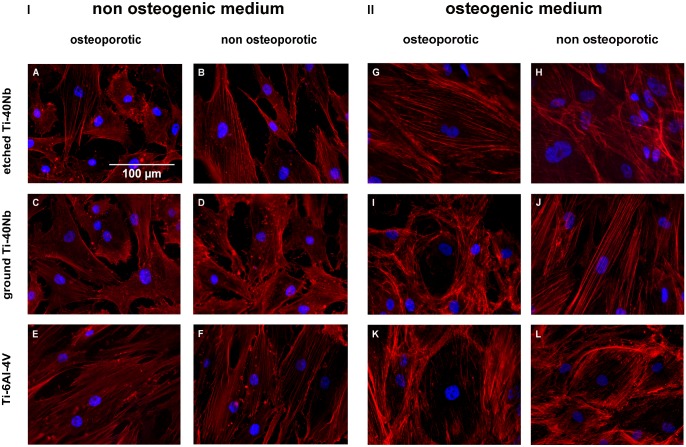
Titanium-40-niobium alloys, mechanically ground or additionally etched and titanium-6-aluminium-4-vanadium were analyzed in combination with brain-derived neurotrophic factor, acetylcholine and nicotine to determine their effects on human mesenchymal stem cells in vitro over 21 days using lactate dehydrogenase and alkaline phosphatase assays, live cell imaging and immunofluorescence microscopy.
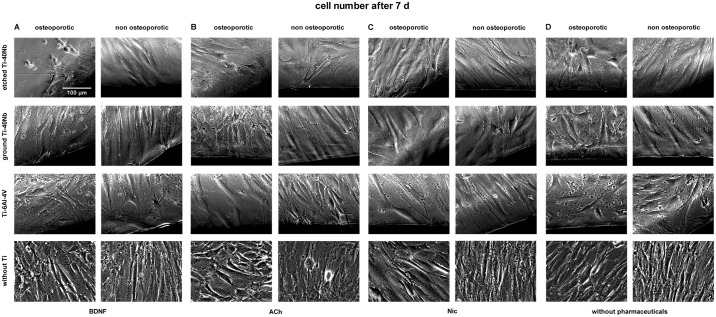
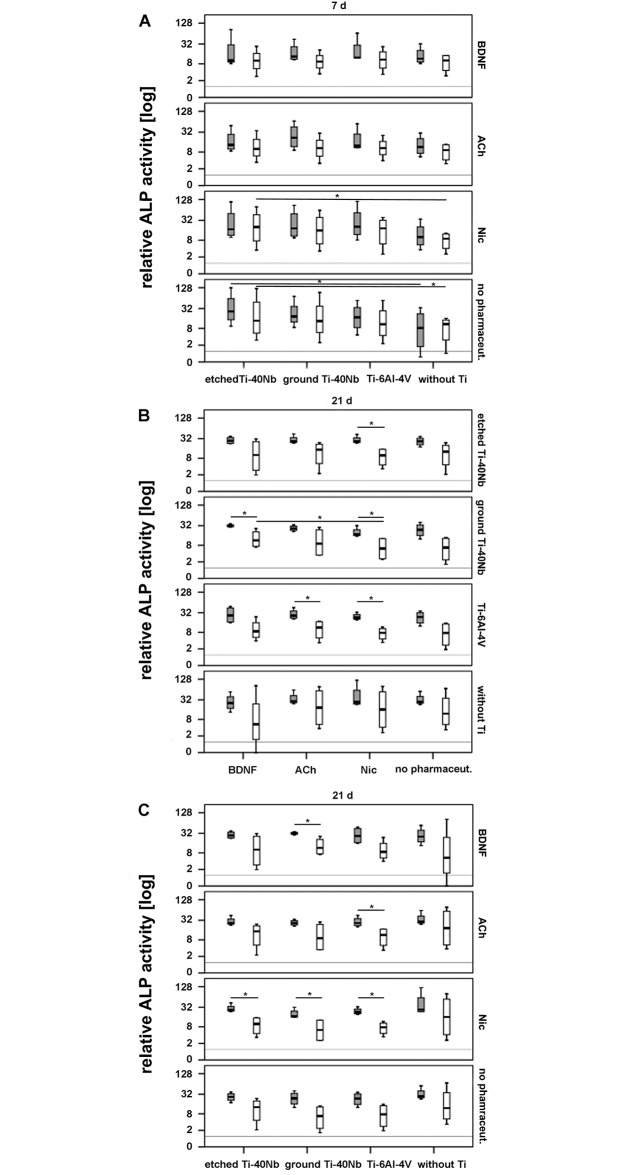
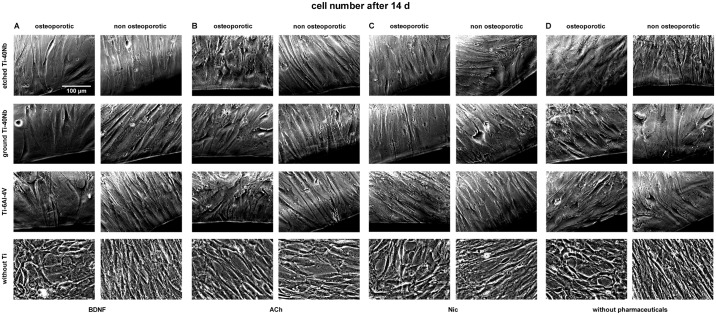
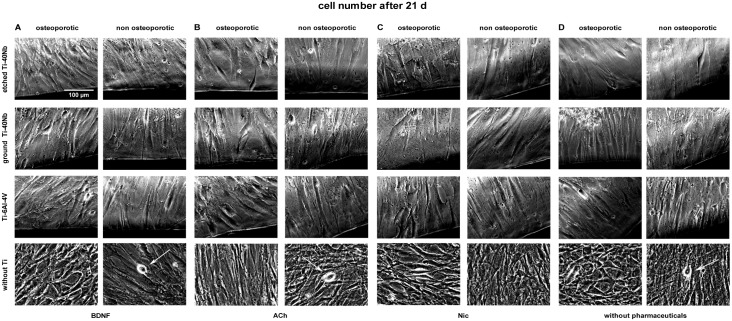
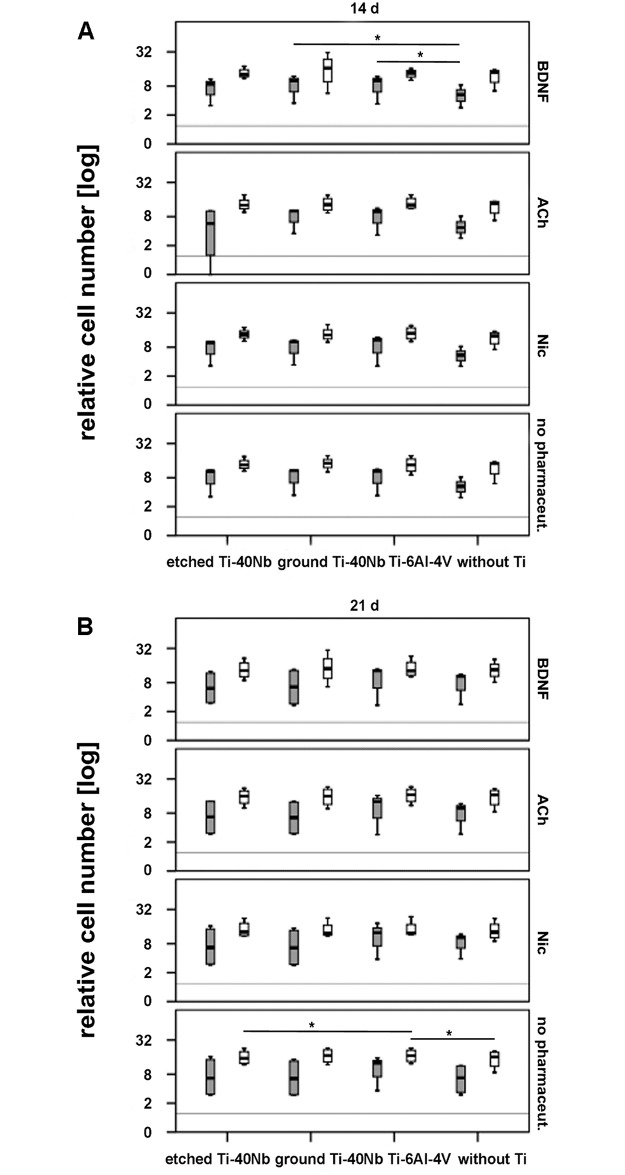
Cell number of human mesenchymal stem cells of osteoporotic donors was increased after 14 d in presence of ground titanium-40-niobium or titanium-6-aluminium-4-vanadium, together with brain-derived neurotrophic factor. Cell number of human mesenchymal stem cells of non osteoporotic donors increased after 21 d in presence of titanium-6-aluminium-4-vanadium without pharmaceuticals. No significant increase was measured for ground or etched titanium-40-niobium after 21 d. Osteoblast differentiation of osteoporotic donors was significantly higher than in non osteoporotic donors after 21 d in presence of etched, ground titanium-40-niobium or titanium-6-aluminium-4-vanadium accompanied by all pharmaceuticals tested. In presence of all alloys tested brain-derived neurotrophic factor, acetylcholine and nicotine increased differentiation of cells of osteoporotic donors and accelerated it in non osteoporotic donors.
We conclude that ground titanium-40-niobium and brain-derived neurotrophic factor might be most suitable for subsequent in vivo testing.
骨质疏松性骨折的治疗仍然具有挑战性,迫切需要新的材料,这些材料应通过调整杨氏模量、适当的表面改性和药物来更好地适应骨质疏松性骨骼。
分析了机械研磨或额外蚀刻的钛-40-铌合金以及钛-6-铝-4-钒,并将其与脑源性神经营养因子、乙酰胆碱和尼古丁结合,通过乳酸脱氢酶和碱性磷酸酶测定、活细胞成像和免疫荧光显微镜,来确定它们对骨质疏松症供体来源的人骨髓间充质干细胞在体外的影响,共 21 天。
在研磨的钛-40-铌或钛-6-铝-4-钒以及脑源性神经营养因子存在的情况下,骨质疏松症供体来源的人骨髓间充质干细胞的细胞数量在 14 天后增加。非骨质疏松症供体来源的人骨髓间充质干细胞的细胞数量在 21 天内增加,而没有使用药物。在 21 天内,研磨或蚀刻的钛-40-铌没有显著增加。在存在蚀刻、研磨的钛-40-铌或钛-6-铝-4-钒以及所有测试药物的情况下,21 天后骨质疏松症供体来源的成骨细胞分化明显高于非骨质疏松症供体来源的成骨细胞分化。在存在所有测试合金的情况下,脑源性神经营养因子、乙酰胆碱和尼古丁增加了骨质疏松症供体来源细胞的分化,并加速了非骨质疏松症供体来源细胞的分化。
我们得出结论,研磨的钛-40-铌和脑源性神经营养因子可能最适合随后的体内测试。