Arredondo Armando, Orozco Emanuel, Alcalde-Rabanal Jaqueline, Navarro Juan, Azar Alejandra
Instituto Nacional de Salud Pública, Cuernavaca, Morelos, Mexico.
Instituto de Saúde Coletiva, Universidade Federal da Bahía, Salvador, BA, Brasil.
Rev Saude Publica. 2018;52:23. doi: 10.11606/s1518-8787.2018052000293. Epub 2018 Feb 26.
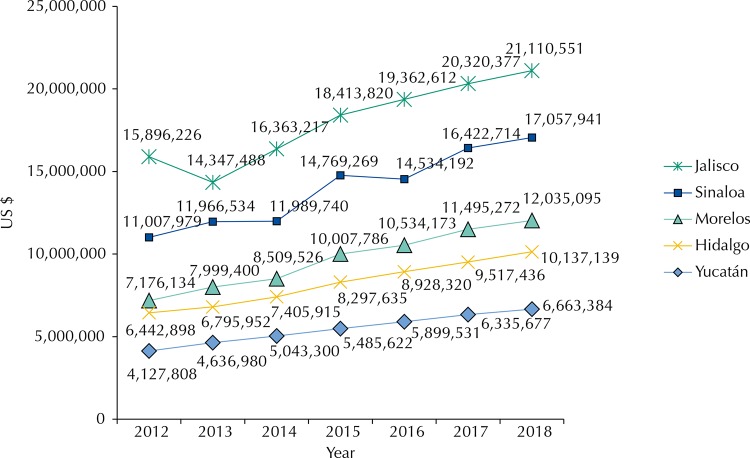
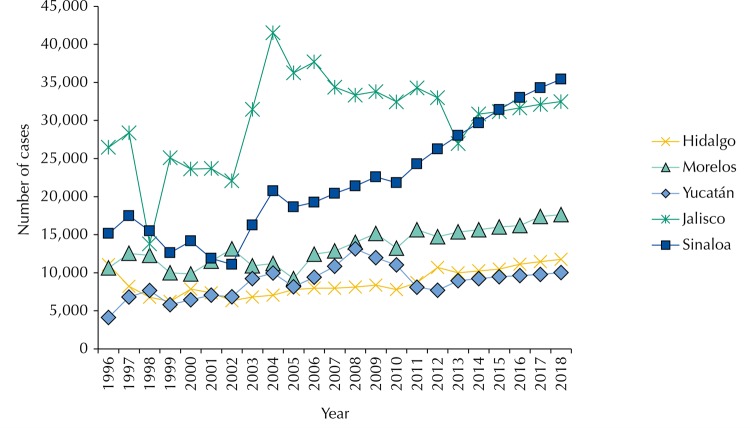
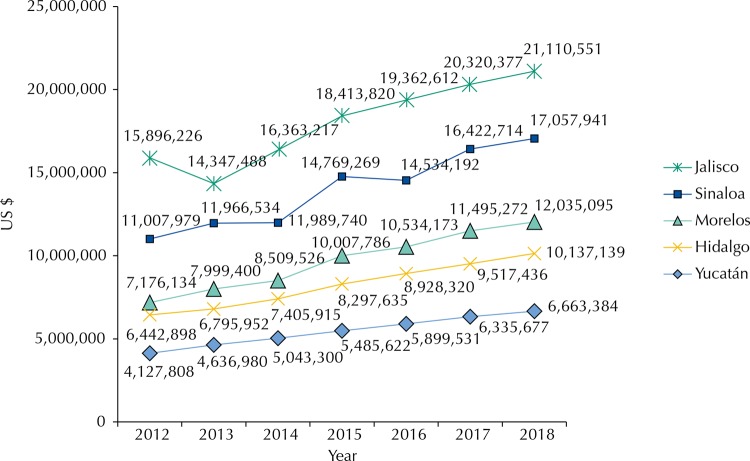
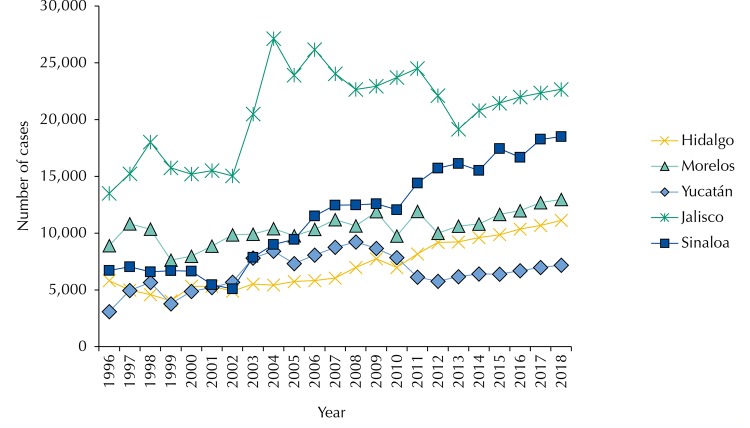
OBJECTIVE To analyze the epidemiological and economic burden of the health services demand due to diabetes and hypertension in Mexico. METHODS Evaluation study based on a time series study that had as a universe of study the assured and uninsured population that demands health services from the three main institutions of the Health System in Mexico: The Health Department, the Mexican Institute of Social Security, and Institute of Services and Social Security for State Workers. The financing method was based on instrumentation and consensus techniques for medium case management. In order to estimate the epidemiological changes and financial requirements, a time series of observed cases for diabetes and hypertension 1994-2013 was integrated. Probabilistic models were developed based on the Box-Jenkins technique for the period of 2013-2018 with 95% confidence intervals and p < 0.05. RESULTS Comparing results from 2013 versus 2018, in the five regions, different incremental trends of 14%-17% in epidemiological changes and 58%-66% in the economic burden for both diseases were observed. CONCLUSIONS If the risk factors and the different models of care remained as they currently are in the three institutions analyzed, the financial consequences would be of greater impact for the Mexican Institute of Social Security, following in order of importance the Institute of Services and Social Security for State Workers and lastly the Health Department. The financial needs for both diseases will represent approximately 13%-15% of the total budget allocated to the uninsured population and 15%-17% for the population insured depending on the region.
目的 分析墨西哥糖尿病和高血压导致的卫生服务需求的流行病学及经济负担。方法 基于时间序列研究的评估研究,研究对象为向墨西哥卫生系统的三个主要机构(卫生部、墨西哥社会保障局和国家工作人员服务与社会保障局)寻求卫生服务的参保和未参保人群。融资方法基于中等病例管理的工具和共识技术。为了估计流行病学变化和资金需求,整合了1994 - 2013年糖尿病和高血压观察病例的时间序列。基于Box - Jenkins技术开发了2013 - 2018年期间的概率模型,置信区间为95%,p < 0.05。结果 比较2013年与2018年的结果,在五个地区,观察到两种疾病的流行病学变化有14% - 17%的不同增量趋势,经济负担有58% - 66%的不同增量趋势。结论 如果在分析的三个机构中风险因素和不同的护理模式保持不变,对墨西哥社会保障局的财务影响将更大,其次是国家工作人员服务与社会保障局,最后是卫生部,按重要性排序。这两种疾病的资金需求将分别占分配给未参保人群总预算的约13% - 15%和参保人群的15% - 17%,具体取决于地区。