Wellcome Trust Brighton and Sussex Centre for Global Health Research, Brighton and Sussex Medical School, Brighton, United Kingdom.
School of Public Health, Addis Ababa University, Addis Ababa, Ethiopia.
PLoS Negl Trop Dis. 2018 Mar 1;12(3):e0006324. doi: 10.1371/journal.pntd.0006324. eCollection 2018 Mar.
Podoconiosis is one of the few diseases that could potentially be eliminated within one generation. Nonetheless, the global distribution of the disease remains largely unknown. The global atlas of podoconiosis was conceived to define the epidemiology and distribution of podoconiosis through dedicated surveys and assembling the available epidemiological data.
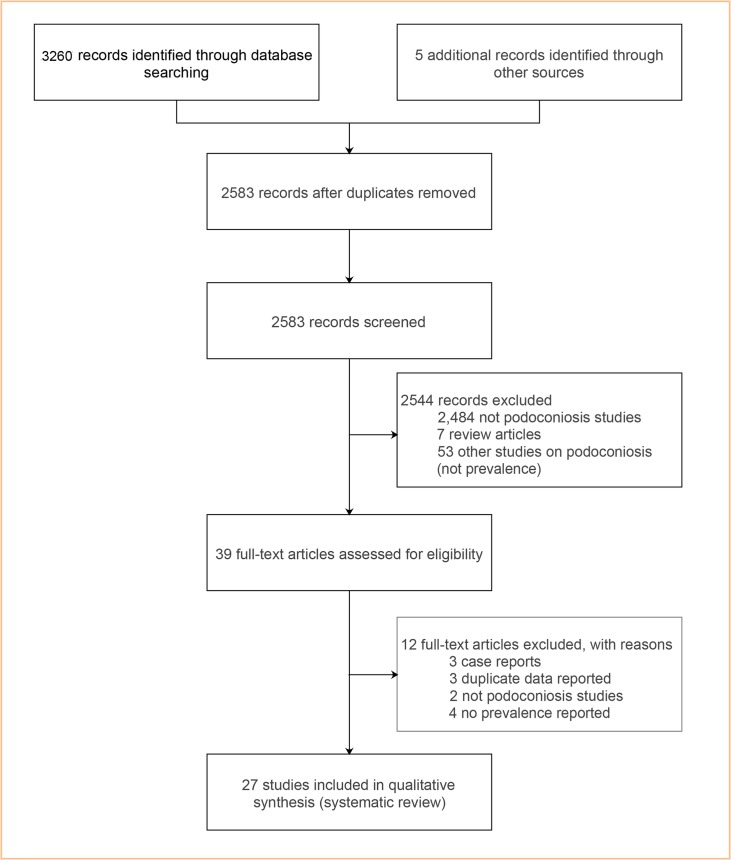
We have synthesized the published literature on the epidemiology of podoconiosis. Through systematic searches in SCOPUS and MEDLINE from inception to February 14, 2018, we identified observational and population-based studies reporting podoconiosis. To establish existence of podoconiosis, we used case reports and presence data. For a study to be included in the prevalence synthesis, it needed to be a population-based survey that involved all residents within a specific area. Studies that did not report original data were excluded. We undertook descriptive analyses of the extracted data. This study is registered with PROSPERO, number CRD42018084959.
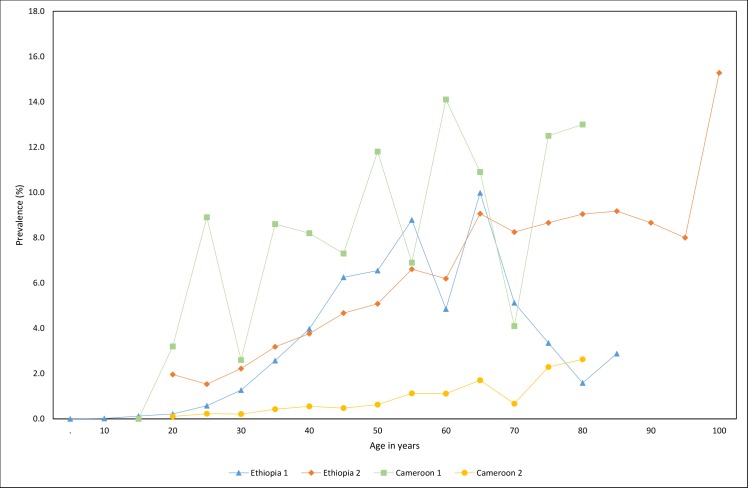
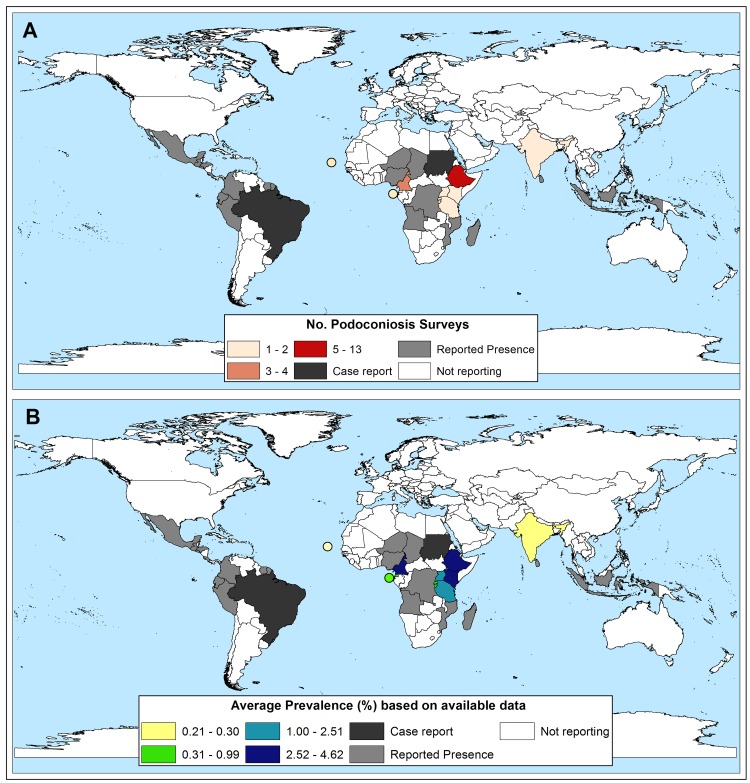
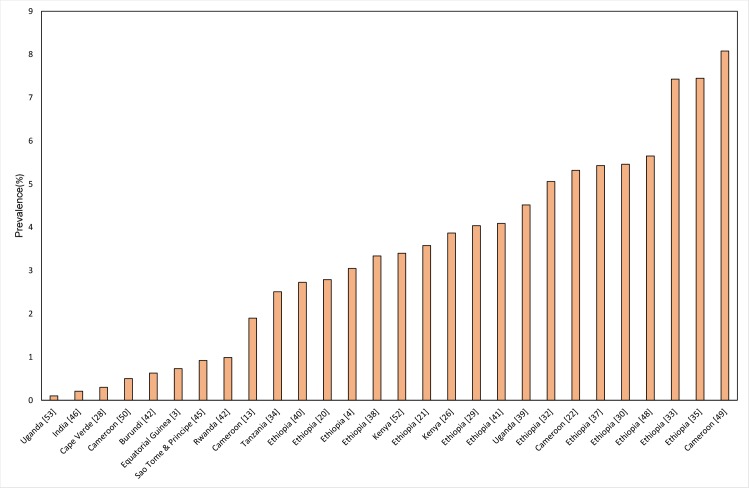
We identified 3,260 records, of which 27 studies met the inclusion criteria. Podoconiosis was described to exist or be endemic in 32 countries, 18 from the African Region, 3 from Asia and 11 from Latin America. Overall, podoconiosis prevalence ranged from 0·10% to 8.08%, was highest in the African region, and was substantially higher in adults than in children and adolescents. The highest reported prevalence values were in Africa (8.08% in Cameroon, 7.45% in Ethiopia, 4.52% in Uganda, 3.87% in Kenya and 2.51% in Tanzania). In India, a single prevalence of 0.21% was recorded from Manipur, Mizoram and Rajasthan states. None of the Latin American countries reported prevalence data.
Our data suggest that podoconiosis is more widespread in the African Region than in the rest of the regions, although this could be related to the fact that most podoconiosis epidemiological research has been focused in the African continent. The assembled dataset confirms that comprehensive podoconiosis control strategies such as promotion of footwear and personal hygiene are urgently needed in endemic parts of Africa. Mapping, active surveillance and a systematic approach to the monitoring of disease burden must accompany the implementation of podoconiosis control activities.
象皮病是少数几种有潜力在一代人的时间内被消灭的疾病之一。然而,这种疾病的全球分布在很大程度上仍不为人知。全球象皮病地图集的构想是通过专门的调查和收集现有的流行病学数据来定义象皮病的流行病学和分布。
我们综合了有关象皮病流行病学的已发表文献。通过在 SCOPUS 和 MEDLINE 中进行系统检索,从创建到 2018 年 2 月 14 日,我们确定了观察性和基于人群的研究报告了象皮病。为了确定象皮病的存在,我们使用了病例报告和存在数据。为了将研究纳入患病率综合分析,该研究需要是一项涉及特定地区所有居民的基于人群的调查。未报告原始数据的研究被排除在外。我们对提取的数据进行了描述性分析。本研究已在 PROSPERO 注册,编号为 CRD42018084959。
我们共确定了 3260 条记录,其中 27 项研究符合纳入标准。象皮病被描述为存在或流行于 32 个国家,其中 18 个来自非洲区域,3 个来自亚洲,11 个来自拉丁美洲。总体而言,象皮病的患病率范围为 0.10%至 8.08%,在非洲区域最高,在成年人中显著高于儿童和青少年。报告的最高患病率值在非洲(喀麦隆 8.08%、埃塞俄比亚 7.45%、乌干达 4.52%、肯尼亚 3.87%和坦桑尼亚 2.51%)。在印度,从曼尼普尔邦、米佐拉姆邦和拉贾斯坦邦记录到的单个患病率为 0.21%。没有拉丁美洲国家报告患病率数据。
我们的数据表明,象皮病在非洲区域的流行程度高于其他区域,尽管这可能与大多数象皮病流行病学研究集中在非洲大陆有关。汇集的数据集证实,在非洲流行地区急需全面的象皮病控制策略,如推广鞋子和个人卫生。疾病负担的监测必须伴随着象皮病控制活动的实施,包括疾病绘图、主动监测和系统的方法。