Breast Cancer Now Research Centre, The Institute of Cancer Research, Fulham Rd, London, SW3 6JB, UK.
Breast Unit, Royal Marsden Hospital, London, SW3 6JJ, UK.
Nat Commun. 2018 Mar 1;9(1):896. doi: 10.1038/s41467-018-03215-x.
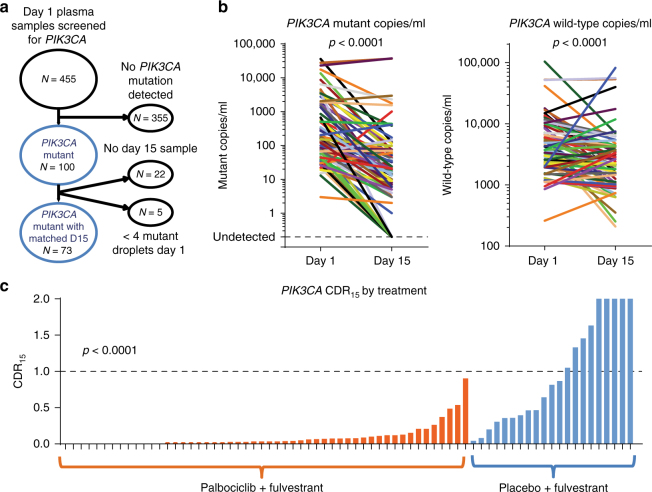
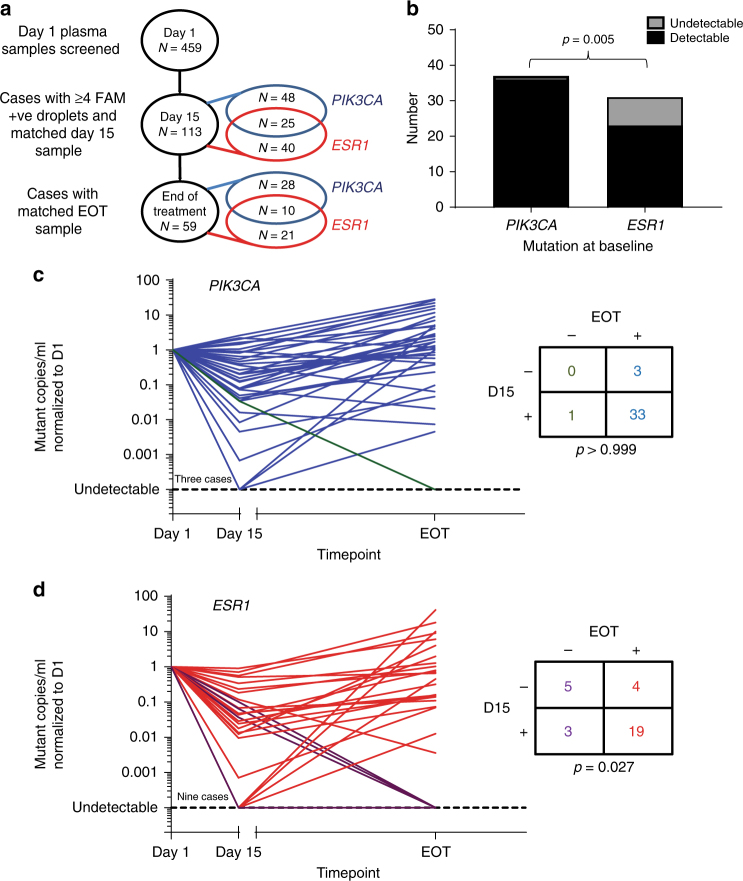
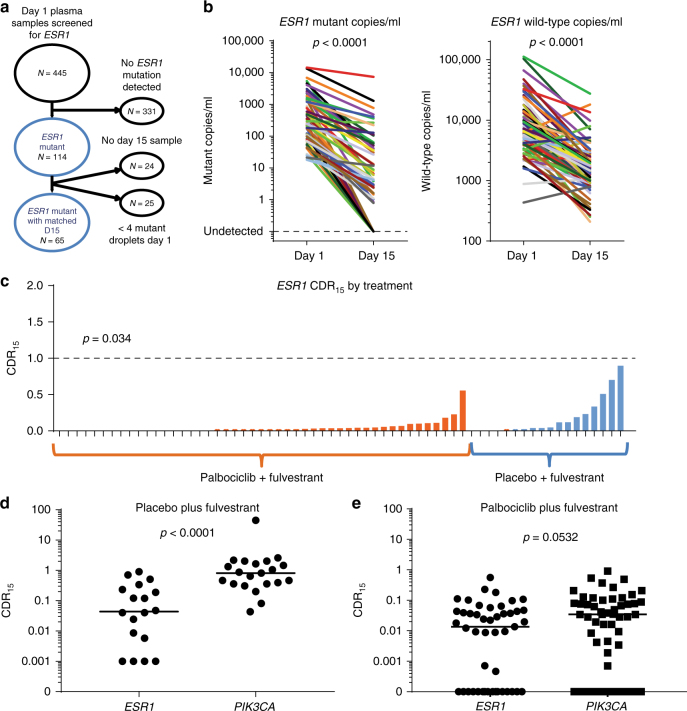
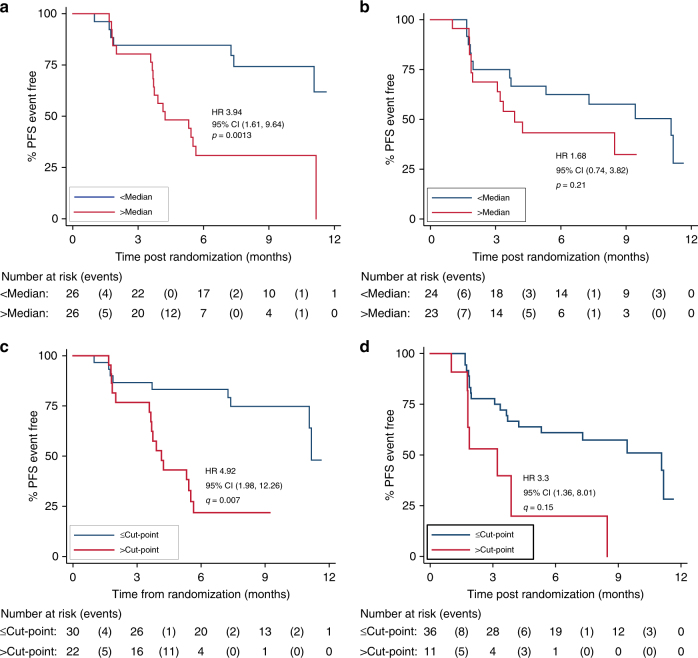
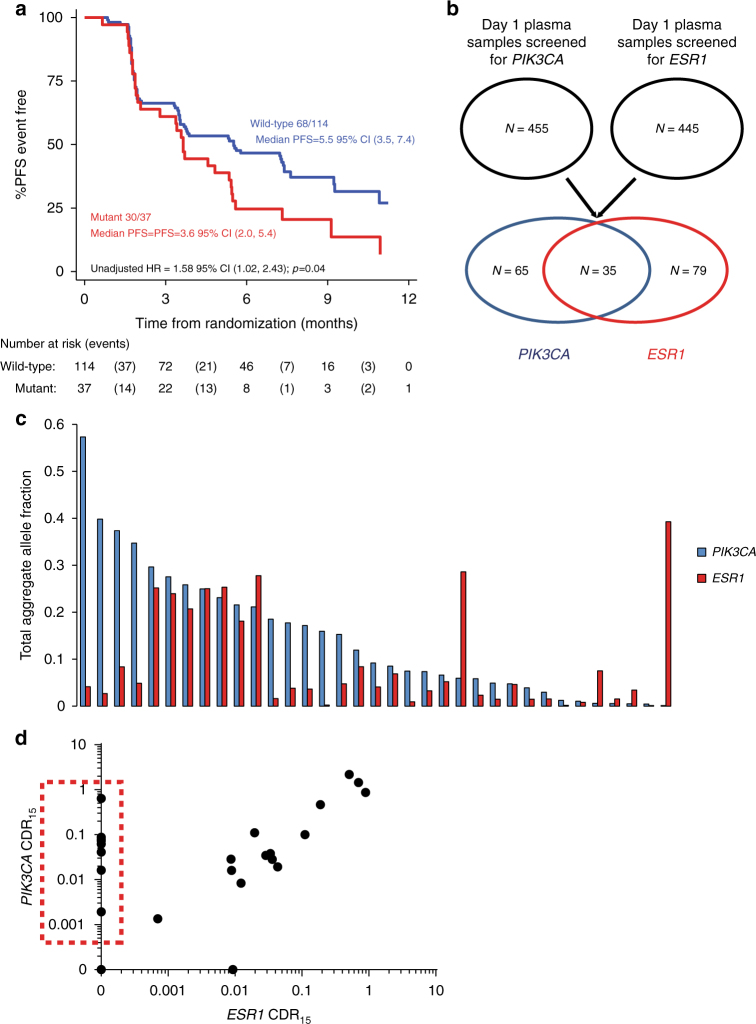
CDK4/6 inhibition substantially improves progression-free survival (PFS) for women with advanced estrogen receptor-positive breast cancer, although there are no predictive biomarkers. Early changes in circulating tumor DNA (ctDNA) level may provide early response prediction, but the impact of tumor heterogeneity is unknown. Here we use plasma samples from patients in the randomized phase III PALOMA-3 study of CDK4/6 inhibitor palbociclib and fulvestrant for women with advanced breast cancer and show that relative change in PIK3CA ctDNA level after 15 days treatment strongly predicts PFS on palbociclib and fulvestrant (hazard ratio 3.94, log-rank p = 0.0013). ESR1 mutations selected by prior hormone therapy are shown to be frequently sub clonal, with ESR1 ctDNA dynamics offering limited prediction of clinical outcome. These results suggest that early ctDNA dynamics may provide a robust biomarker for CDK4/6 inhibitors, with early ctDNA dynamics demonstrating divergent response of tumor sub clones to treatment.
CDK4/6 抑制剂显著改善了晚期雌激素受体阳性乳腺癌女性的无进展生存期(PFS),尽管目前尚无预测生物标志物。循环肿瘤 DNA(ctDNA)水平的早期变化可能提供早期反应预测,但肿瘤异质性的影响尚不清楚。在这里,我们使用来自晚期乳腺癌患者的随机 III 期 PALOMA-3 研究的 CDK4/6 抑制剂 palbociclib 和氟维司群的血浆样本,结果表明,治疗 15 天后 PIK3CA ctDNA 水平的相对变化强烈预测 palbociclib 和氟维司群的 PFS(风险比 3.94,对数秩 p = 0.0013)。先前激素治疗选择的 ESR1 突变被证明是经常亚克隆的,ESR1 ctDNA 动力学对临床结局的预测作用有限。这些结果表明,早期 ctDNA 动力学可能为 CDK4/6 抑制剂提供一种强大的生物标志物,早期 ctDNA 动力学显示肿瘤亚克隆对治疗的反应不同。