Alliance for Research in Exercise, Nutrition and Activity (ARENA), School of Health Sciences, University of South Australia, GPO Box 2471, Adelaide, SA, 5001, Australia.
School of Mathematical Sciences, The University of Adelaide, Adelaide, Australia.
BMC Public Health. 2018 Mar 2;18(1):311. doi: 10.1186/s12889-018-5207-1.
Daily activity data are by nature compositional data. Accordingly, they occupy a specific geometry with unique properties that is different to standard Euclidean geometry. This study aimed to estimate the difference in adiposity associated with isotemporal reallocation between daily activity behaviours, and to compare the findings from compositional isotemporal subsitution to those obtained from traditional isotemporal substitution.
We estimated the differences in adiposity (body fat%) associated with reallocating fixed durations of time (isotemporal substitution) between accelerometer-measured daily activity behaviours (sleep, sedentary time and light and moderate-to-vigorous physical activity (MVPA)) among 1728 children aged 9-11 years from Australia, Canada, Finland and the UK (International Study of Childhood Obesity, Lifestyle and the Environment, 2011-2013). We generated estimates from compositional isotemporal substitution models and traditional non-compositional isotemporal substitution models.
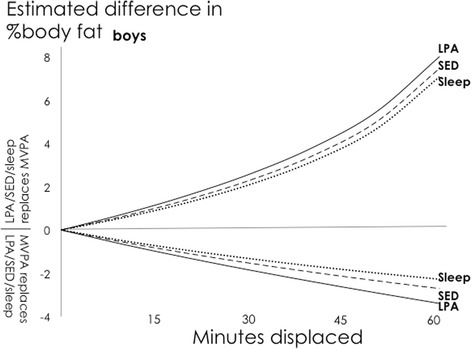
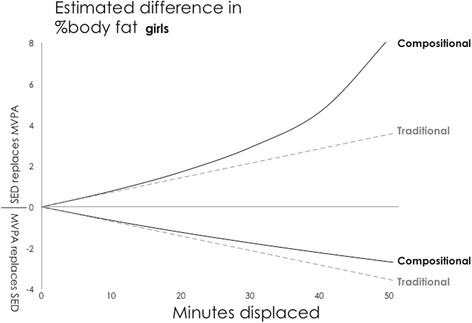
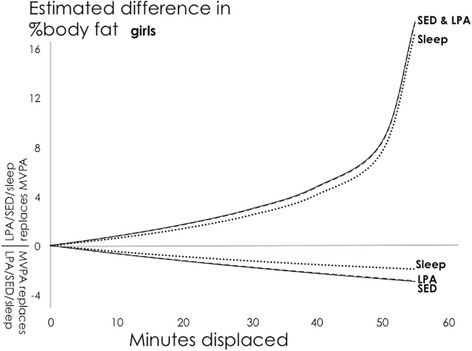
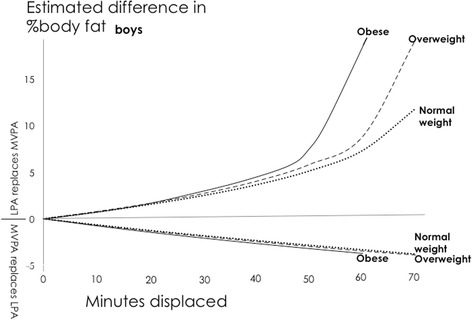
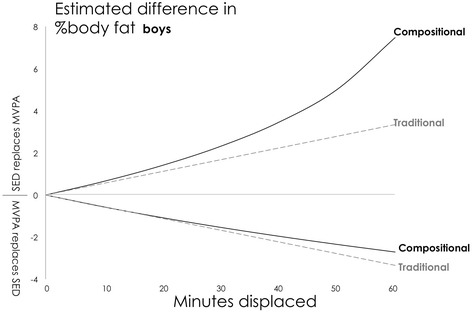
Both compositional and traditional models estimated a positive (unfavourable) difference in body fat% when time was reallocated from MVPA to any other behaviour. Unlike traditional models, compositional models found the differences in estimated adiposity (1) were not necessarily symmetrical when an activity was being displaced, or displacing another (2) were not linearly related to the durations of time reallocated, and (3) varied depending on the starting composition.
The compositional isotemporal model caters for the constrained and therefore relative nature of activity behaviour data and enables all daily behaviours to be included in a single statistical model. The traditional model treats data as real variables, thus the constrained nature of time is not accounted for, nor reflected in the findings. Findings from compositional isotemporal substitution support the importance of MVPA to children's health, and suggest that while interventions to increase MVPA may be of benefit, attention should be directed towards strategies to avoid decline in MVPA levels, particularly among already inactive children. Future applications of the compositional model can extend from pair-wise reallocations to other configurations of time-reallocation, for example, increasing MVPA at the expense of multiple other behaviours.
日常活动数据本质上是组合数据。因此,它们占据了一个具有独特属性的特定几何形状,与标准欧几里得几何形状不同。本研究旨在估计日常活动行为之间等时重分配与肥胖相关的差异,并比较组合等时替代与传统等时替代的发现。
我们估计了澳大利亚、加拿大、芬兰和英国(儿童肥胖症、生活方式和环境国际研究,2011-2013 年)1728 名 9-11 岁儿童在分配固定时间(等时替代)之间重新分配加速度计测量的日常活动行为(睡眠、久坐时间和轻至中度至剧烈体力活动(MVPA))时与肥胖相关的差异。我们从组合等时替代模型和传统非组合等时替代模型中生成了估计值。
组合模型和传统模型都估计了当时间从 MVPA 重新分配到任何其他行为时,体脂百分比会出现正向(不利)差异。与传统模型不同,组合模型发现,(1)当一种活动被取代或取代另一种活动时,估计的肥胖差异不一定是对称的,(2)重新分配的时间长度与差异不呈线性关系,(3)取决于起始组成而有所不同。
组合等时模型考虑了活动行为数据的约束性和因此相对性质,并能够将所有日常行为纳入单个统计模型。传统模型将数据视为真实变量,因此不考虑时间的约束性质,也不会反映在发现中。组合等时替代的发现支持 MVPA 对儿童健康的重要性,并表明增加 MVPA 的干预措施可能是有益的,但应将注意力转向避免 MVPA 水平下降的策略,尤其是在已经不活跃的儿童中。组合模型的未来应用可以从成对重新分配扩展到其他时间重新分配配置,例如,以牺牲多种其他行为为代价增加 MVPA。