Department of Orthopaedic Surgery, Sidney Kimmel Medical College and Graduate Program in Cell Biology and Regenerative Medicine, Thomas Jefferson University, Philadelphia, USA.
Matrix Biol. 2018 Oct;71-72:368-379. doi: 10.1016/j.matbio.2018.02.025. Epub 2018 Mar 1.
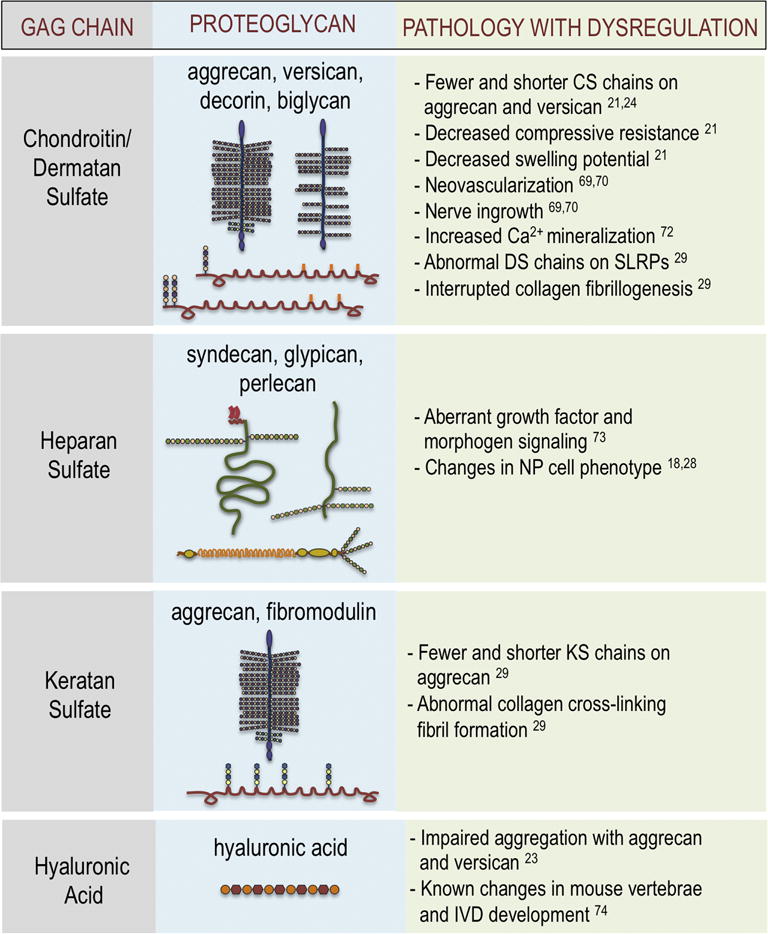
Few human tissues have functions as closely linked to the composition of their extracellular matrices as the intervertebral disc. In fact, the hallmark of intervertebral disc degeneration, commonly accompanying low back and neck pain, is the progressive loss of extracellular matrix molecules - specifically the GAG-substituted proteoglycans. While this loss is often associated with increased extracellular catabolism via metalloproteinases and pro-inflammatory cytokines, there is strong evidence that disc degeneration is related to dysregulation of the enzymes involved in GAG biosynthesis. In this review, we discuss those environmental factors, unique to the disc, that control expression and function of XT-1, GlcAT-I, and ChSy/ChPF in the healthy and degenerative state. Additionally, we address the pathophysiology of aberrant GAG biosynthesis and highlight therapeutic strategies designed to augment the loss of extracellular matrix molecules that afflict the degenerative state.
几乎没有任何人体组织的功能与细胞外基质的组成如此紧密相关,除了椎间盘。事实上,椎间盘退变的标志,通常伴随着下背部和颈部疼痛,是细胞外基质分子的进行性丧失 - 特别是 GAG 取代的蛋白聚糖。虽然这种丧失通常与通过金属蛋白酶和促炎细胞因子的细胞外分解代谢增加有关,但有强有力的证据表明椎间盘退变与参与 GAG 生物合成的酶的失调有关。在这篇综述中,我们讨论了控制健康和退变状态下 XT-1、GlcAT-I 和 ChSy/ChPF 表达和功能的那些特有的椎间盘环境因素。此外,我们还探讨了异常 GAG 生物合成的病理生理学,并强调了旨在增强困扰退行性状态的细胞外基质分子丧失的治疗策略。