Frailty Research Program, Geriatric Education and Research Institute (GERI), Singapore.
Department of Psychological Medicine, National University of Singapore, Singapore.
Clin Interv Aging. 2018 Feb 22;13:309-316. doi: 10.2147/CIA.S157911. eCollection 2018.
Community-based programs can increase and sustain physical activity participation in older adults, even for those who are physically frail. We studied the feasibility and potential effect of a 12-week structured Functional Power Training (FPT) program involving high velocities and low loads for older adults conducted in a common area of their housing estate.
The structured FPT program was conducted in collaboration with a health promotion social enterprise and a community service provider based in a public housing site. We recruited nine inactive residents as participants to the single, group-based, twice-weekly program. Attendance and adverse event(s) were recorded throughout the program. The Short Physical Performance Battery, Timed Up and Go (TUG), and 30s Sit-to-Stand tests were used to assess functional outcomes pre- and postprogram. The FRAIL Scale was used to assess their frailty status, and a postprogram experience survey was conducted.
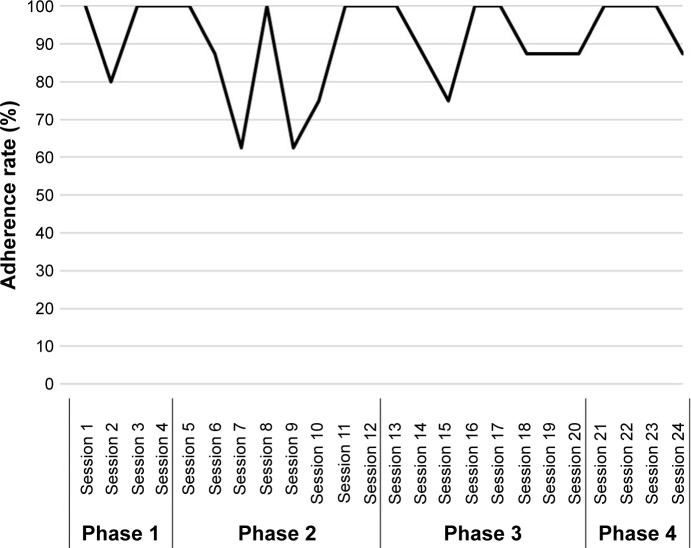
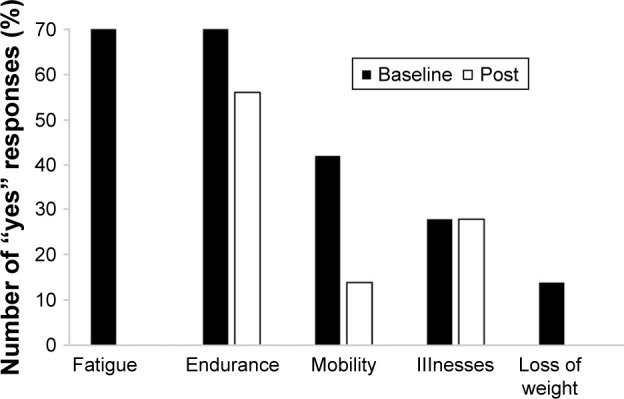
Eight subjects (aged 74±10 years) completed the program with an average overall attendance of 90.3%, with at least five participants present for each session. Changes in functional outcomes showed a moderate-to-large effect with significant improvement in TUG (<0.01). In addition, participants either reversed or maintained their frailty status (<0.01). Overall, the program was perceived to be well structured, engaging, as well as providing physical and psychosocial benefits. No exercise-related adverse events occurred during the program, and participants were keen to recommend this program to others.
Community-based structured FPT is safe and feasible for frail older adults, with the potential to improve function and reverse frailty status.
基于社区的项目可以增加和维持老年人的身体活动参与度,即使是身体虚弱的老年人也不例外。我们研究了在老年人居住的公共区域内进行为期 12 周的结构化功能力量训练(FPT)计划的可行性和潜在效果,该计划涉及高速度和低负荷。
结构化 FPT 计划是与一家健康促进社会企业和一家社区服务提供商合作在公共住房区进行的。我们招募了 9 名不活跃的居民作为参与者,参加每周两次的团体基础单次计划。在整个计划过程中记录出勤率和不良事件。使用简短身体表现电池、计时起立行走测试(TUG)和 30 秒坐立站起测试来评估计划前后的功能结果。使用 FRAIL 量表评估他们的虚弱状态,并进行计划后体验调查。
8 名受试者(年龄 74±10 岁)完成了该计划,平均总体出勤率为 90.3%,每次至少有 5 名参与者参加。功能结果的变化显示出中等至较大的效果,TUG 有显著改善(<0.01)。此外,参与者的虚弱状态要么得到逆转,要么得到维持(<0.01)。总体而言,该计划被认为结构合理、引人入胜,并且提供了身体和心理社会益处。在计划期间没有发生与运动相关的不良事件,参与者热衷于向他人推荐该计划。
基于社区的结构化 FPT 对虚弱的老年人是安全且可行的,具有改善功能和逆转虚弱状态的潜力。