Associate Professor Reshma A Merchant, Division of Geriatric Medicine, Department of Medicine, National University Hospital, 1E Kent Ridge Road, Singapore 119228, Email:
J Nutr Health Aging. 2021;25(4):520-527. doi: 10.1007/s12603-021-1606-6.
Population ageing impacts many areas of society from health and social care cost to housing and future workforce, and whole-of-society approach is required to promote healthy ageing. The Decade of Healthy Ageing report has called upon multi-sectoral collaboration to promote age-friendly communities. The Healthy Ageing Promotion Program for You (HAPPY) is a community-based dual-task exercise program for older adults led by health coaches (HC) or trained volunteers (HAPPY leaders) to promote healthy ageing. The primary objective was to observe improvement in cognition. The secondary objective was to observe improvement in frailty status, functional status, perceived health and reduction of social isolation. We also aim to evaluate the effectiveness and describe the implementation of the HAPPY program.
To engage older adults with prefrailty, frailty and/or cognitive impairment in dual-task exercise program. Recruitment and publicity were through country-wide multisectoral collaboration.
Community setting.
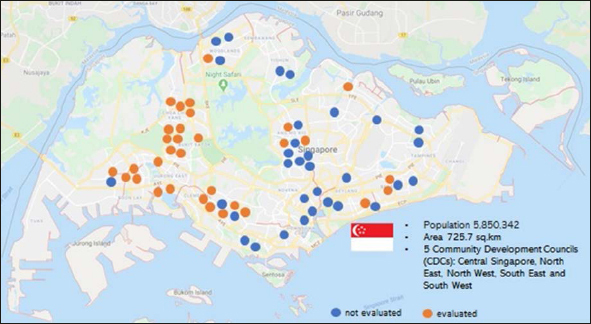
More than 700 older adults participated in ≥ 50 different sites including senior activity centres. Five hundred and sixty-nine participants attended phase 1 screening. Pre-frail or frail ambulant participants or those with underlying cognitive impairment were invited to participate in phase 2 screening. Among them 296 participants enrolled in phase 2 with 66.6% follow up rate at 3 months.
Phase 1 and 2 screening consisted of screening for frailty (FRAIL), cognition (Montreal Cognitive Assessment [MoCA]), falls, vision, grip strength, perceived health (EuroQol vertical visual analogue scale), depression (geriatric depression scale), social network (6-item Lubben Social Network Scale), gait speed and physical function (Short physical performance battery [SPPB]).
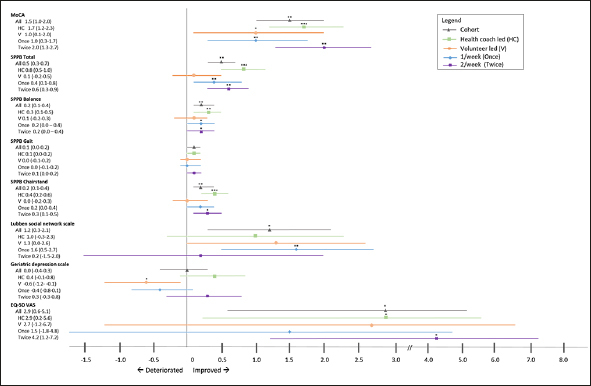
HC led 61.7% of the participants, and HAPPY was conducted twice weekly for 64% of the participants. There was significant improvement in the MoCA scores both in the HC and HAPPY leaders' led groups. Overall physical function, chair-stand and balance domain improved significantly especially in the groups led by HC and those participating in twice-weekly exercises. There was significant improvement in perceived health, reduction in social isolation, improvement in frailty status and reduction of falls at 3 months.
Community embedded peer-led program to promote healthy ageing like HAPPY can improve cognition, physical function, and frailty status, reduce social isolation, and improve perceived health. It takes a "village" to promote healthy ageing, and the need to have a life course approach to healthy longevity which must involve local government and ministerial organisations, non-profit organisations, industries, academia, and community to redesign health.
人口老龄化影响到社会的许多领域,包括健康和社会保健成本、住房和未来劳动力等,因此需要全社会共同努力,促进健康老龄化。《健康老龄化十年报告》呼吁多部门合作,促进建设对老年人友好的社区。《快乐老龄化促进计划》(HAPPY)是一个由健康教练(HC)或经过培训的志愿者(HAPPY 领导者)领导的针对老年人的社区双任务锻炼计划,旨在促进健康老龄化。主要目标是观察认知能力的提高。次要目标是观察虚弱状态、功能状态、感知健康和减少社会隔离的改善。我们还旨在评估 HAPPY 计划的有效性并描述其实施情况。
让有衰弱前期、衰弱和/或认知障碍的老年人参与双任务锻炼计划。通过全国范围内的多部门合作进行招募和宣传。
社区环境。
700 多名老年人参加了 50 多个不同地点的活动,包括老年人活动中心。569 名参与者参加了第 1 阶段的筛查。邀请有衰弱前期或衰弱期、行动不便的参与者或有潜在认知障碍的参与者参加第 2 阶段的筛查。其中 296 名参与者参加了第 2 阶段的筛查,3 个月的随访率为 66.6%。
第 1 阶段和第 2 阶段的筛查包括虚弱(FRAIL)、认知(蒙特利尔认知评估[MoCA])、跌倒、视力、握力、感知健康(欧洲健康问卷垂直视觉模拟量表[EuroQol vertical visual analogue scale])、抑郁(老年抑郁量表)、社交网络(6 项卢本社交网络量表)、步态速度和身体功能(简易体能状况量表[SPPB])。
HC 领导了 61.7%的参与者,有 64%的参与者每周进行 2 次 HAPPY。在 HC 和 HAPPY 领导者领导的组中,MoCA 评分都有显著提高。整体身体功能、椅子站立和平衡域显著改善,特别是在 HC 领导的组和每周进行 2 次锻炼的组中。在 3 个月时,感知健康显著改善,社会隔离减少,虚弱状态改善,跌倒减少。
像 HAPPY 这样的社区嵌入式同伴领导的促进健康老龄化计划可以改善认知、身体功能和虚弱状态,减少社会隔离,改善感知健康。要促进健康老龄化,需要“一个村庄”的努力,必须采取生命全程方法促进健康长寿,这需要地方政府和部级组织、非营利组织、行业、学术界和社区重新设计卫生保健。