Liu Xiao, Seah Jean Wei Ting, Pang Benedict Wei Jun, Tsao Mary Ann, Gu Falong, Ng Wai Chong, Tay Junie Ying Ru, Ng Tze Pin, Wee Shiou Liang
Geriatric Education and Research Institute, 2 Yishun Central 2, Tower E Level 4 GERI Admin, Singapore, 768024 Singapore.
Tsao Foundation, Singapore, Singapore.
Pilot Feasibility Stud. 2020 Jul 21;6:105. doi: 10.1186/s40814-020-00649-3. eCollection 2020.
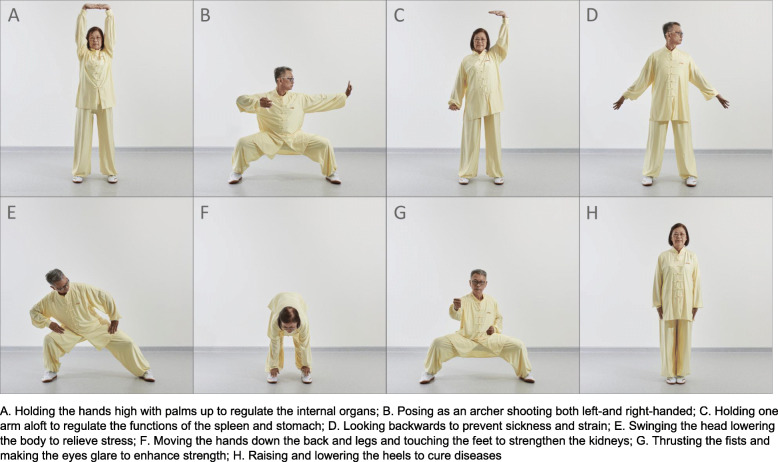
Frailty is a common geriatric syndrome, characterized by reduced physiologic reserve and increased vulnerability to stressors, due to cumulative decline in multiple physiological systems. We studied the feasibility of a community-delivered Baduanjin (BDJ) training program among pre-frail/frail community-dwelling older people. We examined (1) safety (adverse events) and physical and psychological effects; and (2) feasibility of recruitment, retention, adherence; recruitment efforts, and any program challenges, so as to inform future studies.
Our study was a single arm pre-post study in a community setting. Sixteen-week group BDJ training (2×/week in the first 4 weeks and 3×/week thereafter) was co-designed and implemented by community-based providers in Singapore. Recruitment, attendance, and adverse events were recorded throughout the training. A participants' survey was also administered after the training program. Effects of the intervention on physical and functional outcomes (hand grip strength, knee extension strength, Time Up and Go (TUG), Physiological Profile Assessment (PPA), 30-s Sit-to-Stand test, 6-m fast gait speed test), frailty outcomes (frailty score and status), and other outcomes (Maastricht Questionnaire (MQ), Fall Efficacy Scale (FES), Montreal Cognitive Assessment (MoCA), Geriatric Depression Scale (GDS), and EQ-5D-5L) were examined before and after the program.
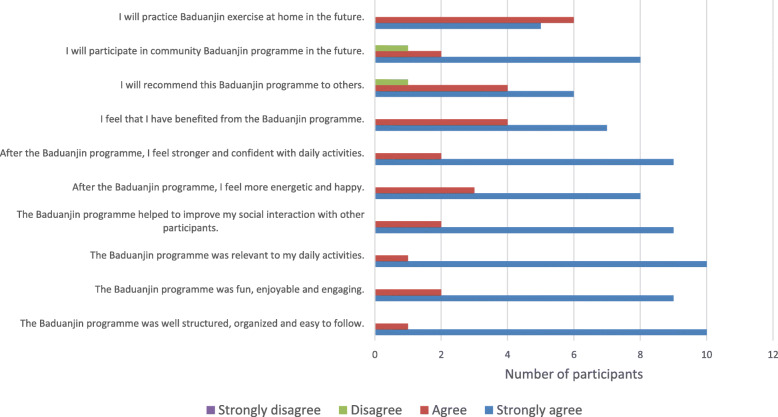
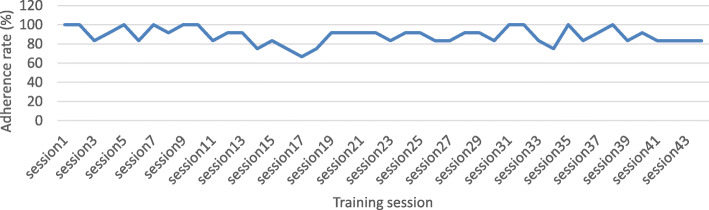
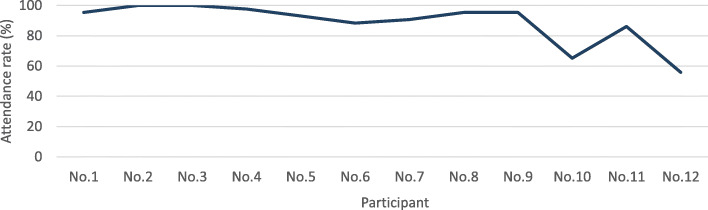
Of 31 older adults screened to be frail, 15 met inclusion criteria and 3 refused participation, resulting in 12 older adults (9 women) enrolled into the program. During the program, one participant was hospitalized (unrelated to BDJ training) and the other 11 (aged 77 ± 6 years; 2 frail, 9 prefrail at baseline) completed the program with average overall attendance of 89%. Most (89%) of the 44 training sessions had attendance > 80%. The program received positive feedback with no training-related adverse events. Participants either reversed ( = 2) or maintained ( = 9) their frailty statuses. There post-training outcomes in hand grip strength, knee extension strength, TUG, MQ, FES, MoCA, GDS, and EQ-5D-5L index score appeared to be better. The reduction of frailty and PPA fall risk scores was of moderate-to-large effect size.
Community-delivered BDJ training program was safe and feasible for prefrail/frail older adults with the potential to improve physical and cognitive function, reduce fall risk, improve psychological well-being, and reverse frailty status.
衰弱是一种常见的老年综合征,其特征是生理储备减少,由于多个生理系统的累积衰退,对压力源的易感性增加。我们研究了在社区居住的衰弱前期/衰弱老年人中开展八段锦(BDJ)训练项目的可行性。我们考察了(1)安全性(不良事件)以及身体和心理影响;(2)招募、留存率、依从性的可行性;招募工作以及项目面临的任何挑战,以便为未来的研究提供参考。
我们的研究是在社区环境中进行的单组前后对照研究。由新加坡的社区服务提供者共同设计并实施了为期16周的八段锦小组训练(前4周每周2次,之后每周3次)。在整个训练过程中记录招募情况、出勤情况和不良事件。在训练项目结束后还进行了参与者调查。考察了干预对身体和功能指标(握力、膝关节伸展力量、起立行走测试(TUG)、生理特征评估(PPA)、30秒坐立测试、6米快速步态速度测试)、衰弱指标(衰弱评分和状态)以及其他指标(马斯特里赫特问卷(MQ)、跌倒效能感量表(FES)、蒙特利尔认知评估(MoCA)、老年抑郁量表(GDS)和EQ-5D-5L)在项目前后的影响。
在筛查出的31名衰弱老年人中,15人符合纳入标准,3人拒绝参与,最终12名老年人(9名女性)纳入该项目。在项目期间,一名参与者住院(与八段锦训练无关),其他11人(年龄77±6岁;基线时2人衰弱,9人衰弱前期)完成了项目,平均总出勤率为89%。44次训练课程中的大多数(89%)出勤率超过80%。该项目得到了积极反馈,未发生与训练相关的不良事件。参与者的衰弱状态要么逆转(=2),要么维持(=9)。训练后在握力、膝关节伸展力量、TUG、MQ、FES、MoCA、GDS和EQ-5D-5L指数评分方面的结果似乎更好。衰弱和PPA跌倒风险评分的降低具有中等到较大的效应量。
对于衰弱前期/衰弱的老年人,社区提供的八段锦训练项目是安全可行的,有可能改善身体和认知功能、降低跌倒风险、改善心理健康并逆转衰弱状态。