Kuo Ching-Yen, Yu Liang-Chin, Chen Hou-Chaung, Chan Chien-Lung
Institute of Information Management, Yuan-Ze University, Taoyuan, Taiwan.
Department of Medical Administration, Taoyuan General Hospital, Ministry of Health and Welfare, Taoyuan, Taiwan.
Healthc Inform Res. 2018 Jan;24(1):29-37. doi: 10.4258/hir.2018.24.1.29. Epub 2018 Jan 31.
The aims of this study were to compare the performance of machine learning methods for the prediction of the medical costs associated with spinal fusion in terms of profit or loss in Taiwan Diagnosis-Related Groups (Tw-DRGs) and to apply these methods to explore the important factors associated with the medical costs of spinal fusion.
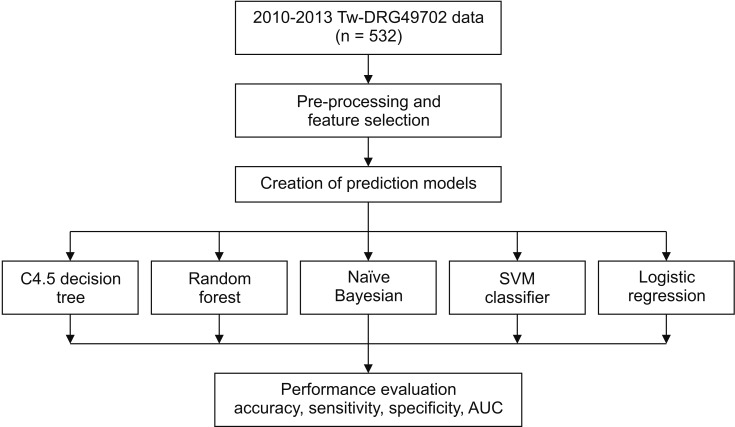
A data set was obtained from a regional hospital in Taoyuan city in Taiwan, which contained data from 2010 to 2013 on patients of Tw-DRG49702 (posterior and other spinal fusion without complications or comorbidities). Naïve-Bayesian, support vector machines, logistic regression, C4.5 decision tree, and random forest methods were employed for prediction using WEKA 3.8.1.
Five hundred thirty-two cases were categorized as belonging to the Tw-DRG49702 group. The mean medical cost was US $4,549.7, and the mean age of the patients was 62.4 years. The mean length of stay was 9.3 days. The length of stay was an important variable in terms of determining medical costs for patients undergoing spinal fusion. The random forest method had the best predictive performance in comparison to the other methods, achieving an accuracy of 84.30%, a sensitivity of 71.4%, a specificity of 92.2%, and an AUC of 0.904.
Our study demonstrated that the random forest model can be employed to predict the medical costs of Tw-DRG49702, and could inform hospital strategy in terms of increasing the financial management efficiency of this operation.
本研究旨在比较机器学习方法在预测台湾诊断相关分组(Tw-DRGs)中与脊柱融合相关的医疗费用盈利或亏损方面的性能,并应用这些方法探索与脊柱融合医疗费用相关的重要因素。
从台湾桃园市一家区域医院获取数据集,其中包含2010年至2013年Tw-DRG49702组(无并发症或合并症的后路及其他脊柱融合)患者的数据。使用WEKA 3.8.1采用朴素贝叶斯、支持向量机、逻辑回归、C4.5决策树和随机森林方法进行预测。
532例病例被归类为Tw-DRG49702组。平均医疗费用为4549.7美元,患者平均年龄为62.4岁。平均住院时间为9.3天。住院时间是确定脊柱融合患者医疗费用的一个重要变量。与其他方法相比,随机森林方法具有最佳的预测性能,准确率为84.30%,灵敏度为71.4%,特异度为92.2%,AUC为0.904。
我们的研究表明,随机森林模型可用于预测Tw-DRG49702的医疗费用,并可在提高该手术财务管理效率方面为医院战略提供参考。