Molecular and Cellular Biology and Biochemistry, Brown University, Providence, Rhode Island, United States of America.
Center for Computational Molecular Biology, Brown University, Providence, Rhode Island, United States of America.
PLoS Genet. 2018 Mar 5;14(3):e1007231. doi: 10.1371/journal.pgen.1007231. eCollection 2018 Mar.
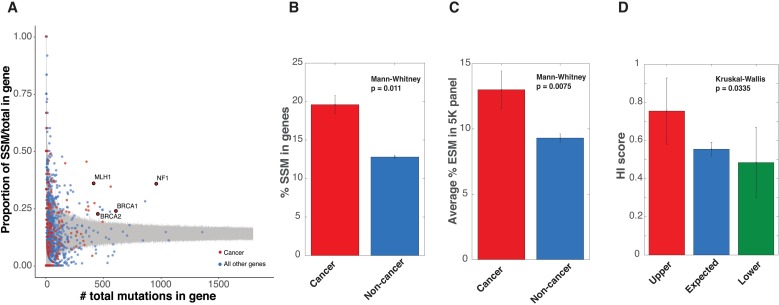
Substitutions that disrupt pre-mRNA splicing are a common cause of genetic disease. On average, 13.4% of all hereditary disease alleles are classified as splicing mutations mapping to the canonical 5' and 3' splice sites. However, splicing mutations present in exons and deeper intronic positions are vastly underreported. A recent re-analysis of coding mutations in exon 10 of the Lynch Syndrome gene, MLH1, revealed an extremely high rate (77%) of mutations that lead to defective splicing. This finding is confirmed by extending the sampling to five other exons in the MLH1 gene. Further analysis suggests a more general phenomenon of defective splicing driving Lynch Syndrome. Of the 36 mutations tested, 11 disrupted splicing. Furthermore, analyzing past reports suggest that MLH1 mutations in canonical splice sites also occupy a much higher fraction (36%) of total mutations than expected. When performing a comprehensive analysis of splicing mutations in human disease genes, we found that three main causal genes of Lynch Syndrome, MLH1, MSH2, and PMS2, belonged to a class of 86 disease genes which are enriched for splicing mutations. Other cancer genes were also enriched in the 86 susceptible genes. The enrichment of splicing mutations in hereditary cancers strongly argues for additional priority in interpreting clinical sequencing data in relation to cancer and splicing.
导致前体 mRNA 剪接异常的突变是遗传疾病的常见病因。平均而言,所有遗传性疾病等位基因中有 13.4%被归类为剪接突变,这些突变映射到规范的 5' 和 3' 剪接位点。然而,外显子和更深的内含子位置的剪接突变报告得非常少。最近对林奇综合征基因 MLH1 第 10 外显子编码突变的重新分析显示,导致剪接缺陷的突变率极高(77%)。这一发现通过将采样扩展到 MLH1 基因的另外五个外显子得到了证实。进一步的分析表明,更普遍的剪接缺陷现象导致了林奇综合征。在测试的 36 个突变中,有 11 个破坏了剪接。此外,分析过去的报告表明,MLH1 中规范剪接位点的突变也占据了总突变的比例(36%)远高于预期。当对人类疾病基因中的剪接突变进行全面分析时,我们发现林奇综合征的三个主要致病基因 MLH1、MSH2 和 PMS2 属于一类 86 个疾病基因,这些基因中富含剪接突变。其他癌症基因也在 86 个易感基因中富集。遗传性癌症中剪接突变的富集强烈表明,在解释与癌症和剪接相关的临床测序数据时,应给予额外的优先权。