Laboratory of Environmental Engineering and EcoTechnology, National Engineering School of Sfax (LR16ES19) (ENIS), Sfax University, Sfax, Tunisia.
Lorraine University, Medical School, INGRES (EA 7298), Vandœuvre-les-Nancy, Nancy, France.
BMC Public Health. 2018 Mar 5;18(1):314. doi: 10.1186/s12889-018-5191-5.
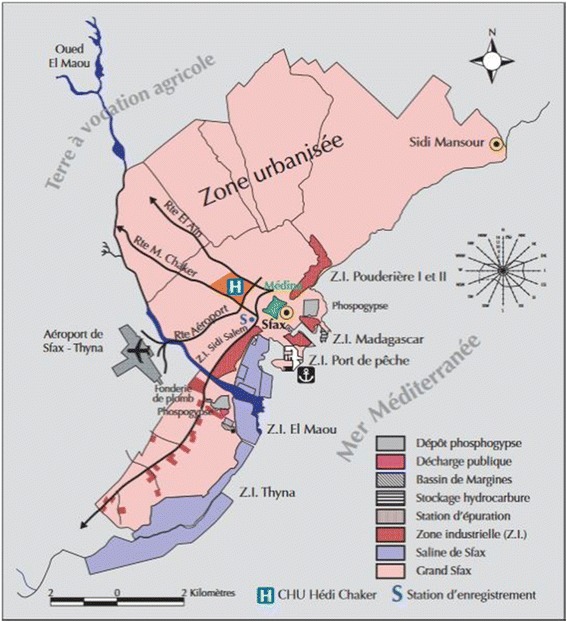
Sfax is a very industrialized city located in the southern region of Tunisia where heavy metals (HMs) pollution is now an established matter of fact. The health of its residents mainly those engaged in industrial metals-based activities is under threat. Indeed, such workers are being exposed to a variety of HMs mixtures, and this exposure has cumulative properties. Whereas current HMs exposure assessment is mainly carried out using direct air monitoring approaches, the present study aims to assess health risks associated with chronic occupational exposure to HMs in industry, using a modeling approach that will be validated later on.
To this end, two questionnaires were used. The first was an identification/descriptive questionnaire aimed at identifying, for each company: the specific activities, materials used, manufactured products and number of employees exposed. The second related to the job-task of the exposed persons, workplace characteristics (dimensions, ventilation, etc.), type of metals and emission configuration in space and time. Indoor air HMs concentrations were predicted, based on the mathematical models generally used to estimate occupational exposure to volatile substances (such as solvents). Later on, and in order to validate the adopted model, air monitoring will be carried out, as well as some biological monitoring aimed at assessing HMs excretion in the urine of workers volunteering to participate. Lastly, an interaction-based hazard index HI and a decision support tool will be used to predict the cumulative risk assessment for HMs mixtures.
One hundred sixty-one persons working in the 5 participating companies have been identified. Of these, 110 are directly engaged with HMs in the course of the manufacturing process. This model-based prediction of occupational exposure represents an alternative tool that is both time-saving and cost-effective in comparison with direct air monitoring approaches. Following validation of the different models according to job processes, via comparison with direct measurements and exploration of correlations with biological monitoring, these estimates will allow a cumulative risk characterization.
斯法克斯是突尼斯南部一个非常工业化的城市,重金属污染现已成为事实。其居民的健康,尤其是从事工业金属活动的居民的健康,受到了威胁。事实上,这些工人接触到了各种重金属混合物,而这种接触具有累积性。目前,重金属暴露评估主要采用直接空气监测方法,而本研究旨在使用建模方法评估工业中慢性职业暴露于重金属相关的健康风险,该方法将在以后进行验证。
为此,我们使用了两份问卷。第一份是识别/描述性问卷,旨在为每家公司确定:特定活动、使用的材料、制造的产品和接触的员工人数。第二份问卷与暴露人员的工作任务、工作场所特征(尺寸、通风等)、金属类型以及空间和时间内的排放配置有关。基于通常用于估计挥发性物质(如溶剂)职业暴露的数学模型,预测了室内空气重金属浓度。之后,为了验证所采用的模型,将进行空气监测,并进行一些生物监测,以评估自愿参与的工人尿液中的重金属排泄情况。最后,将使用基于相互作用的危害指数 HI 和决策支持工具来预测重金属混合物的累积风险评估。
在参与的 5 家公司中,我们确定了 161 名从事与重金属相关工作的人员。其中 110 人直接参与制造过程中的重金属活动。与直接空气监测方法相比,这种基于模型的职业暴露预测是一种省时且具有成本效益的替代工具。根据工作流程,通过与直接测量值进行比较并探索与生物监测的相关性,对不同模型进行验证后,这些估计值将允许进行累积风险特征描述。