Watanabe Machiko, Yamada Chisato, Komagata Yoshinori, Kikuchi Hirotoshi, Hosono Hiroyuki, Itagaki Fumio
1Laboratory of Clinical Pharmaceutics, Faculty of Pharma-Science, Teikyo University, 2-11-1 Kaga, Itabashi-ku, Tokyo, 173-8605 Japan.
2Department of Internal Medicine, Teikyo University School of Medicine, 2-11-1 Kaga, Itabashi-ku, Tokyo, 173-8605 Japan.
J Pharm Health Care Sci. 2018 Mar 1;4:4. doi: 10.1186/s40780-018-0099-x. eCollection 2018.
Patients with Sjögren's syndrome (SS) typically present clinically with xerostomia (dry mouth) because of progressive damage to the exocrine glands. We developed a new, low-dose pilocarpine/sodium alginate (LPA) solution with pilocarpine hydrochloride to inhibit systemic adverse effects by administering via the oral mucosa. The purpose of this study was to assess its stability, safety, and efficacy.
The pilocarpine concentration in an LPA liquid formulation was measured 3, 7, 14, and 28 days after preparation to assess its stability. A prospective clinical trial was undertaken to assess the efficacy and safety of the LPA solution as a symptomatic treatment for dry mouth in SS. Patients ( = 24) with clinically significant xerostomia were enrolled after providing written informed consent. Whole-mouth salivary flow rate was measured twice; immediately before and 60 min after LPA application. Symptoms were assessed by questionnaire with visual analog scales or checkboxes before the first application (baseline), and then once daily for 7 days.
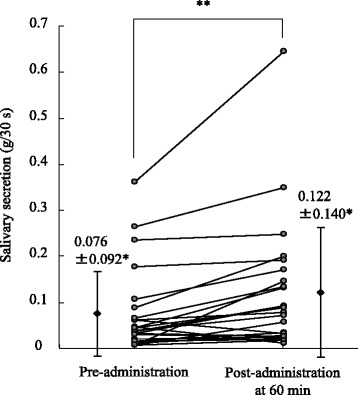
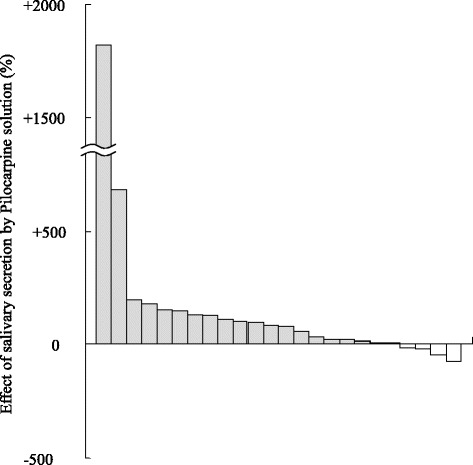
The pilocarpine content 3, 7, 14, and 28 days after preparation showed no marked change, confirming its stability. Salivary flow was significantly increased from 0.076 ± 0.092 g/30 s to 0.122 ± 0.140 g/30 s 60 min after LPA administration ( < 0.001). Dry mouth and thirstiness showed significant improvement compared with that of baseline ( ≤ 0.01). The only adverse effect was sweating, and no serious drug-related adverse events were reported.
This new, low-dose pilocarpine formulation was well-tolerated and resulted in significant improvements in symptoms of dry mouth and other xerostomic conditions in patients with SS.
The study approval number in the institution; 08-068-2. Registered January 19, 2009. UMIN000029307. Registered 27 September 2017 (retrospectively registered).
干燥综合征(SS)患者通常因外分泌腺的进行性损伤而临床上出现口干症状。我们研发了一种新的低剂量毛果芸香碱/海藻酸钠(LPA)溶液,其中含有盐酸毛果芸香碱,通过口腔黏膜给药以抑制全身不良反应。本研究的目的是评估其稳定性、安全性和有效性。
在制备后3、7、14和28天测量LPA液体制剂中的毛果芸香碱浓度,以评估其稳定性。进行了一项前瞻性临床试验,以评估LPA溶液作为SS患者口干症状性治疗的有效性和安全性。24例有临床显著口干症状的患者在提供书面知情同意后入组。全口唾液流速测量两次,分别在应用LPA前和应用后60分钟。在首次应用前(基线)通过视觉模拟量表或复选框问卷评估症状,然后连续7天每天评估一次。
制备后3、7、14和28天的毛果芸香碱含量无明显变化,证实了其稳定性。LPA给药60分钟后,唾液流速从0.076±0.092g/30秒显著增加至0.122±0.140g/30秒(P<0.001)。与基线相比,口干和口渴症状有显著改善(P≤0.01)。唯一的不良反应是出汗,未报告严重的药物相关不良事件。
这种新的低剂量毛果芸香碱制剂耐受性良好,可显著改善SS患者的口干及其他口干燥症状。
机构研究批准号:08 - 068 - 2。于2009年1月19日注册。UMIN000029307。于2017年9月27日注册(追溯注册)。