Spaulding Caitlin N, Klein Roger D, Schreiber Henry L, Janetka James W, Hultgren Scott J
1Department of Immunology and Infectious Disease, Harvard T.H. Chan School of Public Health, Boston, MA 02115 USA.
2Department of Molecular Microbiology, Washington University School of Medicine, St. Louis, MO 63110 USA.
NPJ Biofilms Microbiomes. 2018 Feb 27;4:4. doi: 10.1038/s41522-018-0048-3. eCollection 2018.
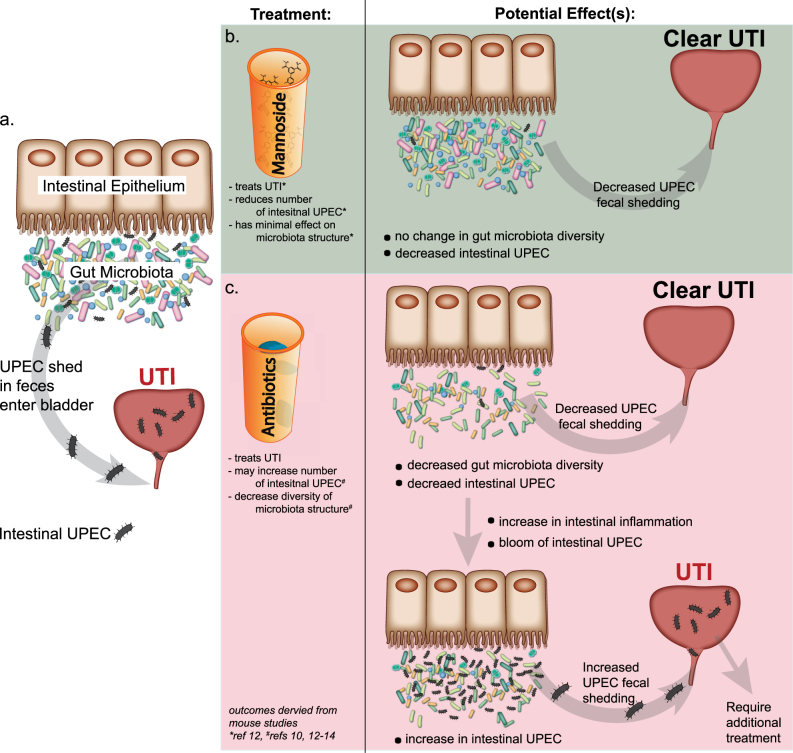
The emergence of drug-resistant pathogens has led to a decline in the efficacy of traditional antimicrobial therapy. The rise in resistance has been driven by widespread use, and in some cases misuse, of antibacterial agents in treating a variety of infections. A growing body of research has begun to elucidate the harmful effects of broad-spectrum antibiotic therapy on the beneficial host microbiota. To combat these threats, increasing effort is being directed toward the development of precision antimicrobial therapeutics that target key virulence determinants of specific pathogens while leaving the remainder of the host microbiota undisturbed. This includes the recent development of small molecules termed "mannosides" that specifically target uropathogenic (UPEC). Mannosides are glycomimetics of the natural mannosylated host receptor for type 1 pili, extracellular appendages that promotes UPEC colonization in the intestine. Type 1 pili are also critical for colonization and infection in the bladder. In both cases, mannosides act as molecular decoys which potently prevent bacteria from binding to host tissues. In mice, oral treatment with mannosides simultaneously clears active bladder infection and removes intestinal UPEC while leaving the gut microbiota structure relatively unchanged. Similar treatment strategies successfully target other pathogens, like adherent-invasive (AIEC), an organism associated with Crohn's disease (CD), in mouse models. While not without its challenges, antibiotic-sparing therapeutic approaches hold great promise in a variety of disease systems, including UTI, CD, otitis media (OM), and others. In this perspective we highlight the benefits, progress, and roadblocks to the development of precision antimicrobial therapeutics.
耐药病原体的出现导致传统抗菌治疗的疗效下降。耐药性的上升是由抗菌药物在治疗各种感染中的广泛使用,以及在某些情况下的滥用所驱动的。越来越多的研究开始阐明广谱抗生素治疗对有益的宿主微生物群的有害影响。为了应对这些威胁,人们越来越致力于开发精准抗菌疗法,该疗法针对特定病原体的关键毒力决定因素,同时不干扰宿主微生物群的其余部分。这包括最近开发的被称为“甘露糖苷”的小分子,它们专门针对尿路致病性大肠杆菌(UPEC)。甘露糖苷是1型菌毛天然甘露糖基化宿主受体的糖模拟物,1型菌毛是促进UPEC在肠道定植的细胞外附属物。1型菌毛对膀胱的定植和感染也至关重要。在这两种情况下,甘露糖苷都作为分子诱饵,有效地阻止细菌与宿主组织结合。在小鼠中,口服甘露糖苷可同时清除活跃的膀胱感染并清除肠道中的UPEC,而肠道微生物群结构相对保持不变。类似的治疗策略在小鼠模型中成功地靶向了其他病原体,如与克罗恩病(CD)相关的黏附侵袭性大肠杆菌(AIEC)。尽管并非没有挑战,但抗生素节约型治疗方法在包括尿路感染(UTI)、CD、中耳炎(OM)等多种疾病系统中具有巨大潜力。在这篇综述中,我们强调了精准抗菌疗法开发的益处、进展和障碍。