Jull Janet, Mazereeuw Maegan, Sheppard Amanada, Kewayosh Alethea, Steiner Richard, Graham Ian D
1Ottawa Hospital Research Institute and University of Ottawa, Ottawa, Ontario Canada.
2Aboriginal Cancer Control Unit, Cancer Care Ontario, Toronto, Ontario Canada.
Res Involv Engagem. 2018 Mar 1;4:6. doi: 10.1186/s40900-018-0085-3. eCollection 2018.
Tailoring and testing a peer support decision making strategy with First Nations, Inuit and Métis people making decisions about their cancer care: A study protocol.First Nations, Inuit and Métis (FNIM) people face higher risks for cancer compared to non-FNIM populations. They also face cultural barriers to health service use. Within non-FNIM populations an approach to health decision making, called shared decision making (SDM), has been found to improve the participation of people in their healthcare. Peer support with SDM further improves these benefits. The purpose of this study is to tailor and test a peer support SDM strategy with community support workers to increase FNIM people's participation in their cancer care.This project has two phases that will be designed and conducted with a Steering Committee that includes members of the FNIM and cancer care communities. First, a peer support SDM strategy will be tailored to meet the needs of cancer system users who are receiving care in urban settings, and training in the SDM strategy developed for community support workers. Three communities will be supported for participation in the study and community support workers who are peers from each community will be trained to use the SDM strategy.Next, each community support worker will work with a community member who has a diagnosis of cancer or who has supported a family member with cancer. Each community support worker and community member pair will use the SDM strategy. The participation and experience of the community support worker and community member will be evaluated.The research will be used to develop strategies to support people who are making decisions about their health.
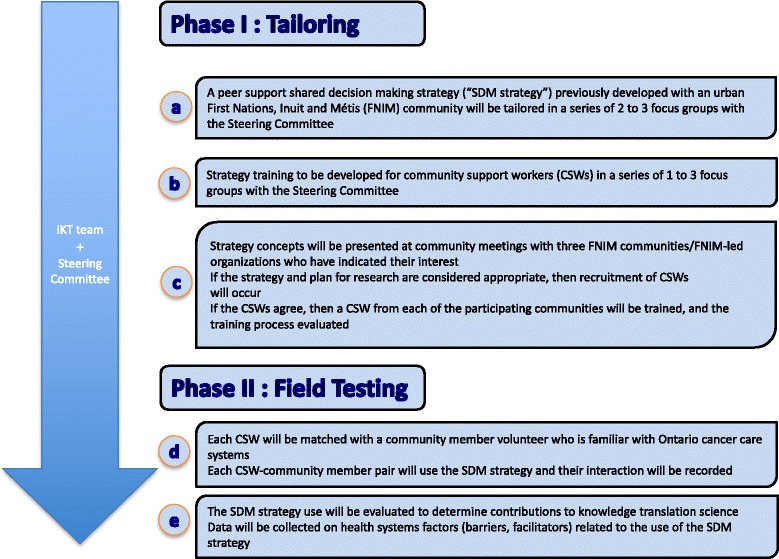
Tailoring and field-testing the use of a knowledge translation peer support shared decision making strategy with First Nations, Inuit and Métis people making decisions about their cancer care: A study protocol First Nations, Inuit and Métis ("FNIM") people face increased cancer risks in relation to general populations and experience barriers to health service use. Shared decision making (SDM) has been found to improve peoples' participation and outcomes in healthcare and peer support with SDM further improves these benefits. The purpose of this study is to tailor and then field test, by and with FNIM communities, a peer support SDM strategy for use in cancer care. This project has 2 theory-driven phases and 5 stages (a-e). A core research team that includes members of the Aboriginal Cancer Control Unit of Cancer Care Ontario communities and academic researchers, will work with a Steering Committee. In , (stage a) a peer support SDM strategy will be tailored to meet the needs of cancer system users who are receiving care in urban settings and (stage b), training developed that will i) introduce participant communities to SDM, and ii) train community support workers (CSWs) within these communities. Next (stage c), three communities will be approached for voluntary participation in the study. These communities will be introduced to SDM in community meetings, and if in agreement then CSWs from each community will be recruited to participate in the study. One volunteer CSW from each community will be trained to use the peer support SDM strategy to enable phase 2 (field test of the peer support SDM strategy).During (stage d), each CSW will be matched to a volunteer community member who has had a diagnosis of cancer or has supported a family member with cancer and is familiar with Ontario cancer systems. Each CSW-community member pair (3 to 4 pairs/community) will use the tailored peer support SDM strategy; their interaction will be audio-recorded and their participation and experience evaluated (total of 9 to 12 interviews). As well (stage e), data will be collected on health systems' factors related to the use of the peer support SDM strategy. Findings will develop peer support SDM strategies to enhance participation of FNIM people in cancer care decisions, advance knowledge translation science, and support a proposal to conduct a multi-site implementation trial.
为原住民、因纽特人和梅蒂斯人量身定制并测试一种同伴支持决策策略,用于他们就癌症护理做出决策:一项研究方案。与非原住民、因纽特人和梅蒂斯人(FNIM)群体相比,原住民、因纽特人和梅蒂斯人面临更高的癌症风险。他们在使用医疗服务方面也面临文化障碍。在非原住民、因纽特人和梅蒂斯人群体中,一种名为共同决策(SDM)的健康决策方法已被发现可提高人们对医疗保健的参与度。同伴支持与共同决策相结合能进一步提升这些益处。本研究的目的是与社区支持工作者一起量身定制并测试一种同伴支持共同决策策略,以提高原住民、因纽特人和梅蒂斯人对癌症护理的参与度。
该项目有两个阶段,将与一个指导委员会共同设计和实施,该指导委员会包括原住民、因纽特人和梅蒂斯人以及癌症护理社区的成员。首先,将量身定制一种同伴支持共同决策策略,以满足在城市环境中接受护理的癌症系统使用者的需求,并为社区支持工作者开展针对所制定的共同决策策略的培训。将支持三个社区参与该研究,并对来自每个社区的作为同伴的社区支持工作者进行培训,使其使用共同决策策略。
接下来,每位社区支持工作者将与一名被诊断患有癌症或曾支持患癌症家庭成员的社区成员合作。每对社区支持工作者和社区成员将使用共同决策策略。将对社区支持工作者和社区成员的参与情况及体验进行评估。
该研究将用于制定策略,以支持那些就自身健康做出决策的人们。
为原住民、因纽特人和梅蒂斯人量身定制并实地测试一种知识转化同伴支持共同决策策略,用于他们就癌症护理做出决策:一项研究方案 与一般人群相比,原住民、因纽特人和梅蒂斯人(“FNIM”)面临更高的癌症风险,且在使用医疗服务方面存在障碍。已发现共同决策(SDM)可提高人们在医疗保健中的参与度和治疗效果,同伴支持与共同决策相结合能进一步提升这些益处。本研究的目的是为癌症护理量身定制并随后与原住民、因纽特人和梅蒂斯社区一起实地测试一种同伴支持共同决策策略。
该项目有2个理论驱动阶段和5个阶段(a - e)。一个核心研究团队,包括安大略癌症护理原住民癌症控制部门的成员和学术研究人员,将与一个指导委员会合作。在(阶段a),将量身定制一种同伴支持共同决策策略,以满足在城市环境中接受护理的癌症系统使用者的需求,并且在(阶段b),开发培训内容,将i)向参与社区介绍共同决策,以及ii)培训这些社区内的社区支持工作者(CSW)。接下来(阶段c),将邀请三个社区自愿参与该研究。将在社区会议上向这些社区介绍共同决策,如果达成一致,将招募每个社区的社区支持工作者参与该研究。将培训每个社区的一名志愿者社区支持工作者使用同伴支持共同决策策略,以开启第2阶段(同伴支持共同决策策略的实地测试)。
在(阶段d)期间,每位社区支持工作者将与一名被诊断患有癌症或曾支持患癌症家庭成员且熟悉安大略癌症系统的志愿者社区成员配对。每对社区支持工作者 - 社区成员(每个社区3至4对)将使用量身定制的同伴支持共同决策策略;他们的互动将进行录音,并对他们的参与情况及体验进行评估(总共9至12次访谈)。同样(阶段e),将收集与使用同伴支持共同决策策略相关的卫生系统因素的数据。研究结果将制定同伴支持共同决策策略,以提高原住民、因纽特人和梅蒂斯人在癌症护理决策中的参与度,推进知识转化科学,并支持开展一项多地点实施试验的提议。
