Department of Cognitive Neuroscience, Biophysics Section, Donders Institute for Brain, Cognition and Behaviour, Radboud University Medical Centre Nijmegen, Nijmegen, The Netherlands.
Department of Biophysics, Donders Institute for Brain, Cognition and Behaviour, Radboud University Nijmegen, Nijmegen, The Netherlands.
Behav Res Methods. 2018 Dec;50(6):2480-2497. doi: 10.3758/s13428-018-1026-7.
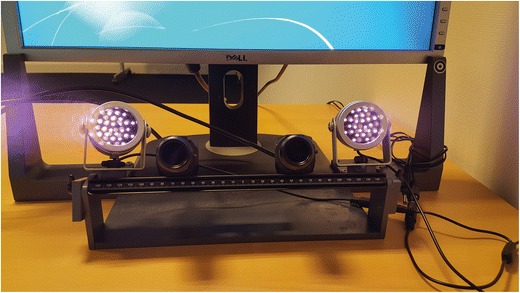
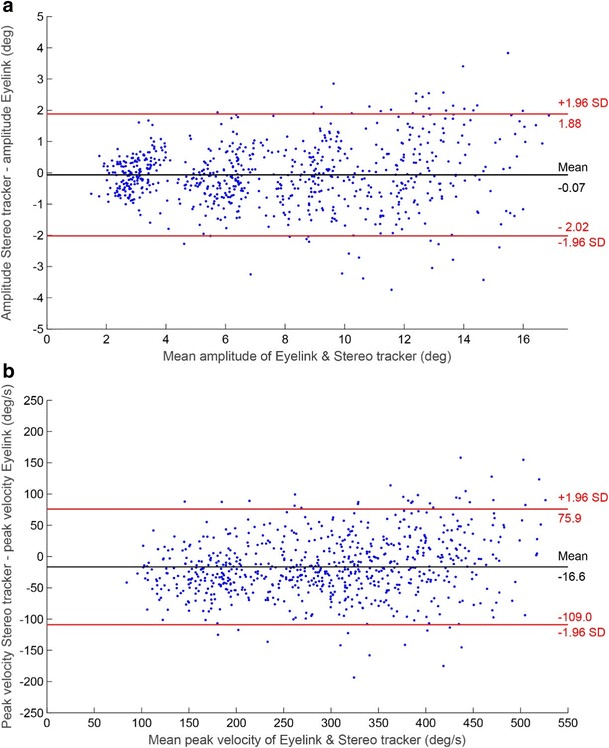
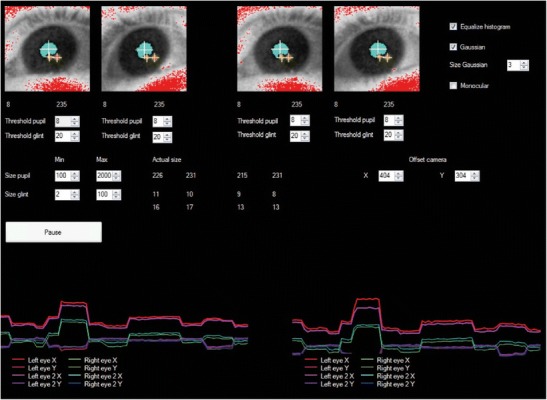
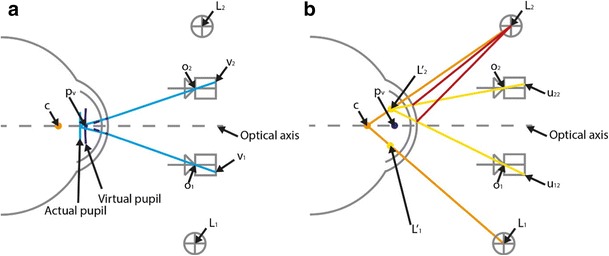
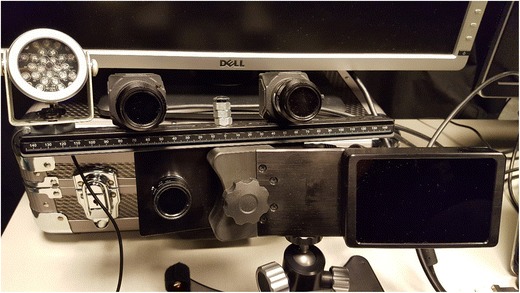
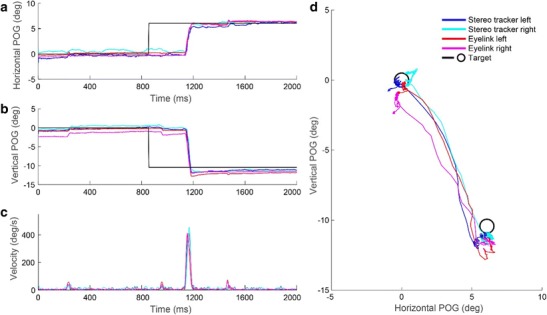
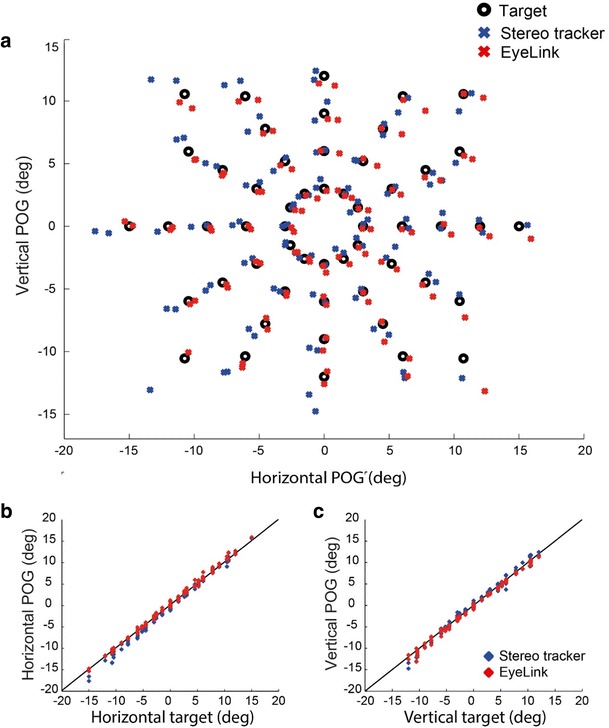
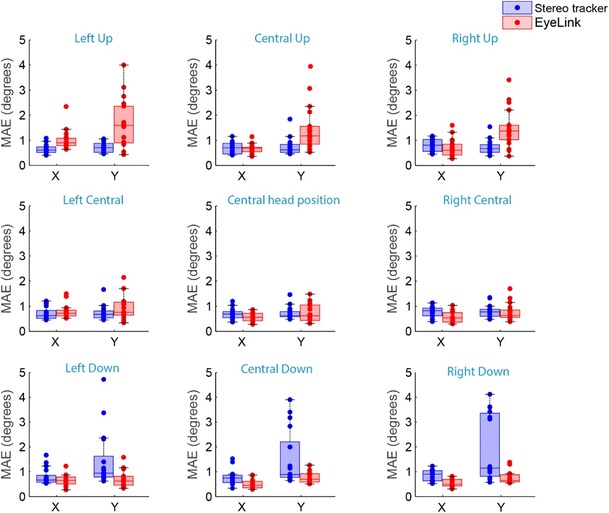
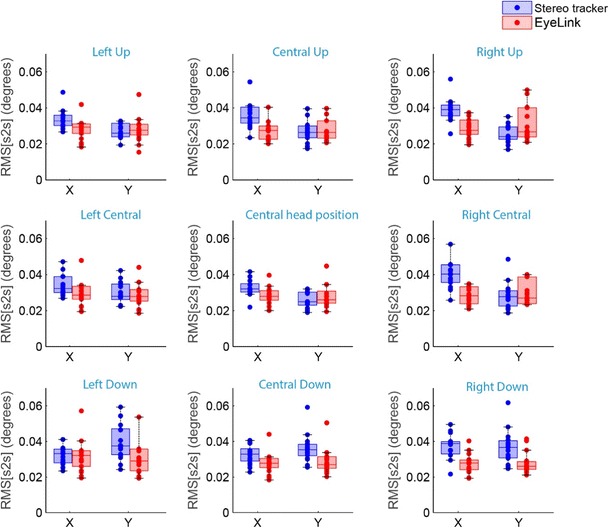
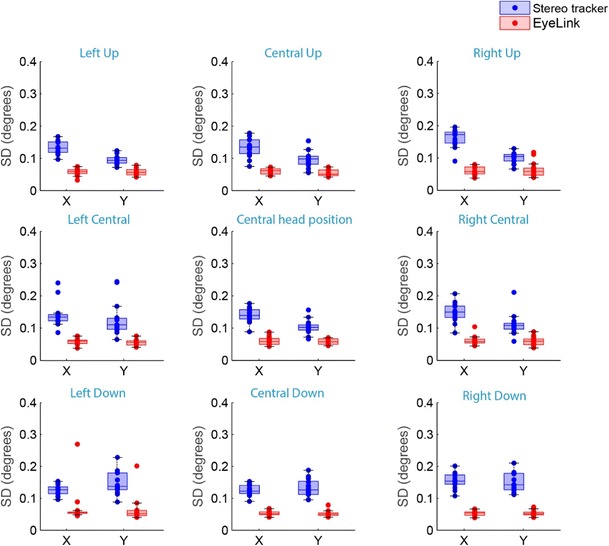
Traditional video-based eyetrackers require participants to perform an individual calibration procedure, which involves the fixation of multiple points on a screen. However, certain participants (e.g., people with oculomotor and/or visual problems or infants) are unable to perform this task reliably. Previous work has shown that with two cameras one can estimate the orientation of the eyes' optical axis directly. Consequently, only one calibration point is needed to determine the deviation between an eye's optical and visual axes. We developed a stereo eyetracker with two USB 3.0 cameras and two infrared light sources that can track both eyes at ~ 350 Hz for eccentricities of up to 20°. A user interface allows for online monitoring and threshold adjustments of the pupil and corneal reflections. We validated this tracker by collecting eye movement data from nine healthy participants and compared these data to eye movement records obtained simultaneously with an established eyetracking system (EyeLink 1000 Plus). The results demonstrated that the two-dimensional accuracy of our portable system is better than 1°, allowing for at least ± 5-cm head motion. Its resolution is better than 0.2° (SD), and its sample-to-sample noise is less than 0.05° (RMS). We concluded that our stereo eyetracker is a valid instrument, especially in settings in which individual calibration is challenging.
传统的基于视频的眼动追踪器要求参与者进行单独的校准程序,其中涉及在屏幕上固定多个点。然而,某些参与者(例如,患有眼球运动和/或视觉问题的人或婴儿)无法可靠地执行此任务。先前的工作表明,使用两个摄像机可以直接估计眼睛光轴的方向。因此,仅需一个校准点即可确定眼睛光轴和视轴之间的偏差。我们开发了一种具有两个 USB 3.0 摄像机和两个红外光源的立体眼动追踪器,可在高达 20°的偏心率下以约 350 Hz 的频率跟踪两只眼睛。用户界面允许在线监测瞳孔和角膜反射的阈值,并进行调整。我们通过从九名健康参与者那里收集眼动数据来验证该追踪器,并将这些数据与同时使用成熟的眼动追踪系统(EyeLink 1000 Plus)获得的眼动记录进行了比较。结果表明,我们的便携式系统的二维精度优于 1°,允许至少± 5 厘米的头部运动。其分辨率优于 0.2°(SD),样本间噪声小于 0.05°(RMS)。我们得出结论,我们的立体眼动追踪器是一种有效的仪器,尤其是在个人校准具有挑战性的环境中。