Sánchez-González Sandra, Diban Nazely, Urtiaga Ane
Department of Chemical and Biomolecular Engineering, University of Cantabria, Avda. Los Castros s/n, 39005 Santander, Spain.
Membranes (Basel). 2018 Mar 5;8(1):12. doi: 10.3390/membranes8010012.
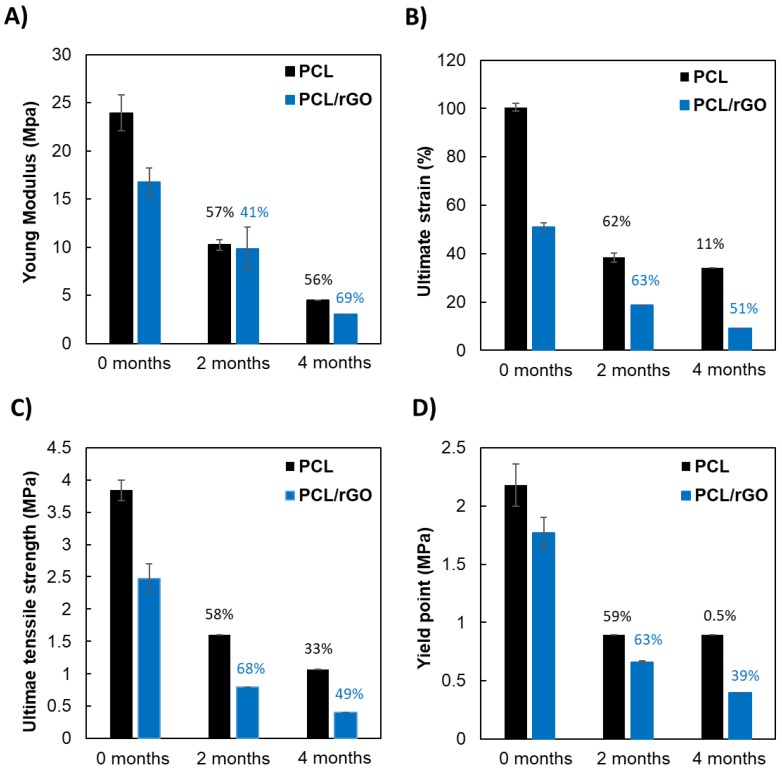
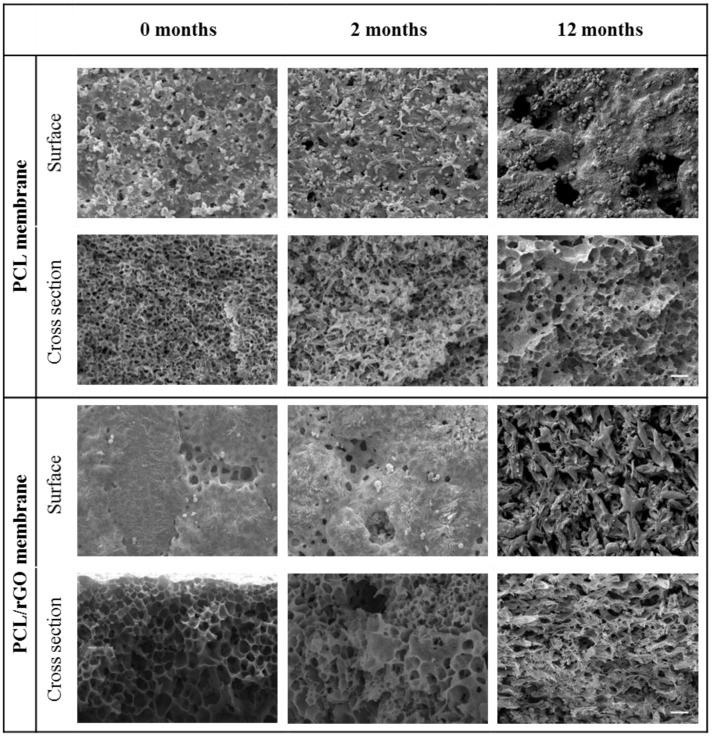
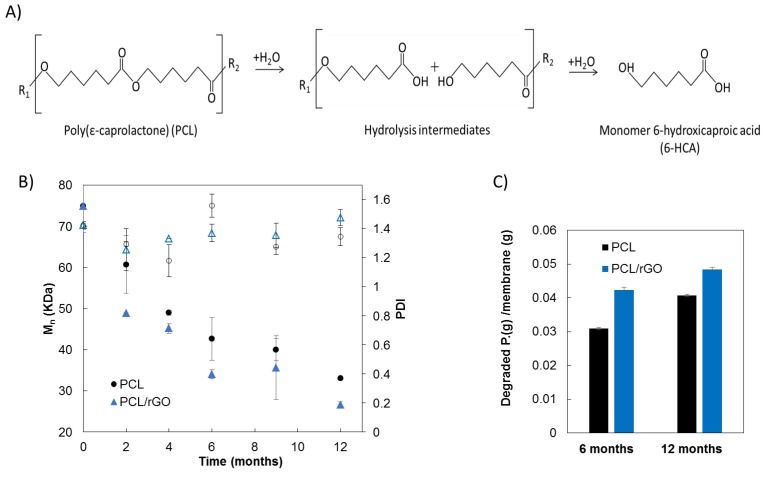
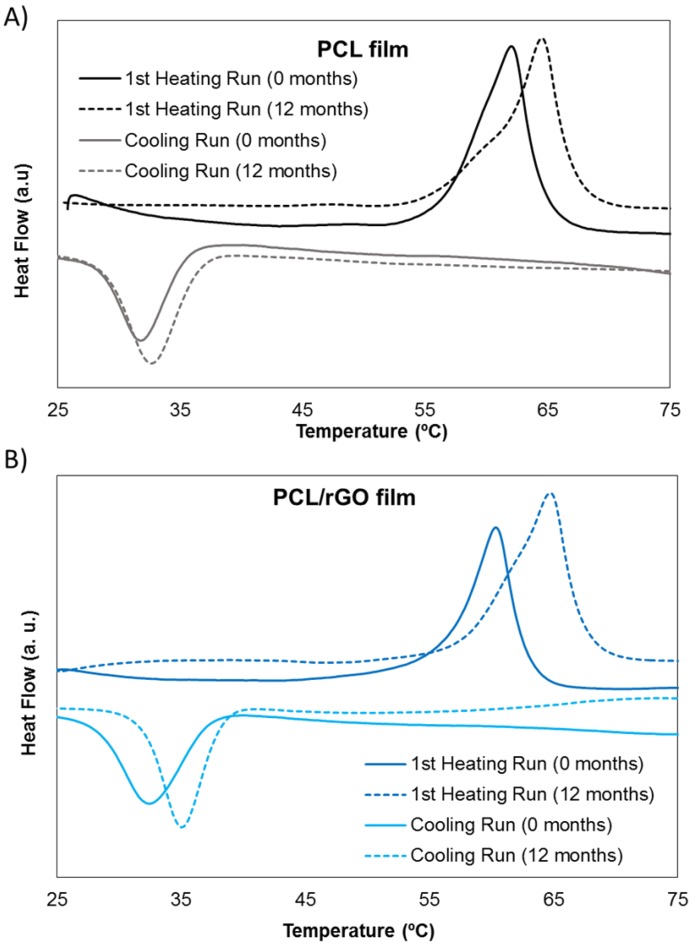
The present work studies the functional behavior of novel poly(ε-caprolactone) (PCL) membranes functionalized with reduced graphene oxide (rGO) nanoplatelets under simulated in vitro culture conditions (phosphate buffer solution (PBS) at 37 °C) during 1 year, in order to elucidate their applicability as scaffolds for in vitro neural regeneration. The morphological, chemical, and DSC results demonstrated that high internal porosity of the membranes facilitated water permeation and procured an accelerated hydrolytic degradation throughout the bulk pathway. Therefore, similar molecular weight reduction, from 80 kDa to 33 kDa for the control PCL, and to 27 kDa for PCL/rGO membranes, at the end of the study, was observed. After 1 year of hydrolytic degradation, though monomers coming from the hydrolytic cleavage of PCL diffused towards the PBS medium, the pH was barely affected, and the rGO nanoplatelets mainly remained in the membranes which envisaged low cytotoxic effect. On the other hand, the presence of rGO nanomaterials accelerated the loss of mechanical stability of the membranes. However, it is envisioned that the gradual degradation of the PCL/rGO membranes could facilitate cells infiltration, interconnectivity, and tissue formation.
本研究工作考察了用还原氧化石墨烯(rGO)纳米片功能化的新型聚(ε-己内酯)(PCL)膜在模拟体外培养条件(37℃的磷酸盐缓冲溶液(PBS))下1年内的功能行为,以阐明其作为体外神经再生支架的适用性。形态学、化学和差示扫描量热法结果表明,膜的高内部孔隙率促进了水渗透,并在整个本体途径中加速了水解降解。因此,在研究结束时,观察到了类似的分子量降低,对照PCL从80 kDa降至33 kDa,PCL/rGO膜降至27 kDa。经过1年的水解降解后,尽管来自PCL水解裂解的单体扩散到PBS介质中,但pH值几乎未受影响,并且rGO纳米片主要保留在膜中,这表明细胞毒性较低。另一方面,rGO纳米材料的存在加速了膜机械稳定性的丧失。然而,可以预想,PCL/rGO膜的逐渐降解可以促进细胞浸润、互连和组织形成。