Damasceno-Ferreira José A, Abreu Leonardo A S, Bechara Gustavo R, Costa Waldemar S, Pereira-Sampaio Marco A, Sampaio Francisco J B, De Souza Diogo B
Urogenital Research Unit, Rio de Janeiro State University, Rio de Janeiro, RJ, Brazil.
Department of Veterinary Clinical Pathology, Fluminense Federal University, Niterói, RJ, Brazil.
BMC Urol. 2018 Mar 6;18(1):16. doi: 10.1186/s12894-018-0328-5.
Mannitol has been employed to ameliorate renal warm ischemia damage during partial nephrectomy, however, there is limited scientific evidence to support the use of mannitol during partial nephrectomy. The objective of the present study was to investigate the glomerular number after renal warm ischemia, with and without the use of mannitol in a Pig Model.
Twenty-four male pigs were assigned into three groups. Eight animals were allocated to the sham group that was subjected to laparoscopic dissection of the left renal hilum, without renal ischemia. Eight animals were allocated to the ischemia group that had the left renal hilum clamped for 30 min through laparoscopic access. Eight animals received mannitol (250 mg/kg) before the occlusion of renal hilum for 30 min. The kidneys were collected after the euthanasia of the pigs 21 days post surgery. The right kidney was utilized as a self-control for each animal. Serum creatinine, urea levels, the weight and volume of the kidneys were measured. Glomerular volumetric density, volume-weighted glomerular volume, and cortical volume were quantified through stereological methods and employed to determine the number of nephrons per kidney. Student's t test and ANOVA were used for statistical analysis.
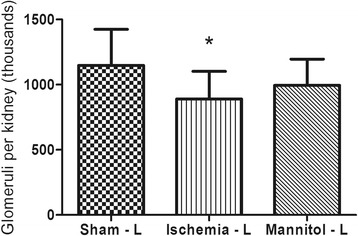
In the ischemia group, the left kidney recorded a reduction of 24.6% (290, 000 glomeruli) in the number of glomeruli in comparison to the right kidney. Kidneys subjected to ischemia also displayed decreased weight and volume in comparison to the sham and mannitol groups. No difference was observed between the left and right kidneys from the sham and mannitol groups. Further, no distinction in serum creatinine and urea among the groups was observed.
The use of mannitol significantly reduces nephron loss during warm ischemia in pigs.
甘露醇已被用于减轻部分肾切除术中肾脏热缺血损伤,然而,支持在部分肾切除术中使用甘露醇的科学证据有限。本研究的目的是在猪模型中研究热缺血时使用和不使用甘露醇情况下的肾小球数量。
将24只雄性猪分为三组。8只动物被分配到假手术组,该组接受左肾门的腹腔镜解剖,不进行肾脏缺血。8只动物被分配到缺血组,通过腹腔镜途径将左肾门夹闭30分钟。8只动物在肾门闭塞前30分钟接受甘露醇(250mg/kg)。术后21天对猪实施安乐死后收集肾脏。每只动物的右肾用作自身对照。测量血清肌酐、尿素水平、肾脏重量和体积。通过体视学方法对肾小球体积密度、体积加权肾小球体积和皮质体积进行量化,并用于确定每个肾脏的肾单位数量。采用学生t检验和方差分析进行统计分析。
在缺血组中,与右肾相比,左肾的肾小球数量减少了24.6%(290,000个肾小球)。与假手术组和甘露醇组相比,遭受缺血的肾脏重量和体积也有所下降。在假手术组和甘露醇组的左肾和右肾之间未观察到差异。此外,各组之间血清肌酐和尿素没有差异。
使用甘露醇可显著减少猪热缺血期间的肾单位损失。