Department of Developmental and Educational Psychology, Institute of Psychology, Leiden University, Wassenaarseweg 52, 2333 AK, Leiden, The Netherlands.
Rivierduinen, Centre for Autism, Leiden, The Netherlands.
J Autism Dev Disord. 2018 Aug;48(8):2727-2739. doi: 10.1007/s10803-018-3519-8.
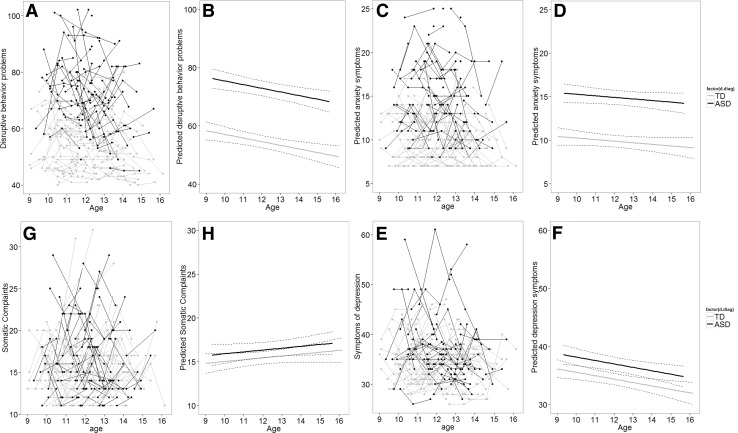
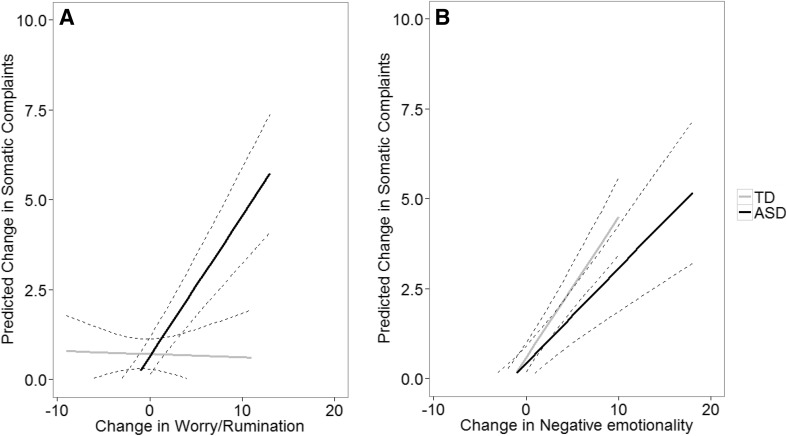
Children and adolescents with Autism Spectrum Disorder (ASD) often show comorbid emotional and behavior problems. The aim of this longitudinal study is to examine the relation between emotion control (i.e., negative emotionality, emotion awareness, and worry/rumination) and the development of internalizing and externalizing problems. Boys with and without ASD (N = 157; age 9-15) were followed over a period of 1.5 years (3 waves). We found that baseline levels of worry/rumination was a specific predictor of later externalizing problems for boys with ASD. Furthermore, the developmental trajectory of worry/rumination predicted the development of internalizing and externalizing problems in both groups. Our findings suggest that worry/rumination may constitute a transdiagnostic factor underlying both internalizing and externalizing problems in boys with and without ASD.
自闭症谱系障碍(ASD)儿童和青少年常伴有情绪和行为问题。本纵向研究旨在探讨情绪控制(即负性情绪、情绪意识和担忧/沉思)与内化和外化问题发展之间的关系。本研究共招募了 157 名男孩,包括 ASD 男孩和非 ASD 男孩(年龄 9-15 岁),随访时间为 1.5 年(共 3 个时间点)。结果发现,基线水平的担忧/沉思是 ASD 男孩外化问题的一个特定预测因素。此外,担忧/沉思的发展轨迹可以预测两组内化和外化问题的发展。研究结果表明,担忧/沉思可能是 ASD 男孩和非 ASD 男孩内化和外化问题的一个跨诊断因素。