Department of Psychology, Inland Norway University of Applied Sciences, Holsetgata, Norway.
Division Mental Health Care, Innlandet Hospital Trust, Brumunddal, Norway.
BMC Psychiatry. 2023 Mar 9;23(1):149. doi: 10.1186/s12888-023-04635-w.
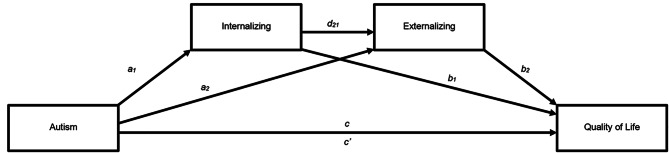
Individuals with autism tend to have a reduced quality of life across their lifespan. This reduced quality of life may be a result of autism traits, mental distress, and poor person/environment fit. In this longitudinal study, we looked at the role of adolescence internalizing and externalizing problems in mediating the relationship between having an autism diagnosis from childhood and perceived quality of life as emerging adults.
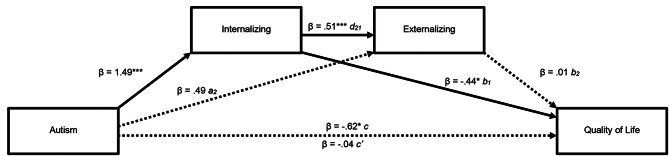
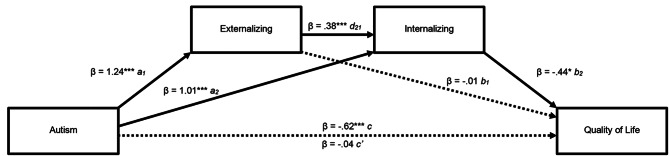
A total of 66 participants in a group of emerging adults with autism (mean age 22.2 years), and without autism (mean age 20.9 years) were assessed in three assessment waves (T1 at 12 years, T2 at 14 years, and T3 at 22 years of age). Parents filled out the Child Behavior Checklist at T2 and participants filled out the Perceived Quality of Life Questionnaire at T3. Total and indirect effects were tested in serial mediation analysis.
The results showed that internalizing problems fully mediated the association between childhood autism diagnosis and the quality of life in emerging adulthood, while externalizing problems did not.
Our findings suggest that attention to adolescent internalizing problems is important to improve the later quality of life for emerging adults with autism.
自闭症患者在其一生中的生活质量往往会降低。这种生活质量的下降可能是自闭症特征、精神困扰和人与环境不匹配的结果。在这项纵向研究中,我们研究了青春期内化和外化问题在多大程度上可以调节从儿童期被诊断为自闭症与成年早期感知生活质量之间的关系。
共有 66 名自闭症成年早期患者(平均年龄 22.2 岁)和非自闭症成年早期患者(平均年龄 20.9 岁)参加了这项研究,他们在三个评估时间点(T1 在 12 岁,T2 在 14 岁,T3 在 22 岁)接受了评估。在 T2 时,家长填写了《儿童行为检查表》,在 T3 时,参与者填写了《生活质量问卷》。采用连续中介分析检验总效应和间接效应。
结果表明,内化问题完全中介了儿童自闭症诊断与成年早期生活质量之间的关联,而外化问题则没有。
我们的研究结果表明,关注青少年内化问题对于提高自闭症成年早期患者的生活质量很重要。