Institute for Biomedical and Neural Engineering, Reykjavík University, Reykjavík, Iceland.
Icelandic Heart Association (Hjartavernd), Kópavogur, Iceland.
PLoS One. 2018 Mar 7;13(3):e0193241. doi: 10.1371/journal.pone.0193241. eCollection 2018.
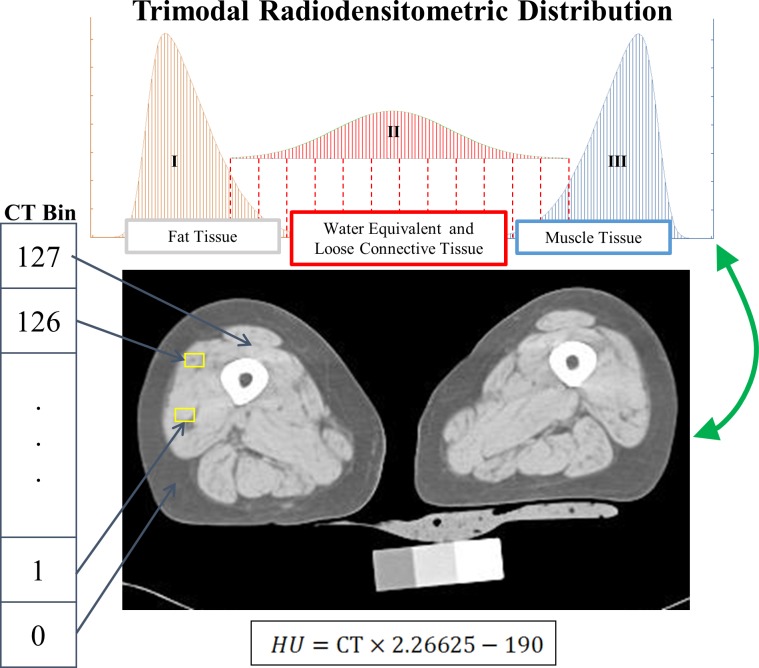
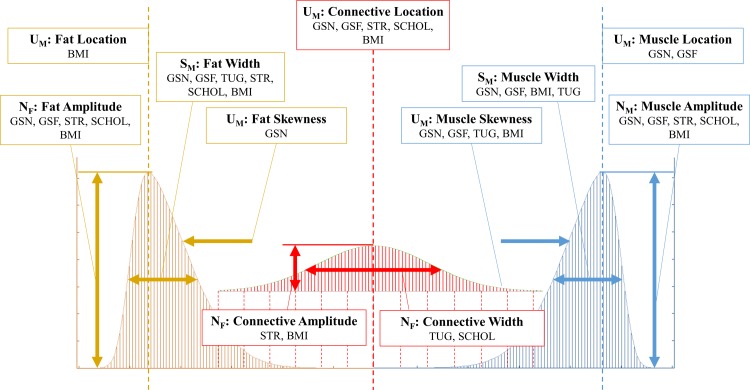
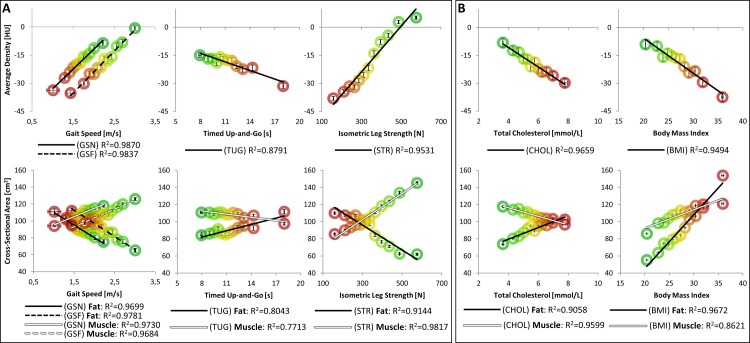
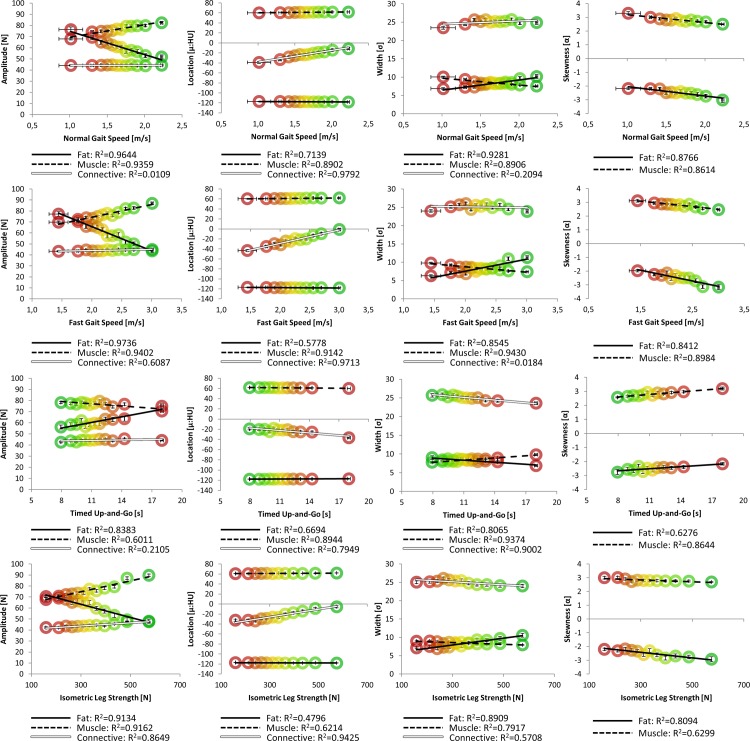
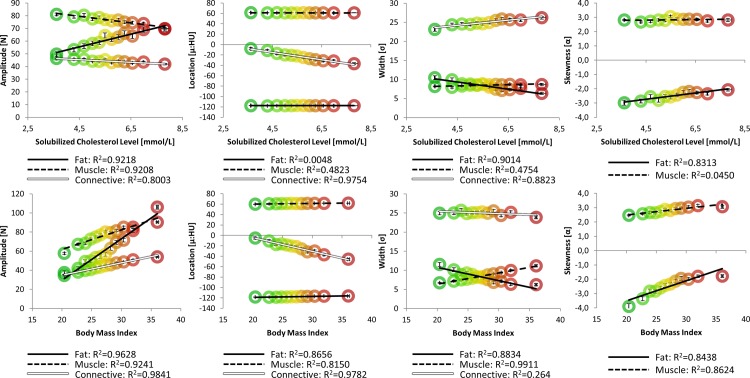
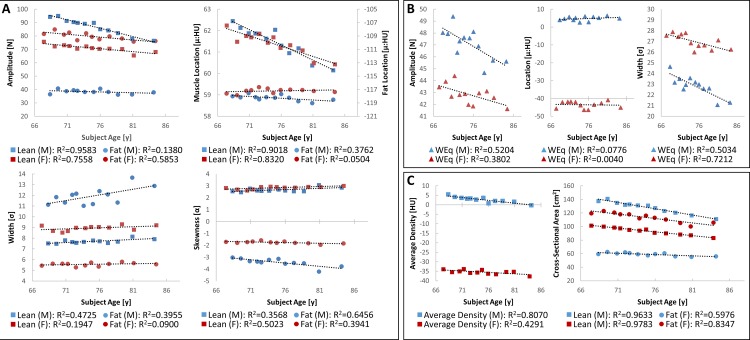
Sarcopenic muscular degeneration has been consistently identified as an independent risk factor for mortality in aging populations. Recent investigations have realized the quantitative potential of computed tomography (CT) image analysis to describe skeletal muscle volume and composition; however, the optimum approach to assessing these data remains debated. Current literature reports average Hounsfield unit (HU) values and/or segmented soft tissue cross-sectional areas to investigate muscle quality. However, standardized methods for CT analyses and their utility as a comorbidity index remain undefined, and no existing studies compare these methods to the assessment of entire radiodensitometric distributions. The primary aim of this study was to present a comparison of nonlinear trimodal regression analysis (NTRA) parameters of entire radiodensitometric muscle distributions against extant CT metrics and their correlation with lower extremity function (LEF) biometrics (normal/fast gait speed, timed up-and-go, and isometric leg strength) and biochemical and nutritional parameters, such as total solubilized cholesterol (SCHOL) and body mass index (BMI). Data were obtained from 3,162 subjects, aged 66-96 years, from the population-based AGES-Reykjavik Study. 1-D k-means clustering was employed to discretize each biometric and comorbidity dataset into twelve subpopulations, in accordance with Sturges' Formula for Class Selection. Dataset linear regressions were performed against eleven NTRA distribution parameters and standard CT analyses (fat/muscle cross-sectional area and average HU value). Parameters from NTRA and CT standards were analogously assembled by age and sex. Analysis of specific NTRA parameters with standard CT results showed linear correlation coefficients greater than 0.85, but multiple regression analysis of correlative NTRA parameters yielded a correlation coefficient of 0.99 (P<0.005). These results highlight the specificities of each muscle quality metric to LEF biometrics, SCHOL, and BMI, and particularly highlight the value of the connective tissue regime in this regard.
肌肉减少性肌萎缩症一直被认为是老龄化人口死亡的独立危险因素。最近的研究已经意识到 CT(计算机断层扫描)图像分析在描述骨骼肌体积和组成方面的定量潜力;然而,评估这些数据的最佳方法仍存在争议。目前的文献报告平均 Hounsfield 单位(HU)值和/或分割的软组织横截面积来研究肌肉质量。然而,CT 分析的标准化方法及其作为合并症指数的效用仍然没有定义,也没有现有的研究将这些方法与整个放射密度分布的评估进行比较。本研究的主要目的是比较整个放射密度肌肉分布的非线性三峰回归分析(NTRA)参数与现有的 CT 指标及其与下肢功能(LEF)生物计量学(正常/快速步行速度、计时起立行走和等长腿部力量)和生化及营养参数(总可溶性胆固醇(SCHOL)和体重指数(BMI))的相关性。数据来自年龄在 66-96 岁的 3162 名来自基于人群的 AGES-Reykjavik 研究的受试者。使用 1-D k-均值聚类将每个生物计量和合并症数据集按照 Sturges 公式的分类选择离散化为 12 个子集。对数据集进行线性回归,与 11 个 NTRA 分布参数和标准 CT 分析(脂肪/肌肉横截面积和平均 HU 值)进行比较。根据年龄和性别对 NTRA 和 CT 标准的参数进行类似的组合。特定 NTRA 参数与标准 CT 结果的分析显示线性相关系数大于 0.85,但相关 NTRA 参数的多元回归分析得出的相关系数为 0.99(P<0.005)。这些结果突出了每个肌肉质量指标与 LEF 生物计量学、SCHOL 和 BMI 的特异性,特别是突出了结缔组织状态在这方面的价值。