Recenti Marco, Ricciardi Carlo, Edmunds Kyle, Gislason Magnus K, Gargiulo Paolo
Institute for Biomedical and Neural Engineering, Reykjavík University, Reykjavík, Iceland.
Department of Advanced Biomedical Sciences, University Hospital of Naples 'Federico II', Naples, Italy.
Eur J Transl Myol. 2020 Apr 1;30(1):8892. doi: 10.4081/ejtm.2019.8892. eCollection 2020 Apr 7.
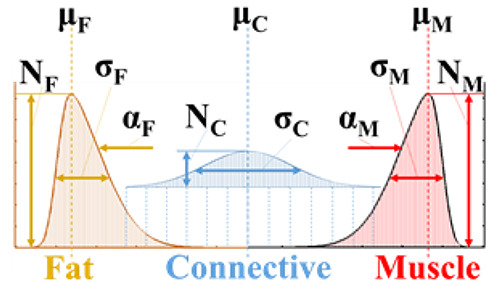
The nonlinear trimodal regression analysis (NTRA) method based on radiodensitometric CT images distributions was developed for the quantitative characterization of soft tissue changes according to the lower extremity function of elderly subjects. In this regard, the NTRA method defines 11 subject-specific soft tissue parameters and has illustrated high sensitivity to changes in skeletal muscle form and function. The present work further explores the use of these 11 NTRA parameters in the construction of a machine learning (ML) system to predict body mass index and isometric leg strength using tree-based regression algorithms. Results obtained from these models demonstrate that when using an ML approach, these soft tissue features have a significant predictive value for these physiological parameters. These results further support the use of NTRA-based ML predictive assessment and support the future investigation of other physiological parameters and comorbidities.
基于放射性密度CT图像分布的非线性三峰回归分析(NTRA)方法被开发出来,用于根据老年受试者的下肢功能对软组织变化进行定量表征。在这方面,NTRA方法定义了11个受试者特定的软组织参数,并已证明对骨骼肌形态和功能的变化具有高敏感性。目前的工作进一步探索了使用这11个NTRA参数构建机器学习(ML)系统,以使用基于树的回归算法预测体重指数和等长腿部力量。从这些模型获得的结果表明,当使用ML方法时,这些软组织特征对这些生理参数具有显著的预测价值。这些结果进一步支持基于NTRA的ML预测评估的使用,并支持对其他生理参数和合并症的未来研究。