Department for Biosystems Science and Engineering, ETH Zürich, Basel, Switzerland.
aiNET GmbH, ETH Zürich, Basel, Switzerland.
Front Immunol. 2018 Feb 21;9:224. doi: 10.3389/fimmu.2018.00224. eCollection 2018.
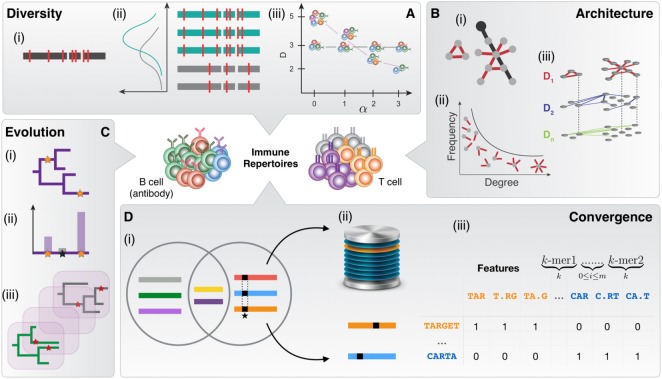
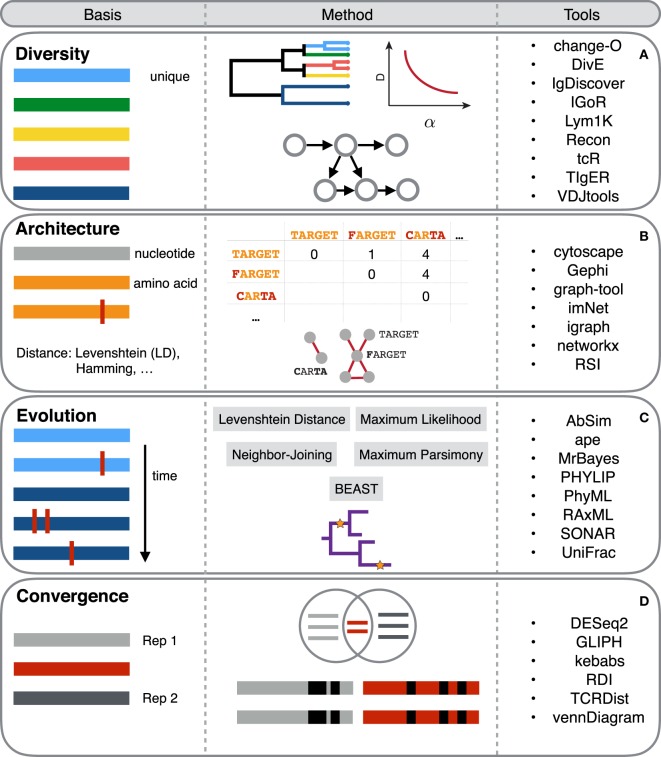
The adaptive immune system recognizes antigens an immense array of antigen-binding antibodies and T-cell receptors, the immune repertoire. The interrogation of immune repertoires is of high relevance for understanding the adaptive immune response in disease and infection (e.g., autoimmunity, cancer, HIV). Adaptive immune receptor repertoire sequencing (AIRR-seq) has driven the quantitative and molecular-level profiling of immune repertoires, thereby revealing the high-dimensional complexity of the immune receptor sequence landscape. Several methods for the computational and statistical analysis of large-scale AIRR-seq data have been developed to resolve immune repertoire complexity and to understand the dynamics of adaptive immunity. Here, we review the current research on (i) diversity, (ii) clustering and network, (iii) phylogenetic, and (iv) machine learning methods applied to dissect, quantify, and compare the architecture, evolution, and specificity of immune repertoires. We summarize outstanding questions in computational immunology and propose future directions for systems immunology toward coupling AIRR-seq with the computational discovery of immunotherapeutics, vaccines, and immunodiagnostics.
适应性免疫系统识别抗原——大量的抗原结合抗体和 T 细胞受体,即免疫受体库。免疫受体库的研究对于理解疾病和感染中的适应性免疫反应(例如自身免疫、癌症、HIV)具有重要意义。适应性免疫受体库测序(AIRR-seq)推动了免疫受体库的定量和分子水平分析,从而揭示了免疫受体序列景观的高维复杂性。已经开发了几种用于大规模 AIRR-seq 数据的计算和统计分析的方法,以解决免疫受体复杂性问题,并了解适应性免疫的动态。在这里,我们综述了当前应用于剖析、量化和比较免疫受体库结构、进化和特异性的(i)多样性、(ii)聚类和网络、(iii)系统发生和(iv)机器学习方法的研究,总结了计算免疫学中的悬而未决的问题,并为系统免疫学提出了未来的方向,即通过与免疫治疗、疫苗和免疫诊断的计算发现相结合,来耦合 AIRR-seq。