Maini Rishma, Mounier-Jack Sandra, Borghi Josephine
Faculty of Public Health Policy, Global Health Department, London School of Hygiene & Tropical Medicine, London, UK.
BMJ Glob Health. 2018 Jan 3;3(1):e000617. doi: 10.1136/bmjgh-2017-000617. eCollection 2018.
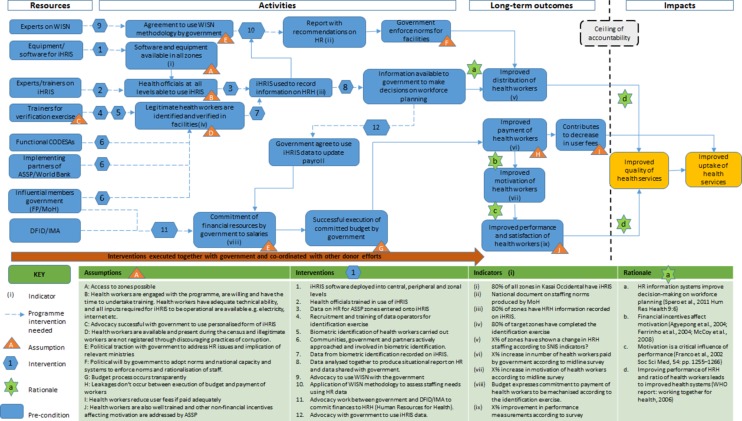
Theories of change (ToCs) describe how interventions can bring about long-term outcomes through a logical sequence of intermediate outcomes and have been used to design and measure the impact of public health programmes in several countries. In recognition of their capacity to provide a framework for monitoring and evaluation, they are being increasingly employed in the development sector. The construction of a ToC typically occurs through a consultative process, requiring stakeholders to reflect on how their programmes can bring about change. ToCs help make explicit any underlying assumptions, acknowledge the role of context and provide evidence to justify the chain of causal pathways. However, while much literature exists on how to develop a ToC with respect to interventions in theory, there is comparatively little reflection on applying it in practice to complex interventions in the health sector. This paper describes the initial process of developing a ToC to inform the design of an evaluation of a complex intervention aiming to improve government payments to health workers in the Democratic Republic of Congo. Lessons learnt include: the need for the ToC to understand how the intervention produces effects on the wider system and having broad stakeholder engagement at the outset to maximise chances of the intervention's success and ensure ownership. Power relationships between stakeholders may also affect the ToC discourse but can be minimised by having an independent facilitator. We hope these insights are of use to other global public health practitioners using this approach to evaluate complex interventions.
变革理论(ToC)描述了干预措施如何通过一系列合乎逻辑的中间结果实现长期成果,并且已被用于设计和衡量多个国家公共卫生项目的影响。鉴于其能够为监测和评估提供框架,变革理论在发展领域的应用越来越广泛。变革理论的构建通常通过协商过程进行,要求利益相关者思考其项目如何带来变革。变革理论有助于明确任何潜在假设,认识到背景的作用,并为因果路径链提供正当理由。然而,尽管有大量关于如何从理论上针对干预措施制定变革理论的文献,但对于在实践中将其应用于卫生部门的复杂干预措施的反思相对较少。本文描述了制定变革理论的初始过程,以指导对一项旨在改善刚果民主共和国政府向卫生工作者支付款项的复杂干预措施进行评估的设计。吸取的经验教训包括:变革理论需要理解干预措施如何对更广泛的系统产生影响,并且从一开始就需要广泛的利益相关者参与,以最大限度地提高干预措施成功的机会并确保所有权。利益相关者之间的权力关系也可能影响变革理论的讨论,但可以通过聘请独立的协调人将其影响降至最低。我们希望这些见解对其他使用这种方法评估复杂干预措施的全球公共卫生从业者有用。