LEAD Graduate School & Research Network, University of Tuebingen, Tuebingen, Germany.
Department of Psychology, University of Tuebingen, Tuebingen, Germany.
Behav Brain Funct. 2018 Mar 10;14(1):5. doi: 10.1186/s12993-018-0137-8.
Arithmetic processing in adults is known to rely on a frontal-parietal network. However, neurocognitive research focusing on the neural and behavioral correlates of arithmetic development has been scarce, even though the acquisition of arithmetic skills is accompanied by changes within the fronto-parietal network of the developing brain. Furthermore, experimental procedures are typically adjusted to constraints of functional magnetic resonance imaging, which may not reflect natural settings in which children and adolescents actually perform arithmetic. Therefore, we investigated the longitudinal neurocognitive development of processes involved in performing the four basic arithmetic operations in 19 adolescents. By using functional near-infrared spectroscopy, we were able to use an ecologically valid task, i.e., a written production paradigm.
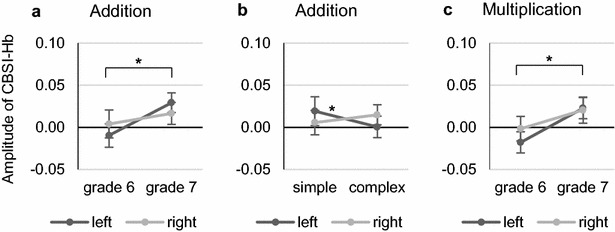
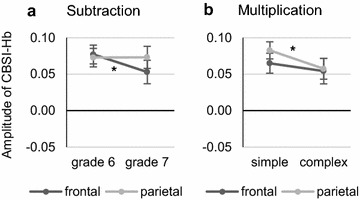
A common pattern of activation in the bilateral fronto-parietal network for arithmetic processing was found for all basic arithmetic operations. Moreover, evidence was obtained for decreasing activation during subtraction over the course of 1 year in middle and inferior frontal gyri, and increased activation during addition and multiplication in angular and middle temporal gyri. In the self-paced block design, parietal activation in multiplication and left angular and temporal activation in addition were observed to be higher for simple than for complex blocks, reflecting an inverse effect of arithmetic complexity.
In general, the findings suggest that the brain network for arithmetic processing is already established in 12-14 year-old adolescents, but still undergoes developmental changes.
已知成年人的算术处理依赖于额顶网络。然而,尽管算术技能的获得伴随着发育中大脑的额顶网络的变化,但专注于算术发展的神经认知研究仍然很少。此外,实验程序通常会根据功能磁共振成像的限制进行调整,而这可能无法反映儿童和青少年实际进行算术的自然环境。因此,我们调查了 19 名青少年在执行四项基本算术运算过程中的纵向神经认知发展。通过使用功能性近红外光谱学,我们能够使用生态有效的任务,即书面生成范式。
对于所有基本的算术运算,在双侧额顶网络中都发现了一种共同的算术处理激活模式。此外,在 1 年的时间里,在中部和下部额回中发现了减法过程中的激活减少,在角回和中部颞回中发现了加法和乘法过程中的激活增加。在自我调节的块设计中,观察到乘法中的顶叶激活和加法中的左侧角回和颞叶激活对于简单块比复杂块更高,反映了算术复杂性的反比效应。
总的来说,这些发现表明,12-14 岁青少年的算术处理大脑网络已经建立,但仍在发育变化。