de Souza Jessica M, Goncalves Bruno D C, Gomez Marcus V, Vieira Luciene B, Ribeiro Fabiola M
Department of Biochemistry and Immunology, Institute of Biological Sciences, Universidade Federal de Minas Gerais, Belo Horizonte, Brazil.
Department of Pharmacology, Institute of Biological Sciences, Universidade Federal de Minas Gerais, Belo Horizonte, Brazil.
Front Pharmacol. 2018 Feb 23;9:145. doi: 10.3389/fphar.2018.00145. eCollection 2018.
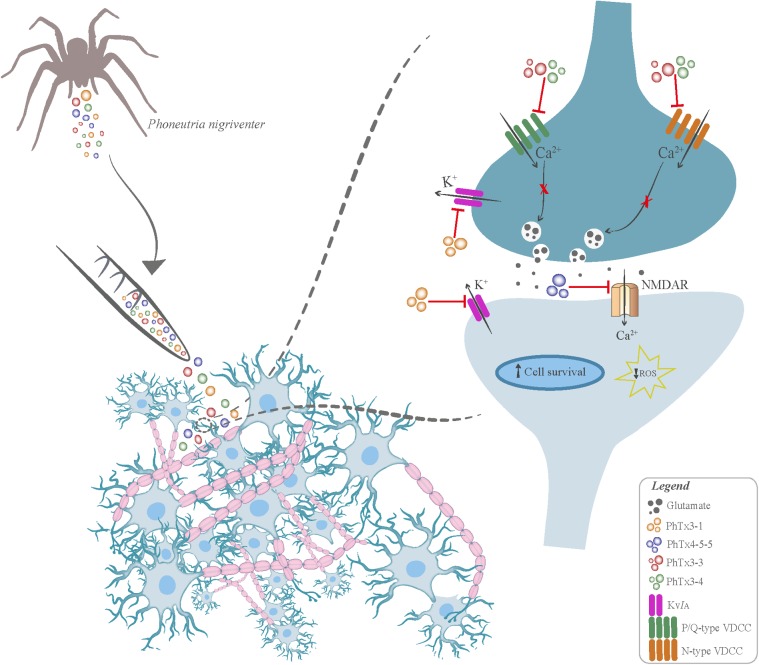
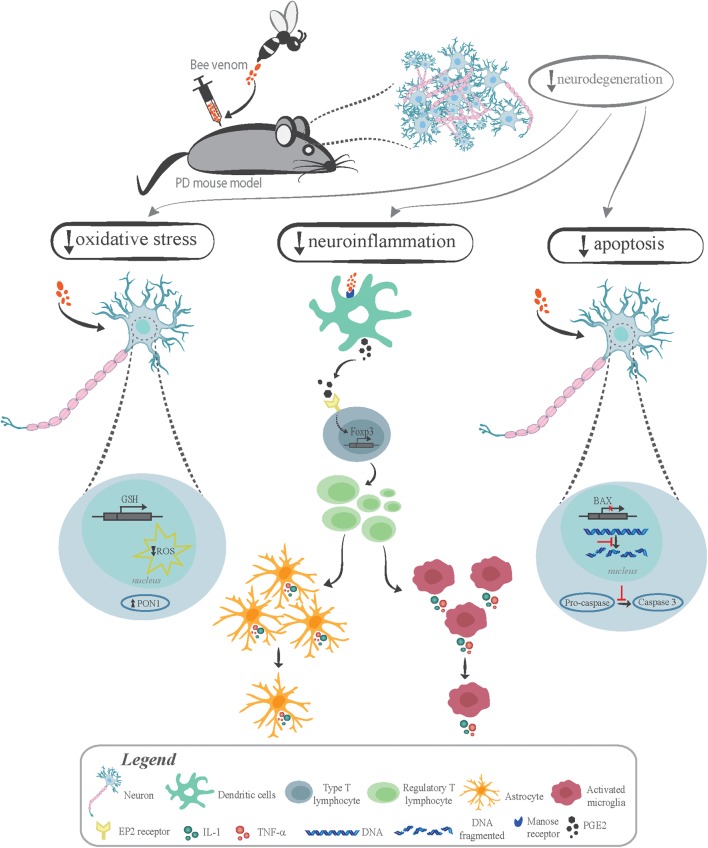
Neurodegenerative diseases affect millions of individuals worldwide. So far, no disease-modifying drug is available to treat patients, making the search for effective drugs an urgent need. Neurodegeneration is triggered by the activation of several cellular processes, including oxidative stress, mitochondrial impairment, neuroinflammation, aging, aggregate formation, glutamatergic excitotoxicity, and apoptosis. Therefore, many research groups aim to identify drugs that may inhibit one or more of these events leading to neuronal cell death. Venoms are fruitful natural sources of new molecules, which have been relentlessly enhanced by evolution through natural selection. Several studies indicate that venom components can exhibit selectivity and affinity for a wide variety of targets in mammalian systems. For instance, an expressive number of natural peptides identified in venoms from animals, such as snakes, scorpions, bees, and spiders, were shown to lessen inflammation, regulate glutamate release, modify neurotransmitter levels, block ion channel activation, decrease the number of protein aggregates, and increase the levels of neuroprotective factors. Thus, these venom components hold potential as therapeutic tools to slow or even halt neurodegeneration. However, there are many technological issues to overcome, as venom peptides are hard to obtain and characterize and the amount obtained from natural sources is insufficient to perform all the necessary experiments and tests. Fortunately, technological improvements regarding heterologous protein expression, as well as peptide chemical synthesis will help to provide enough quantities and allow chemical and pharmacological enhancements of these natural occurring compounds. Thus, the main focus of this review is to highlight the most promising studies evaluating animal toxins as therapeutic tools to treat a wide variety of neurodegenerative conditions, including Alzheimer's disease, Parkinson's disease, brain ischemia, glaucoma, amyotrophic lateral sclerosis, and multiple sclerosis.
神经退行性疾病影响着全球数百万人。到目前为止,尚无疾病修饰药物可用于治疗患者,因此寻找有效药物成为当务之急。神经退行性变是由多种细胞过程的激活引发的,包括氧化应激、线粒体损伤、神经炎症、衰老、聚集体形成、谷氨酸能兴奋性毒性和细胞凋亡。因此,许多研究小组旨在鉴定可能抑制这些导致神经元细胞死亡的事件中的一种或多种的药物。毒液是新分子丰富的天然来源,通过自然选择在进化过程中不断得到强化。多项研究表明,毒液成分可对哺乳动物系统中的多种靶点表现出选择性和亲和力。例如,在蛇、蝎子、蜜蜂和蜘蛛等动物的毒液中鉴定出的大量天然肽被证明可减轻炎症、调节谷氨酸释放、改变神经递质水平、阻断离子通道激活、减少蛋白质聚集体数量并提高神经保护因子水平。因此,这些毒液成分具有作为减缓甚至阻止神经退行性变的治疗工具的潜力。然而,仍有许多技术问题需要克服,因为毒液肽难以获得和表征,且从天然来源获得的量不足以进行所有必要的实验和测试。幸运的是,异源蛋白表达以及肽化学合成方面的技术改进将有助于提供足够的量,并对这些天然存在的化合物进行化学和药理学增强。因此,本综述的主要重点是突出最有前景的研究,这些研究评估动物毒素作为治疗多种神经退行性疾病的治疗工具,包括阿尔茨海默病、帕金森病、脑缺血、青光眼、肌萎缩侧索硬化症和多发性硬化症。