Diao Muhe, Huisman Jef, Muyzer Gerard
Department of Freshwater and Marine Ecology, Institute for Biodiversity and Ecosystem Dynamics, University of Amsterdam, 1090 GE Amsterdam, The Netherlands.
FEMS Microbiol Ecol. 2018 Apr 1;94(4). doi: 10.1093/femsec/fiy040.
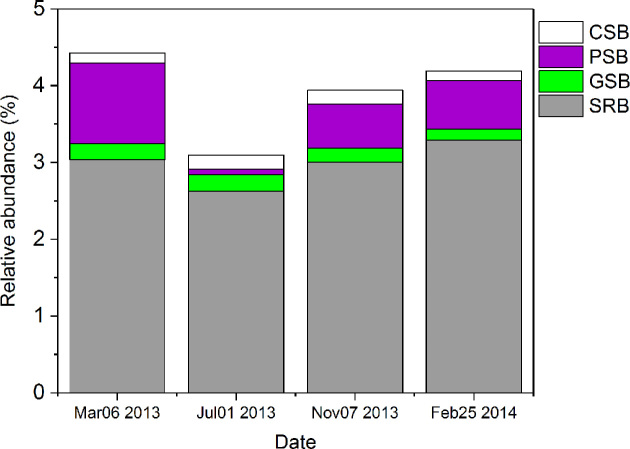
Sulfate-reducing bacteria (SRB) and sulfur-oxidizing bacteria drive major transformations in the sulfur cycle, and play vital roles in oxic--anoxic transitions in lakes and coastal waters. However, information on the succession of these sulfur bacteria in seasonally stratified lakes using molecular biological techniques is scarce. Here, we used 16S rRNA gene amplicon sequencing to study the spatio-temporal dynamics of sulfur bacteria during oxic--anoxic regime shifts in Lake Vechten. Oxygen and sulfate were mixed throughout the water column in winter and early spring. Meanwhile, SRB, green sulfur bacteria (GSB), purple sulfur bacteria (PSB), and colorless sulfur bacteria (CSB) exclusively inhabited the sediment. After the water column stratified, oxygen and nitrate concentrations decreased in the hypolimnion and various SRB species expanded into the anoxic hypolimnion. Consequently, sulfate was reduced to sulfide, stimulating the growth of PSB and GSB in the metalimnion and hypolimnion during summer stratification. When hypoxia spread throughout the water column during fall turnover, SRB and GSB vanished from the water column, whereas CSB (mainly Arcobacter) and PSB (Lamprocystis) became dominant and oxidized the accumulated sulfide under micro-aerobic conditions. Our results support the view that, once ecosystems have become anoxic and sulfidic, a large oxygen influx is needed to overcome the anaerobic sulfur cycle and bring the ecosystems back into their oxic state.
硫酸盐还原菌(SRB)和硫氧化细菌推动着硫循环中的主要转化过程,并在湖泊和沿海水域的有氧-缺氧过渡中发挥着至关重要的作用。然而,利用分子生物学技术研究季节性分层湖泊中这些硫细菌演替的信息却很匮乏。在此,我们利用16S rRNA基因扩增子测序技术,研究了费希滕湖在有氧-缺氧状态转变过程中硫细菌的时空动态变化。在冬季和早春,氧气和硫酸盐在整个水柱中混合。与此同时,硫酸盐还原菌、绿色硫细菌(GSB)、紫色硫细菌(PSB)和无色硫细菌(CSB)仅栖息于沉积物中。水柱分层后,下层滞水层中的氧气和硝酸盐浓度降低,各种硫酸盐还原菌物种扩展到缺氧的下层滞水层。因此,硫酸盐被还原为硫化物,在夏季分层期间刺激了温跃层和下层滞水层中紫色硫细菌和绿色硫细菌的生长。当秋季水体循环期间缺氧状态扩散到整个水柱时,硫酸盐还原菌和绿色硫细菌从水柱中消失,而无色硫细菌(主要是弓形杆菌)和紫色硫细菌(闪光囊硫菌属)成为优势菌,并在微需氧条件下氧化积累的硫化物。我们的研究结果支持这样一种观点,即一旦生态系统进入缺氧和含硫状态,就需要大量的氧气流入来克服厌氧硫循环,并使生态系统恢复到有氧状态。