Department of Microorganisms, Leibniz Institute DSMZ - German Collection of Microorganisms and Cell Cultures GmbH, Braunschweig D-38124, Germany.
Department of Bacteriology, University of Wisconsin-Madison, Madison, WI, 53706, USA.
FEMS Microbiol Rev. 2023 Sep 5;47(5). doi: 10.1093/femsre/fuad058.
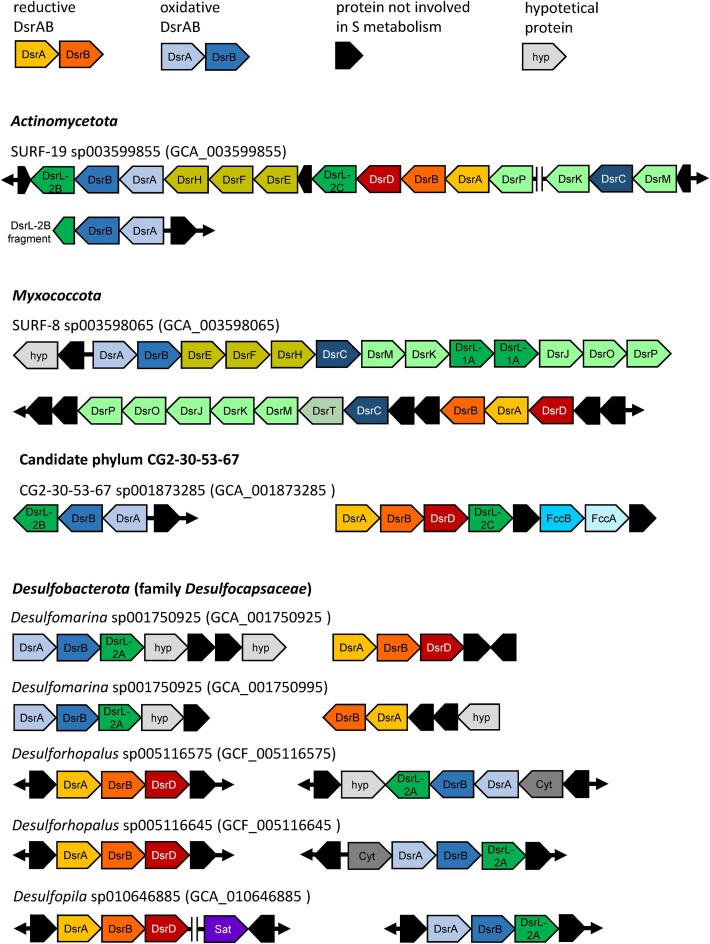
Sulfate/sulfite-reducing microorganisms (SRM) are ubiquitous in nature, driving the global sulfur cycle. A hallmark of SRM is the dissimilatory sulfite reductase encoded by the genes dsrAB. Based on analysis of 950 mainly metagenome-derived dsrAB-carrying genomes, we redefine the global diversity of microorganisms with the potential for dissimilatory sulfate/sulfite reduction and uncover genetic repertoires that challenge earlier generalizations regarding their mode of energy metabolism. We show: (i) 19 out of 23 bacterial and 2 out of 4 archaeal phyla harbor uncharacterized SRM, (ii) four phyla including the Desulfobacterota harbor microorganisms with the genetic potential to switch between sulfate/sulfite reduction and sulfur oxidation, and (iii) the combination as well as presence/absence of different dsrAB-types, dsrL-types and dsrD provides guidance on the inferred direction of dissimilatory sulfur metabolism. We further provide an updated dsrAB database including > 60% taxonomically resolved, uncultured family-level lineages and recommendations on existing dsrAB-targeted primers for environmental surveys. Our work summarizes insights into the inferred ecophysiology of newly discovered SRM, puts SRM diversity into context of the major recent changes in bacterial and archaeal taxonomy, and provides an up-to-date framework to study SRM in a global context.
硫酸盐/亚硫酸盐还原微生物(SRM)在自然界中无处不在,推动着全球硫循环。SRM 的一个标志是由基因 dsrAB 编码的异化亚硫酸盐还原酶。基于对 950 个主要基于宏基因组的 dsrAB 携带基因组的分析,我们重新定义了具有异化硫酸盐/亚硫酸盐还原潜力的微生物的全球多样性,并揭示了遗传库,这些遗传库挑战了关于其能量代谢方式的早期概括。我们表明:(i) 23 个细菌门和 4 个古菌门中的 19 个门都含有未被描述的 SRM,(ii) 包括脱硫杆菌门在内的四个门都含有具有在硫酸盐/亚硫酸盐还原和硫氧化之间切换的遗传潜力的微生物,以及 (iii) 不同的 dsrAB 型、dsrL 型和 dsrD 的组合以及存在/不存在,为推断的异化硫代谢方向提供了指导。我们进一步提供了一个更新的 dsrAB 数据库,其中包括超过 60%的分类学上已解决的、未培养的科级谱系,并对现有的 dsrAB 靶向引物进行了环境调查的建议。我们的工作总结了对新发现的 SRM 的推断生态生理学的见解,将 SRM 多样性置于细菌和古菌分类学最近重大变化的背景下,并提供了一个最新的框架来在全球范围内研究 SRM。