Center for Infectious Disease Dynamics, Pennsylvania State University, University Park, PA, USA.
Institute of Biodiversity Animal Health and Comparative Medicine, University of Glasgow, Glasgow, Scotland, UK.
Parasit Vectors. 2018 Mar 12;11(1):178. doi: 10.1186/s13071-018-2761-4.
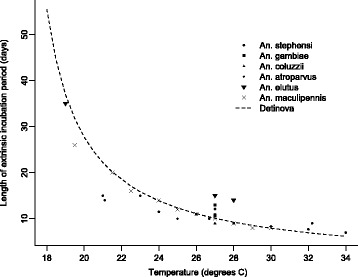
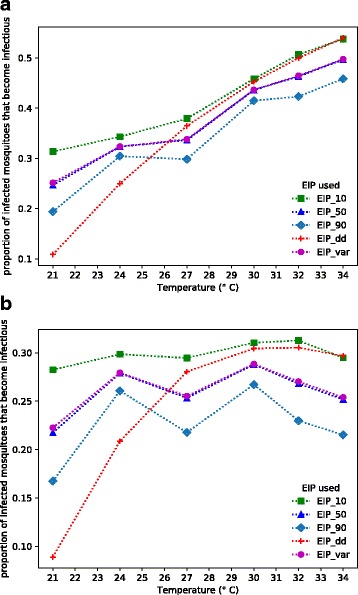
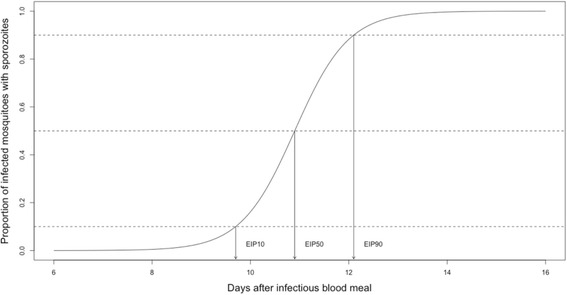
The time it takes for malaria parasites to develop within a mosquito, and become transmissible, is known as the extrinsic incubation period, or EIP. EIP is a key parameter influencing transmission intensity as it combines with mosquito mortality rate and competence to determine the number of mosquitoes that ultimately become infectious. In spite of its epidemiological significance, data on EIP are scant. Current approaches to estimate EIP are largely based on temperature-dependent models developed from data collected on parasite development within a single mosquito species in the 1930s. These models assume that the only factor affecting EIP is mean environmental temperature. Here, we review evidence to suggest that in addition to mean temperature, EIP is likely influenced by genetic diversity of the vector, diversity of the parasite, and variation in a range of biotic and abiotic factors that affect mosquito condition. We further demonstrate that the classic approach of measuring EIP as the time at which mosquitoes first become infectious likely misrepresents EIP for a mosquito population. We argue for a better understanding of EIP to improve models of transmission, refine predictions of the possible impacts of climate change, and determine the potential evolutionary responses of malaria parasites to current and future mosquito control tools.
疟原虫在蚊子体内发育并具有传播能力所需的时间称为外潜伏期(EIP)。EIP 是影响传播强度的关键参数,因为它结合了蚊子死亡率和媒介能力,决定了最终具有感染性的蚊子数量。尽管 EIP 具有流行病学意义,但有关它的数据却很少。目前估计 EIP 的方法主要基于上世纪 30 年代从单一蚊子物种体内寄生虫发育数据中得出的温度依赖性模型。这些模型假设影响 EIP 的唯一因素是环境平均温度。在这里,我们回顾了一些证据,这些证据表明,除了平均温度外,EIP 还可能受到媒介遗传多样性、寄生虫多样性以及影响蚊子状况的一系列生物和非生物因素的变化的影响。我们进一步证明,经典的测量 EIP 的方法,即蚊子首次具有传染性的时间,可能会错误地代表蚊子种群的 EIP。我们主张更好地了解 EIP,以改进传播模型,更准确地预测气候变化的可能影响,并确定疟原虫对当前和未来蚊子控制工具的潜在进化反应。