Department of Ecology and Evolution, Stony Brook University, Stony Brook, NY 11794-5245.
State Collection for Anthropology and Palaeoanatomy, Bavarian Natural History Collections, 80333 Munich, Germany.
Proc Natl Acad Sci U S A. 2018 Mar 27;115(13):3494-3499. doi: 10.1073/pnas.1719880115. Epub 2018 Mar 12.
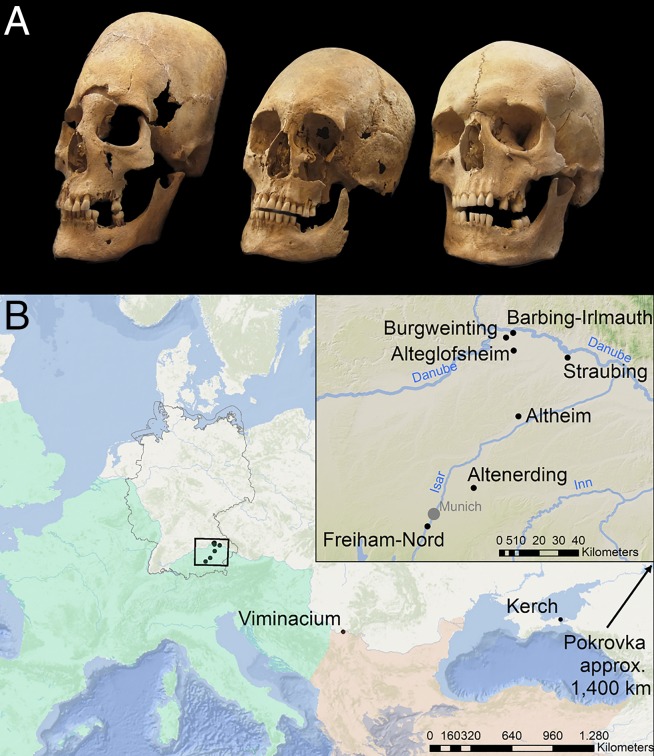
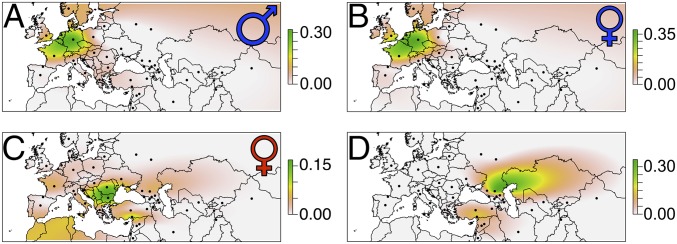
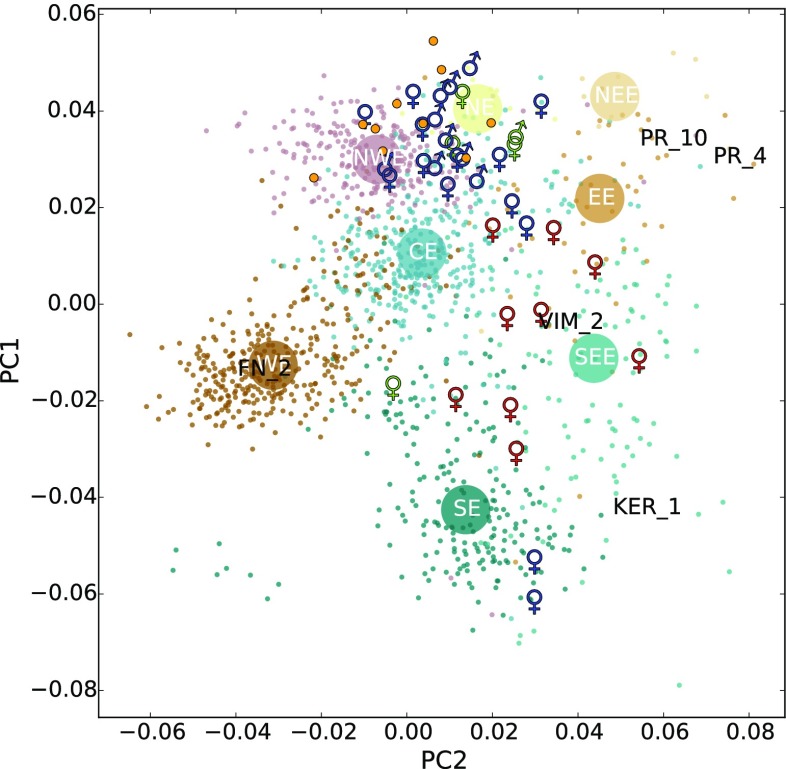
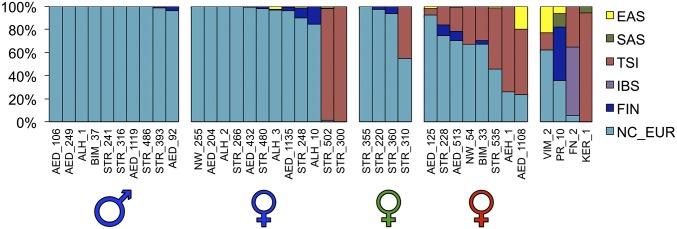
Modern European genetic structure demonstrates strong correlations with geography, while genetic analysis of prehistoric humans has indicated at least two major waves of immigration from outside the continent during periods of cultural change. However, population-level genome data that could shed light on the demographic processes occurring during the intervening periods have been absent. Therefore, we generated genomic data from 41 individuals dating mostly to the late 5th/early 6th century AD from present-day Bavaria in southern Germany, including 11 whole genomes (mean depth 5.56×). In addition we developed a capture array to sequence neutral regions spanning a total of 5 Mb and 486 functional polymorphic sites to high depth (mean 72×) in all individuals. Our data indicate that while men generally had ancestry that closely resembles modern northern and central Europeans, women exhibit a very high genetic heterogeneity; this includes signals of genetic ancestry ranging from western Europe to East Asia. Particularly striking are women with artificial skull deformations; the analysis of their collective genetic ancestry suggests an origin in southeastern Europe. In addition, functional variants indicate that they also differed in visible characteristics. This example of female-biased migration indicates that complex demographic processes during the Early Medieval period may have contributed in an unexpected way to shape the modern European genetic landscape. Examination of the panel of functional loci also revealed that many alleles associated with recent positive selection were already at modern-like frequencies in European populations ∼1,500 years ago.
现代欧洲的遗传结构与地理因素密切相关,而对史前人类的遗传分析表明,在文化变革时期,欧洲大陆至少曾有两次主要的外来移民潮。然而,在这两个移民潮之间的历史时期,我们缺乏能够揭示当时人口变化过程的全基因组数据。因此,我们从现今德国南部巴伐利亚地区的 41 名个体中获取了基因组数据,这些个体的年代主要集中在公元 5 世纪末到 6 世纪初,其中包括 11 个全基因组(平均测序深度为 5.56×)。此外,我们开发了一个捕获阵列,对覆盖总长度为 5Mb 的中性区域和 486 个功能性多态性位点进行测序,所有个体的测序深度均达到较高水平(平均深度为 72×)。我们的数据表明,男性的祖先与现代北欧和中欧人非常相似,而女性则表现出极高的遗传异质性;这其中包括从西欧到东亚的遗传祖先信号。特别引人注目的是那些颅骨受过人工变形的女性,对她们的集体遗传祖先进行分析表明,她们的起源可能在东南欧。此外,功能性变体表明,她们在外貌特征上也存在差异。这种女性偏向性的迁移表明,中世纪早期的复杂人口变化过程可能以出人意料的方式塑造了现代欧洲的遗传格局。对这组功能性基因座的研究还揭示了许多与近期正选择相关的等位基因,在 1500 年前的欧洲人群中就已经达到了现代的频率。