Daly Michael, Delaney Liam, Baumeister Roy F
Behavioural Science Centre, Stirling Management School, University of Stirling, Scotland, United Kingdom.
UCD Geary Institute, University College Dublin, Ireland.
Addict Behav Rep. 2015 Jul 29;1:89-96. doi: 10.1016/j.abrep.2015.07.002. eCollection 2015 Jun.
The pronounced discrepancy between smokers' intentions to quit and their smoking behavior has led researchers to suggest that many smokers are time inconsistent, have self-control problems, and may benefit from external efforts to constrain their consumption. This study aims to test whether self-control and future orientation predict smoking levels and to identify if these traits modify how cigarette consumption responds to the introduction of tobacco control measures.
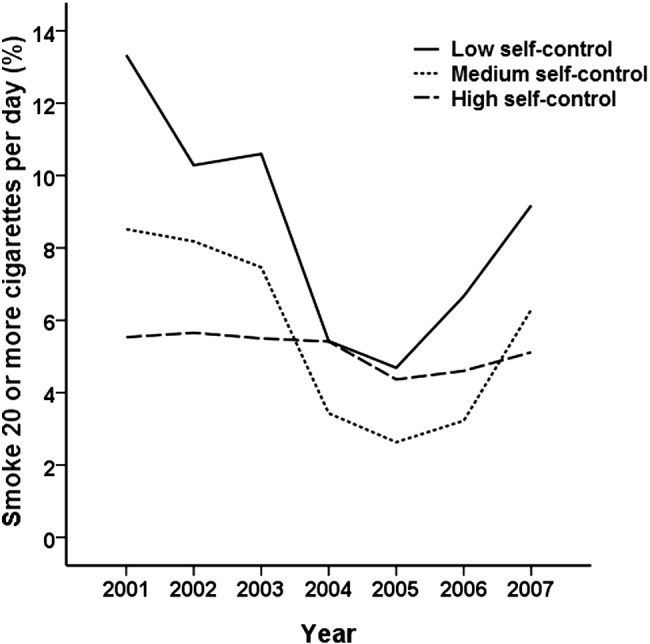
A sample of Dutch adults (N = 1585) completed a measure of self-control and the Consideration of Future Consequences Scale (CFCS) in 2001 and indicated their tobacco consumption each year from 2001 to 2007. In 2004, a workplace smoking ban and substantial tax increase on tobacco was introduced in the Netherlands. To identify the potential impact of these tobacco control measures we examined whether participants smoked or were heavy smokers (20 + cigarettes per day) each year from 2001 to 2007.
Participants with high self-control and CFCS scores showed lower rates of smoking across the seven year period of the study. The 2004 smoking restrictions were linked with a subsequent decline in heavy smoking. This decline was moderated by self-control levels. Those with low self-control showed a large reduction in heavy smoking whereas those with high self-control did not. The effects were, however, temporary: many people with low self-control resumed heavy smoking 2-3 years after the introduction of the tobacco restrictions.
The immediate costs which national tobacco control measures impose on smokers may assist smokers with poor self-control in reducing their cigarette consumption.
吸烟者戒烟意愿与吸烟行为之间存在明显差异,这使得研究人员认为许多吸烟者存在时间不一致性、自我控制问题,并且可能受益于外部限制其消费的措施。本研究旨在测试自我控制和未来导向是否能预测吸烟水平,并确定这些特质是否会改变香烟消费对烟草控制措施实施的反应。
2001年,一组荷兰成年人(N = 1585)完成了一项自我控制量表和未来后果考虑量表(CFCS)的测试,并表明了他们在2001年至2007年每年的烟草消费量。2004年,荷兰实施了工作场所禁烟令并大幅提高了烟草税。为了确定这些烟草控制措施的潜在影响,我们考察了参与者在2001年至2007年每年是否吸烟或是否为重度吸烟者(每天吸20支及以上香烟)。
在该研究的七年期间,自我控制和CFCS得分高的参与者吸烟率较低。2004年的吸烟限制与随后重度吸烟率的下降有关。这种下降受到自我控制水平的调节。自我控制能力低的人重度吸烟率大幅下降,而自我控制能力高的人则没有。然而,这些影响是暂时的:许多自我控制能力低的人在烟草限制措施实施2至3年后又恢复了重度吸烟。
国家烟草控制措施给吸烟者带来的直接成本可能有助于自我控制能力差的吸烟者减少香烟消费。