The Medical Research Center for Prophylaxis and Health Protection in Industrial Workers, 30 Popov Str., Ekaterinburg 620014, Russia.
The Institute of Natural Sciences, The Ural Federal University, Ekaterinburg 620000, Russia.
Int J Mol Sci. 2018 Mar 13;19(3):837. doi: 10.3390/ijms19030837.
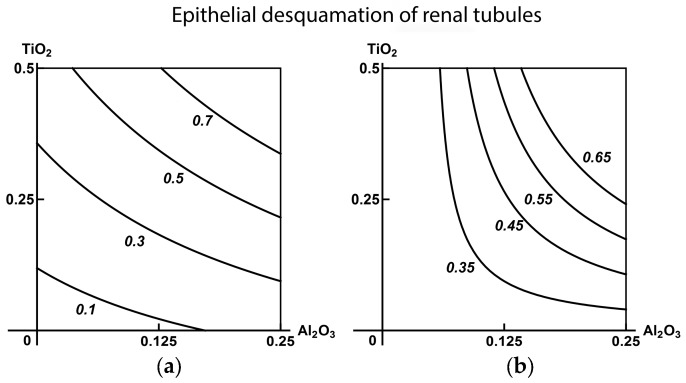
Stable suspensions of metal/metalloid oxide nanoparticles (MeO-NPs) obtained by laser ablation of 99.99% pure elemental aluminum, titanium or silicon under a layer of deionized water were used separately, or in three binary combinations, or in a ternary combination to induce subchronic intoxications in rats. To this end, the MeO-NPs were repeatedly injected intraperitoneally (i.p.) 18 times during 6 weeks before measuring a large number of functional, biochemical, morphological and cytological indices for the organism's status. In many respects, the Al₂O₃-NP was found to be the most toxic species alone and the most dangerous component of the combinations studied. Mathematical modeling with the help of the Response Surface Methodology showed that, as well as in the case of any other binary toxic combinations previously investigated by us, the organism's response to a simultaneous exposure to any two of the MeO-NP species under study was characterized by a complex interaction between all possible types of combined toxicity (additivity, subadditivity or superadditivity of unidirectional action and different variants of opposite effects) depending on which outcome this type was estimated for and on effect and dose levels. With any third MeO-NP species acting in the background, the type of combined toxicity displayed by the other two remained virtually the same or changed significantly, becoming either more or less unfavorable. Various harmful effects produced by the (Al₂O₃-NP + TiO₂-NP + SiO₂-NP)-combination, including its genotoxicity, were substantially attenuated by giving the rats per os during the entire exposure period a complex of innocuous bioactive substances expected to increase the organism's antitoxic resistance.
使用激光烧蚀 99.99%纯度的元素铝、钛或硅,在一层去离子水下分别获得金属/类金属氧化物纳米粒子(MeO-NPs)的稳定悬浮液,或者以三种二元组合或三元组合的形式,用于诱导大鼠亚慢性中毒。为此,在 6 周内,通过腹膜内(i.p.)重复注射 MeO-NPs18 次,然后测量大量功能、生化、形态和细胞学指标,以评估机体的状态。在许多方面,Al₂O₃-NP 是单独毒性最强的物种,也是研究组合中最危险的成分。借助响应面方法学的数学建模表明,与我们之前研究的任何其他二元毒性组合一样,当同时暴露于研究中的任何两种 MeO-NP 物种时,机体的反应表现出所有可能类型的组合毒性(单向作用的加性、亚加性或超加性,以及不同的相反效应变体)之间的复杂相互作用,这取决于对哪种结果进行估计以及效应和剂量水平。在任何第三种 MeO-NP 物种的作用下,其他两种的组合毒性类型保持几乎相同或发生显著变化,变得更加有利或不利。由(Al₂O₃-NP+TiO₂-NP+SiO₂-NP)组合产生的各种有害影响,包括其遗传毒性,通过在整个暴露期间给大鼠口服给予预计会增加机体抗毒性的无害生物活性物质复合物而得到实质性减弱。