Da Silva Xavier Gabriela
Section of Functional Genomics and Cell Biology, Department of Medicine, Imperial College London, Hammersmith Hospital Campus, Du Cane Road, London W12 0NN, UK.
Institute of Metabolism and Systems Research (IMSR), University of Birmingham, Edgbaston B15 2TT, UK.
J Clin Med. 2018 Mar 12;7(3):54. doi: 10.3390/jcm7030054.
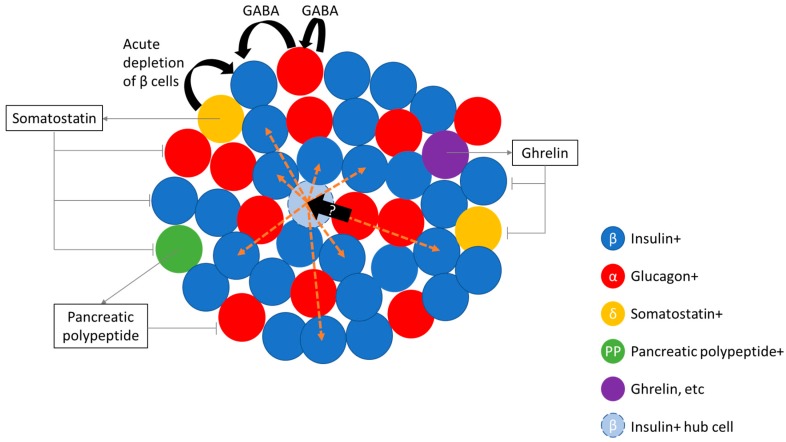
Islets of Langerhans are islands of endocrine cells scattered throughout the pancreas. A number of new studies have pointed to the potential for conversion of non-β islet cells in to insulin-producing β-cells to replenish β-cell mass as a means to treat diabetes. Understanding normal islet cell mass and function is important to help advance such treatment modalities: what should be the target islet/β-cell mass, does islet architecture matter to energy homeostasis, and what may happen if we lose a particular population of islet cells in favour of β-cells? These are all questions to which we will need answers for islet replacement therapy by transdifferentiation of non-β islet cells to be a reality in humans. We know a fair amount about the biology of β-cells but not quite as much about the other islet cell types. Until recently, we have not had a good grasp of islet mass and distribution in the human pancreas. In this review, we will look at current data on islet cells, focussing more on non-β cells, and on human pancreatic islet mass and distribution.
胰岛是散布于整个胰腺的内分泌细胞岛。一些新研究指出,将非β胰岛细胞转化为产生胰岛素的β细胞以补充β细胞数量,作为治疗糖尿病的一种手段具有潜力。了解正常胰岛细胞数量和功能对于推进此类治疗方式很重要:目标胰岛/β细胞数量应该是多少,胰岛结构对能量稳态是否重要,如果我们为了β细胞而失去特定的胰岛细胞群会发生什么?对于非β胰岛细胞转分化进行胰岛替代疗法在人类中成为现实,这些都是我们需要找到答案的问题。我们对β细胞的生物学了解不少,但对其他胰岛细胞类型了解得没那么多。直到最近,我们才对人类胰腺中的胰岛数量和分布有了较好的认识。在这篇综述中,我们将审视关于胰岛细胞的现有数据,更多地关注非β细胞以及人类胰腺胰岛数量和分布。