• 文献检索
  • 文档翻译
  • 深度研究
  • 学术资讯
  • Suppr Zotero 插件Zotero 插件
  • 邀请有礼
  • 套餐&价格
  • 历史记录
应用&插件
Suppr Zotero 插件Zotero 插件浏览器插件Mac 客户端Windows 客户端微信小程序
定价
高级版会员购买积分包购买API积分包
服务
文献检索文档翻译深度研究API 文档MCP 服务
关于我们
关于 Suppr公司介绍联系我们用户协议隐私条款
关注我们

Suppr 超能文献

核心技术专利:CN118964589B侵权必究
粤ICP备2023148730 号-1Suppr @ 2026

文献检索

告别复杂PubMed语法,用中文像聊天一样搜索,搜遍4000万医学文献。AI智能推荐,让科研检索更轻松。

立即免费搜索

文件翻译

保留排版,准确专业,支持PDF/Word/PPT等文件格式,支持 12+语言互译。

免费翻译文档

深度研究

AI帮你快速写综述,25分钟生成高质量综述,智能提取关键信息,辅助科研写作。

立即免费体验

阿司匹林使用与癌症风险的关联:观察性研究的荟萃分析。

Associations between aspirin use and the risk of cancers: a meta-analysis of observational studies.

机构信息

Department of Social Medicine and Health Management, School of Public Health, Tongji Medical College, Huazhong University of Science and Technology, Wuhan, 430030, People's Republic of China.

Department of Nutriology, The People's Hospital of Henan Province, Zhengzhou, Henan, 450003, People's Republic of China.

出版信息

BMC Cancer. 2018 Mar 13;18(1):288. doi: 10.1186/s12885-018-4156-5.

DOI:10.1186/s12885-018-4156-5
PMID:29534696
原文链接:https://pmc.ncbi.nlm.nih.gov/articles/PMC5851082/
Abstract

BACKGROUND

Epidemiological studies have clarified the potential associations between regular aspirin use and cancers. However, it remains controversial on whether aspirin use decreases the risk of cancers risks. Therefore, we conducted an updated meta-analysis to assess the associations between aspirin use and cancers.

METHODS

The PubMed, Embase, and Web of Science databases were systematically searched up to March 2017 to identify relevant studies. Relative risks (RRs) with 95% confidence intervals (CIs) were used to assess the strength of associations.

RESULTS

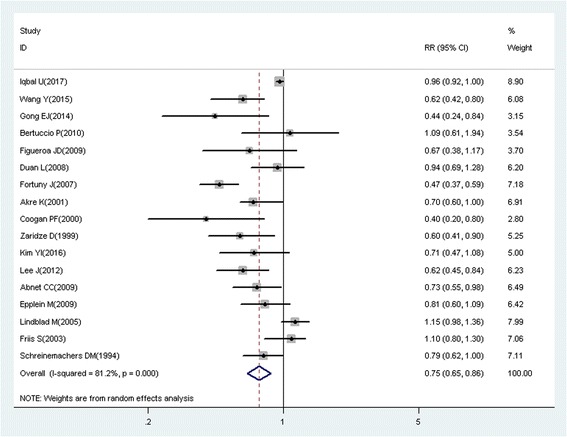
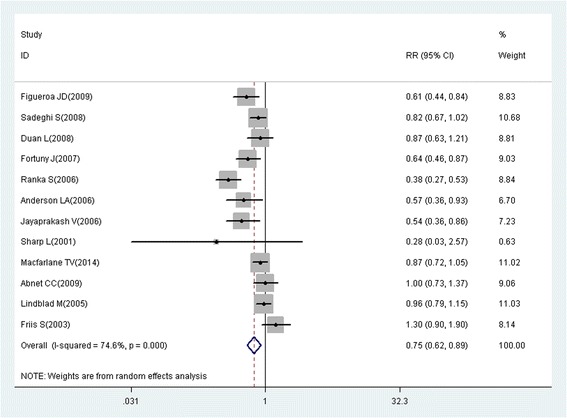
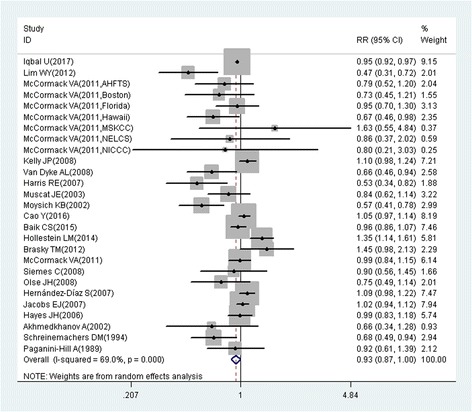
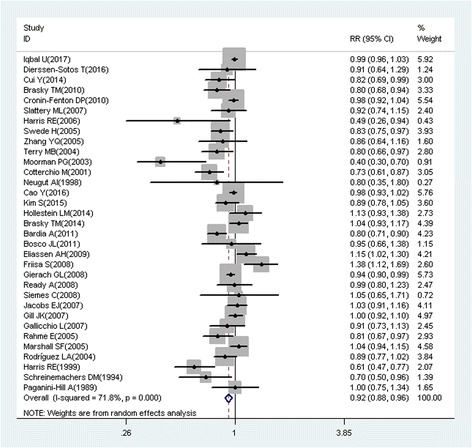
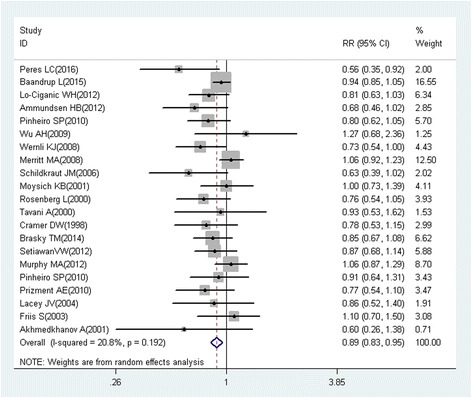
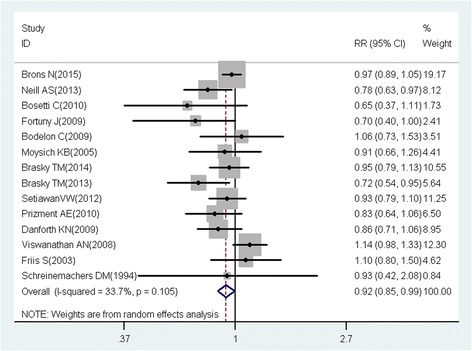
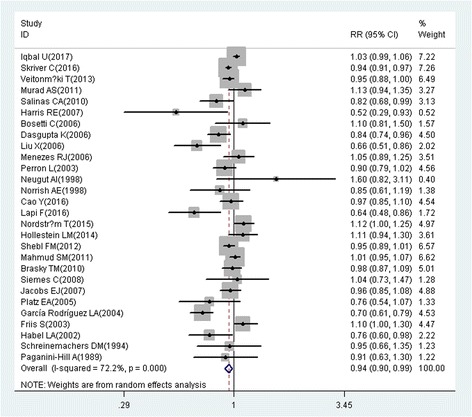
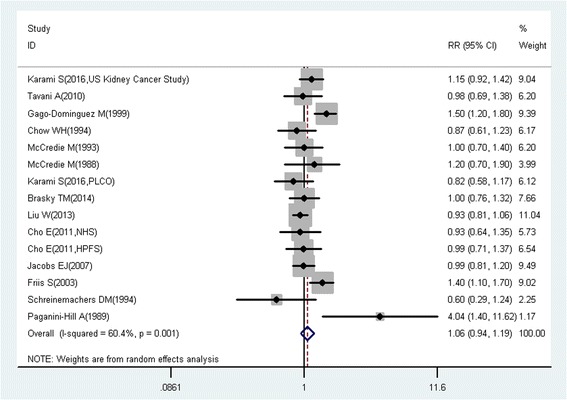
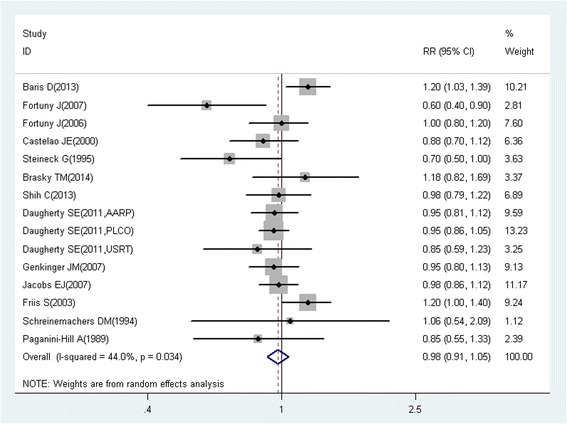
A total of 218 studies with 309 reports were eligible for this meta-analysis. Aspirin use was associated with a significant decrease in the risk of overall cancer (RR = 0.89, 95% CI: 0.87-0.91), and gastric (RR = 0.75, 95% CI: 0.65-0.86), esophageal (RR = 0.75, 95% CI: 0.62-0.89), colorectal (RR = 0.79, 95% CI: 0.74-0.85), pancreatic (RR = 0.80, 95% CI: 0.68-0.93), ovarian (RR = 0.89, 95% CI: 0.83-0.95), endometrial (RR = 0.92, 95% CI: 0.85-0.99), breast (RR = 0.92, 95% CI: 0.88-0.96), and prostate (RR = 0.94, 95% CI: 0.90-0.99) cancers, as well as small intestine neuroendocrine tumors (RR = 0.17, 95% CI: 0.05-0.58).

CONCLUSIONS

These findings suggest that aspirin use is associated with a reduced risk of gastric, esophageal, colorectal, pancreatic, ovarian, endometrial, breast, and prostate cancers, and small intestine neuroendocrine tumors.

摘要

背景

流行病学研究已经明确了常规使用阿司匹林与癌症之间的潜在关联。然而,阿司匹林的使用是否降低癌症风险仍存在争议。因此,我们进行了一项更新的荟萃分析,以评估阿司匹林的使用与癌症之间的关联。

方法

系统检索了 PubMed、Embase 和 Web of Science 数据库,以确定相关研究。使用相对风险(RR)及其 95%置信区间(CI)来评估关联的强度。

结果

共有 218 项研究和 309 项报告符合纳入标准。荟萃分析结果显示,阿司匹林的使用与总体癌症(RR=0.89,95%CI:0.87-0.91)、胃癌(RR=0.75,95%CI:0.65-0.86)、食管癌(RR=0.75,95%CI:0.62-0.89)、结直肠癌(RR=0.79,95%CI:0.74-0.85)、胰腺癌(RR=0.80,95%CI:0.68-0.93)、卵巢癌(RR=0.89,95%CI:0.83-0.95)、子宫内膜癌(RR=0.92,95%CI:0.85-0.99)、乳腺癌(RR=0.92,95%CI:0.88-0.96)和前列腺癌(RR=0.94,95%CI:0.90-0.99)以及小肠神经内分泌肿瘤(RR=0.17,95%CI:0.05-0.58)的风险降低相关。

结论

这些发现表明,阿司匹林的使用与胃癌、食管癌、结直肠癌、胰腺癌、卵巢癌、子宫内膜癌、乳腺癌和前列腺癌以及小肠神经内分泌肿瘤的风险降低相关。

https://cdn.ncbi.nlm.nih.gov/pmc/blobs/b59e/5851082/04b9d23b9385/12885_2018_4156_Fig19_HTML.jpg
https://cdn.ncbi.nlm.nih.gov/pmc/blobs/b59e/5851082/7e966bd68649/12885_2018_4156_Fig1_HTML.jpg
https://cdn.ncbi.nlm.nih.gov/pmc/blobs/b59e/5851082/c1d5978df17f/12885_2018_4156_Fig2_HTML.jpg
https://cdn.ncbi.nlm.nih.gov/pmc/blobs/b59e/5851082/d9b1e18faa04/12885_2018_4156_Fig3_HTML.jpg
https://cdn.ncbi.nlm.nih.gov/pmc/blobs/b59e/5851082/f9fab6cb08da/12885_2018_4156_Fig4_HTML.jpg
https://cdn.ncbi.nlm.nih.gov/pmc/blobs/b59e/5851082/791a9d3443da/12885_2018_4156_Fig5_HTML.jpg
https://cdn.ncbi.nlm.nih.gov/pmc/blobs/b59e/5851082/179b85843f7d/12885_2018_4156_Fig6_HTML.jpg
https://cdn.ncbi.nlm.nih.gov/pmc/blobs/b59e/5851082/4abab06ce308/12885_2018_4156_Fig7_HTML.jpg
https://cdn.ncbi.nlm.nih.gov/pmc/blobs/b59e/5851082/b6a60cc9d1ef/12885_2018_4156_Fig8_HTML.jpg
https://cdn.ncbi.nlm.nih.gov/pmc/blobs/b59e/5851082/bc43c9b358c4/12885_2018_4156_Fig9_HTML.jpg
https://cdn.ncbi.nlm.nih.gov/pmc/blobs/b59e/5851082/613800c82cd7/12885_2018_4156_Fig10_HTML.jpg
https://cdn.ncbi.nlm.nih.gov/pmc/blobs/b59e/5851082/3817baf93062/12885_2018_4156_Fig11_HTML.jpg
https://cdn.ncbi.nlm.nih.gov/pmc/blobs/b59e/5851082/e1db61f0124b/12885_2018_4156_Fig12_HTML.jpg
https://cdn.ncbi.nlm.nih.gov/pmc/blobs/b59e/5851082/3a9971d2c98d/12885_2018_4156_Fig13_HTML.jpg
https://cdn.ncbi.nlm.nih.gov/pmc/blobs/b59e/5851082/c6bcc706dc2a/12885_2018_4156_Fig14_HTML.jpg
https://cdn.ncbi.nlm.nih.gov/pmc/blobs/b59e/5851082/14524567782d/12885_2018_4156_Fig15_HTML.jpg
https://cdn.ncbi.nlm.nih.gov/pmc/blobs/b59e/5851082/4022378f66ab/12885_2018_4156_Fig16_HTML.jpg
https://cdn.ncbi.nlm.nih.gov/pmc/blobs/b59e/5851082/7d9c7a090a33/12885_2018_4156_Fig17_HTML.jpg
https://cdn.ncbi.nlm.nih.gov/pmc/blobs/b59e/5851082/d8b16364860b/12885_2018_4156_Fig18_HTML.jpg
https://cdn.ncbi.nlm.nih.gov/pmc/blobs/b59e/5851082/04b9d23b9385/12885_2018_4156_Fig19_HTML.jpg
https://cdn.ncbi.nlm.nih.gov/pmc/blobs/b59e/5851082/7e966bd68649/12885_2018_4156_Fig1_HTML.jpg
https://cdn.ncbi.nlm.nih.gov/pmc/blobs/b59e/5851082/c1d5978df17f/12885_2018_4156_Fig2_HTML.jpg
https://cdn.ncbi.nlm.nih.gov/pmc/blobs/b59e/5851082/d9b1e18faa04/12885_2018_4156_Fig3_HTML.jpg
https://cdn.ncbi.nlm.nih.gov/pmc/blobs/b59e/5851082/f9fab6cb08da/12885_2018_4156_Fig4_HTML.jpg
https://cdn.ncbi.nlm.nih.gov/pmc/blobs/b59e/5851082/791a9d3443da/12885_2018_4156_Fig5_HTML.jpg
https://cdn.ncbi.nlm.nih.gov/pmc/blobs/b59e/5851082/179b85843f7d/12885_2018_4156_Fig6_HTML.jpg
https://cdn.ncbi.nlm.nih.gov/pmc/blobs/b59e/5851082/4abab06ce308/12885_2018_4156_Fig7_HTML.jpg
https://cdn.ncbi.nlm.nih.gov/pmc/blobs/b59e/5851082/b6a60cc9d1ef/12885_2018_4156_Fig8_HTML.jpg
https://cdn.ncbi.nlm.nih.gov/pmc/blobs/b59e/5851082/bc43c9b358c4/12885_2018_4156_Fig9_HTML.jpg
https://cdn.ncbi.nlm.nih.gov/pmc/blobs/b59e/5851082/613800c82cd7/12885_2018_4156_Fig10_HTML.jpg
https://cdn.ncbi.nlm.nih.gov/pmc/blobs/b59e/5851082/3817baf93062/12885_2018_4156_Fig11_HTML.jpg
https://cdn.ncbi.nlm.nih.gov/pmc/blobs/b59e/5851082/e1db61f0124b/12885_2018_4156_Fig12_HTML.jpg
https://cdn.ncbi.nlm.nih.gov/pmc/blobs/b59e/5851082/3a9971d2c98d/12885_2018_4156_Fig13_HTML.jpg
https://cdn.ncbi.nlm.nih.gov/pmc/blobs/b59e/5851082/c6bcc706dc2a/12885_2018_4156_Fig14_HTML.jpg
https://cdn.ncbi.nlm.nih.gov/pmc/blobs/b59e/5851082/14524567782d/12885_2018_4156_Fig15_HTML.jpg
https://cdn.ncbi.nlm.nih.gov/pmc/blobs/b59e/5851082/4022378f66ab/12885_2018_4156_Fig16_HTML.jpg
https://cdn.ncbi.nlm.nih.gov/pmc/blobs/b59e/5851082/7d9c7a090a33/12885_2018_4156_Fig17_HTML.jpg
https://cdn.ncbi.nlm.nih.gov/pmc/blobs/b59e/5851082/d8b16364860b/12885_2018_4156_Fig18_HTML.jpg
https://cdn.ncbi.nlm.nih.gov/pmc/blobs/b59e/5851082/04b9d23b9385/12885_2018_4156_Fig19_HTML.jpg

相似文献

1
Associations between aspirin use and the risk of cancers: a meta-analysis of observational studies.阿司匹林使用与癌症风险的关联:观察性研究的荟萃分析。
BMC Cancer. 2018 Mar 13;18(1):288. doi: 10.1186/s12885-018-4156-5.
2
Aspirin and cancer risk: an updated quantitative review to 2005.阿司匹林与癌症风险:截至2005年的最新定量综述
Cancer Causes Control. 2006 Sep;17(7):871-88. doi: 10.1007/s10552-006-0033-7.
3
Effects of non-steroidal anti-inflammatory drugs on cancer sites other than the colon and rectum: a meta-analysis.非甾体抗炎药对结肠和直肠以外癌症部位的影响:一项荟萃分析。
BMC Cancer. 2003 Oct 31;3:28. doi: 10.1186/1471-2407-3-28.
4
Aspirin use and the risk of prostate cancer: a meta-analysis of 24 epidemiologic studies.阿司匹林的使用与前列腺癌风险:24项流行病学研究的荟萃分析
Int Urol Nephrol. 2014 Sep;46(9):1715-28. doi: 10.1007/s11255-014-0703-4. Epub 2014 Apr 1.
5
Aspirin and the risk of nondigestive tract cancers: An updated meta-analysis to 2019.阿司匹林与非消化道癌症风险:更新至 2019 年的荟萃分析。
Int J Cancer. 2021 Mar 15;148(6):1372-1382. doi: 10.1002/ijc.33311. Epub 2020 Oct 6.
6
Relationship between aspirin use of esophageal, gastric and colorectal cancer patient survival: a meta-analysis.阿司匹林使用与食管、胃和结直肠癌患者生存关系的Meta 分析。
BMC Cancer. 2020 Jul 9;20(1):638. doi: 10.1186/s12885-020-07117-4.
7
A large cohort study of long-term daily use of adult-strength aspirin and cancer incidence.一项关于长期每日服用成人剂量阿司匹林与癌症发病率的大型队列研究。
J Natl Cancer Inst. 2007 Apr 18;99(8):608-15. doi: 10.1093/jnci/djk132.
8
Aspirin Use and Risk of Breast Cancer: A Meta-analysis of Observational Studies from 1989 to 2019.阿司匹林的使用与乳腺癌风险:一项 1989 年至 2019 年观察性研究的荟萃分析。
Clin Breast Cancer. 2021 Dec;21(6):552-565. doi: 10.1016/j.clbc.2021.02.005. Epub 2021 Feb 17.
9
Aspirin might reduce the incidence of breast cancer: An updated meta-analysis of 38 observational studies.阿司匹林可能降低乳腺癌发病率:38项观察性研究的最新荟萃分析
Medicine (Baltimore). 2020 Sep 18;99(38):e21917. doi: 10.1097/MD.0000000000021917.
10
Nonsteroidal anti-inflammatory drugs and risk of ovarian cancer: systematic review and meta-analysis of observational studies.非甾体抗炎药与卵巢癌风险:观察性研究的系统评价和荟萃分析。
Acta Obstet Gynecol Scand. 2013 Mar;92(3):245-55. doi: 10.1111/aogs.12069. Epub 2013 Jan 22.

引用本文的文献

1
Risk factors for gastric cancer: an umbrella review of systematic reviews and meta-analyses.胃癌的危险因素:系统评价和荟萃分析的伞状综述
Front Oncol. 2025 Jun 26;15:1564575. doi: 10.3389/fonc.2025.1564575. eCollection 2025.
2
Drug combination-wide association studies of cancer.癌症的药物联合全基因组关联研究。
Commun Med (Lond). 2025 Jul 9;5(1):285. doi: 10.1038/s43856-025-00991-8.
3
Aspirin Use Is Protective Against Gastric Cancer in a High-Incidence Region of Central America.在中美洲的一个高发病地区,使用阿司匹林对胃癌具有保护作用。

本文引用的文献

1
Aspirin induces cell death by directly modulating mitochondrial voltage-dependent anion channel (VDAC).阿司匹林通过直接调节线粒体电压依赖性阴离子通道(VDAC)诱导细胞死亡。
Sci Rep. 2017 Mar 22;7:45184. doi: 10.1038/srep45184.
2
Aspirin-Induced Chemoprevention and Response Kinetics Are Enhanced by PIK3CA Mutations in Colorectal Cancer Cells.PIK3CA突变增强了阿司匹林诱导的结直肠癌细胞化学预防作用及反应动力学。
Cancer Prev Res (Phila). 2017 Mar;10(3):208-218. doi: 10.1158/1940-6207.CAPR-16-0175. Epub 2017 Feb 2.
3
Aspirin Use and Reduced Risk of Pancreatic Cancer.
Dig Dis Sci. 2025 Jun 6. doi: 10.1007/s10620-025-09042-7.
4
Targeting platelet-tumor cell interactions: a novel approach to cancer therapy.靶向血小板-肿瘤细胞相互作用:一种癌症治疗的新方法。
Med Oncol. 2025 Jun 2;42(7):232. doi: 10.1007/s12032-025-02787-1.
5
Risk factors for breast cancer: an umbrella review of observational cohort studies and causal relationship analysis.乳腺癌的危险因素:观察性队列研究的综合评价及因果关系分析
Front Oncol. 2025 May 2;15:1541233. doi: 10.3389/fonc.2025.1541233. eCollection 2025.
6
Proteomic Profiling Informs Mechanisms of Esophageal Adenocarcinoma Inhibition by Cranberry Proanthocyanidins.蛋白质组学分析揭示蔓越莓原花青素抑制食管腺癌的机制
Mol Nutr Food Res. 2025 Aug;69(15):e70102. doi: 10.1002/mnfr.70102. Epub 2025 May 12.
7
Role of Phytonutrients in the Prevention and Treatment of Chronic Diseases: A Concrete Review.植物营养素在慢性病预防和治疗中的作用:一项具体综述。
ACS Omega. 2025 Mar 27;10(13):12724-12755. doi: 10.1021/acsomega.4c02927. eCollection 2025 Apr 8.
8
Non-steroidal anti-inflammatory drugs and risk of kidney cancer: A Swedish nationwide cohort study in the general and high-use populations.非甾体抗炎药与肾癌风险:瑞典全国性队列研究,涵盖普通人群和高使用量人群
J Intern Med. 2025 May;297(5):505-517. doi: 10.1111/joim.20079. Epub 2025 Mar 10.
9
Aspirin use reduces cancer risk in betel nut chewers: a nationwide population-based cohort study.阿司匹林的使用可降低嚼槟榔者患癌风险:一项基于全国人口的队列研究。
Am J Cancer Res. 2024 Dec 15;14(12):5921-5934. doi: 10.62347/JXMI9007. eCollection 2024.
10
Association between sulfur microbial diet and the risk of esophageal cancer: a prospective cohort study in 101,752 American adults.硫微生物饮食与食管癌风险的关联:101752 名美国成年人的前瞻性队列研究。
Nutr J. 2024 Nov 7;23(1):139. doi: 10.1186/s12937-024-01035-y.
阿司匹林的使用与胰腺癌风险降低
Cancer Epidemiol Biomarkers Prev. 2017 Jan;26(1):68-74. doi: 10.1158/1055-9965.EPI-16-0508. Epub 2016 Dec 20.
4
Aspirin and non-steroidal anti-inflammatory drugs use reduce gastric cancer risk: A dose-response meta-analysis.阿司匹林和非甾体抗炎药的使用可降低胃癌风险:一项剂量反应荟萃分析。
Oncotarget. 2017 Jan 17;8(3):4781-4795. doi: 10.18632/oncotarget.13591.
5
Effect of statin on hepatocellular carcinoma in patients with type 2 diabetes: A nationwide nested case-control study.他汀类药物对2型糖尿病患者肝细胞癌的影响:一项全国性巢式病例对照研究。
Int J Cancer. 2017 Feb 15;140(4):798-806. doi: 10.1002/ijc.30506. Epub 2016 Nov 16.
6
Nonsteroidal anti-inflammatory drugs, statins, and pancreatic cancer risk: a population-based case-control study.非甾体抗炎药、他汀类药物与胰腺癌风险:一项基于人群的病例对照研究。
Cancer Causes Control. 2016 Dec;27(12):1457-1464. doi: 10.1007/s10552-016-0824-4. Epub 2016 Nov 5.
7
Does aspirin use reduce the risk for cancer?服用阿司匹林是否能降低患癌风险?
J Investig Med. 2017 Feb;65(2):391-392. doi: 10.1136/jim-2016-000275. Epub 2016 Oct 27.
8
Exploring Differences in the Aspirin-Colorectal Cancer Association by Sex and Race/Ethnicity: The Multiethnic Cohort Study.按性别和种族/民族探究阿司匹林与结直肠癌关联的差异:多民族队列研究
Cancer Epidemiol Biomarkers Prev. 2017 Feb;26(2):162-169. doi: 10.1158/1055-9965.EPI-16-0560. Epub 2016 Oct 10.
9
Aspirin use and the incidence of breast, colon, ovarian, and pancreatic cancers in elderly women in the Iowa Women's Health Study.爱荷华州女性健康研究中阿司匹林的使用与老年女性乳腺癌、结肠癌、卵巢癌和胰腺癌的发病率
Cancer Causes Control. 2016 Nov;27(11):1395-1402. doi: 10.1007/s10552-016-0804-8. Epub 2016 Sep 27.
10
Use of non-steroidal anti-inflammatory drugs and risk of breast cancer: The Spanish Multi-Case-control (MCC) study.非甾体抗炎药的使用与乳腺癌风险:西班牙多病例对照研究
BMC Cancer. 2016 Aug 20;16(1):660. doi: 10.1186/s12885-016-2692-4.