Division of Quantitative Methods and Modeling, Office of Research and Standards, Office of Generic Drugs, Center for Drug Evaluation and Research, Food and Drug Administration, Silver Spring, Maryland, USA.
Clin Transl Sci. 2018 May;11(3):305-311. doi: 10.1111/cts.12541. Epub 2018 Mar 13.
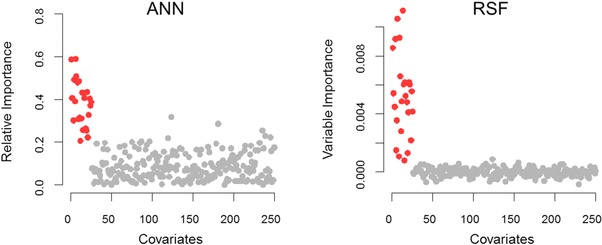
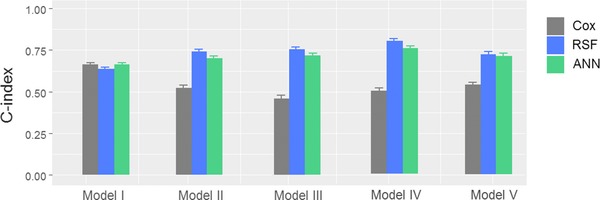
Additional value can be potentially created by applying big data tools to address pharmacometric problems. The performances of machine learning (ML) methods and the Cox regression model were evaluated based on simulated time-to-event data synthesized under various preset scenarios, i.e., with linear vs. nonlinear and dependent vs. independent predictors in the proportional hazard function, or with high-dimensional data featured by a large number of predictor variables. Our results showed that ML-based methods outperformed the Cox model in prediction performance as assessed by concordance index and in identifying the preset influential variables for high-dimensional data. The prediction performances of ML-based methods are also less sensitive to data size and censoring rates than the Cox regression model. In conclusion, ML-based methods provide a powerful tool for time-to-event analysis, with a built-in capacity for high-dimensional data and better performance when the predictor variables assume nonlinear relationships in the hazard function.
通过应用大数据工具来解决药物计量学问题,可以创造额外的价值。基于各种预设场景下合成的模拟生存时间数据,评估了机器学习 (ML) 方法和 Cox 回归模型的性能,例如,在比例风险函数中具有线性与非线性以及相依与独立预测因子,或者在具有大量预测变量的高维数据中。我们的研究结果表明,基于 ML 的方法在预测性能(通过一致性指数评估)和识别高维数据中预设的有影响的变量方面优于 Cox 模型。基于 ML 的方法的预测性能对数据量和删失率的敏感性也低于 Cox 回归模型。总之,基于 ML 的方法为生存时间分析提供了一种强大的工具,具有内置的处理高维数据的能力,并且在预测因子在危险函数中呈现非线性关系时具有更好的性能。