Marschalek Marie-Louise, Worda Christof, Kuessel Lorenz, Koelbl Heinz, Oberaigner Willi, Leitner Hermann, Marschalek Julian, Husslein Heinrich
Department of Obstetrics and Gynecology, Medical University Vienna, Vienna, Austria.
Division of Obstetrics and Feto-Maternal Medicine, Department of Obstetrics and Gynecology, Medical University Vienna, Vienna, Austria.
Birth. 2018 Dec;45(4):409-415. doi: 10.1111/birt.12346. Epub 2018 Mar 14.
In view of the reported increase in obstetric anal sphincter injuries, the objective of this study was to evaluate the incidence of such injuries over time and the associated risk and protective factors.
This was a retrospective cohort study from a national database of 168 137 primiparous women with term, singleton, cephalic, vaginal delivery between 2008 and 2014. The main outcome measure was obstetric anal sphincter injury. A multivariate regression model was used to identify risk and protective factors.
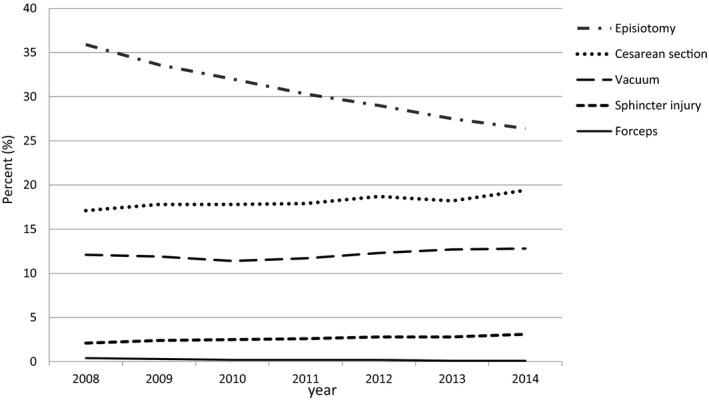
Age >19 years, birthweight >4000 g, and operative vaginal delivery were independent risk factors for obstetric anal sphincter injuries. Mediolateral episiotomy increased the risk for obstetric anal sphincter injuries in spontaneous vaginal birth (number needed to harm 333), whereas it was protective in vacuum delivery (number needed to treat 50). From 2008 to 2014, there was an increase in the rate of obstetric anal sphincter injuries (2.1% vs 3.1%, P < .01), vacuum deliveries (12.1% vs 12.8%, P < .01), and cesarean delivery after labor (17.1% vs 19.4%, P < .01), while forceps deliveries (0.4% vs 0.1%, P < .01) and episiotomy rate decreased (35.9% vs 26.4%, P < .01).
Episiotomy may be a risk or protective factor depending on the type of episiotomy and the clinical setting in which it is used. Our study supports a restrictive use of mediolateral episiotomy in spontaneous vaginal deliveries. In vacuum deliveries mediolateral episiotomy may help prevent obstetric anal sphincter injuries.
鉴于有报道称产科肛门括约肌损伤有所增加,本研究的目的是评估此类损伤随时间的发生率以及相关的风险和保护因素。
这是一项回顾性队列研究,数据来自一个全国性数据库,该数据库包含2008年至2014年间168137例足月、单胎、头位、经阴道分娩的初产妇。主要结局指标是产科肛门括约肌损伤。采用多变量回归模型来确定风险和保护因素。
年龄>19岁、出生体重>4000g以及阴道助产是产科肛门括约肌损伤的独立危险因素。会阴侧切术增加了自然阴道分娩时产科肛门括约肌损伤的风险(伤害所需人数为333),而在真空吸引分娩中则具有保护作用(治疗所需人数为50)。从2008年到2014年,产科肛门括约肌损伤率(2.1%对3.1%,P<.01)、真空吸引分娩率(12.1%对12.8%,P<.01)以及产程后剖宫产率(17.1%对19.4%,P<.01)均有所上升,而产钳助产率(0.4%对0.1%,P<.01)和会阴侧切率下降(35.9%对26.4%,P<.01)。
会阴侧切术可能是一个风险因素或保护因素,这取决于会阴侧切术的类型及其使用的临床情况。我们的研究支持在自然阴道分娩中限制使用会阴侧切术。在真空吸引分娩中,会阴侧切术可能有助于预防产科肛门括约肌损伤。