Martin Jessica E, Sandercock Dale A, Sandilands Victoria, Sparrey Julian, Baker Laurence, Sparks Nick H C, McKeegan Dorothy E F
The Royal (Dick) School of Veterinary Studies and The Roslin Institute, Easter Bush Campus, The University of Edinburgh, Edinburgh EH25 9RG, UK.
Animal and Veterinary Science Research Group, Scotland's Rural College (SRUC), West Mains Road, Edinburgh EH16 4SA, UK.
Animals (Basel). 2018 Mar 15;8(3):39. doi: 10.3390/ani8030039.
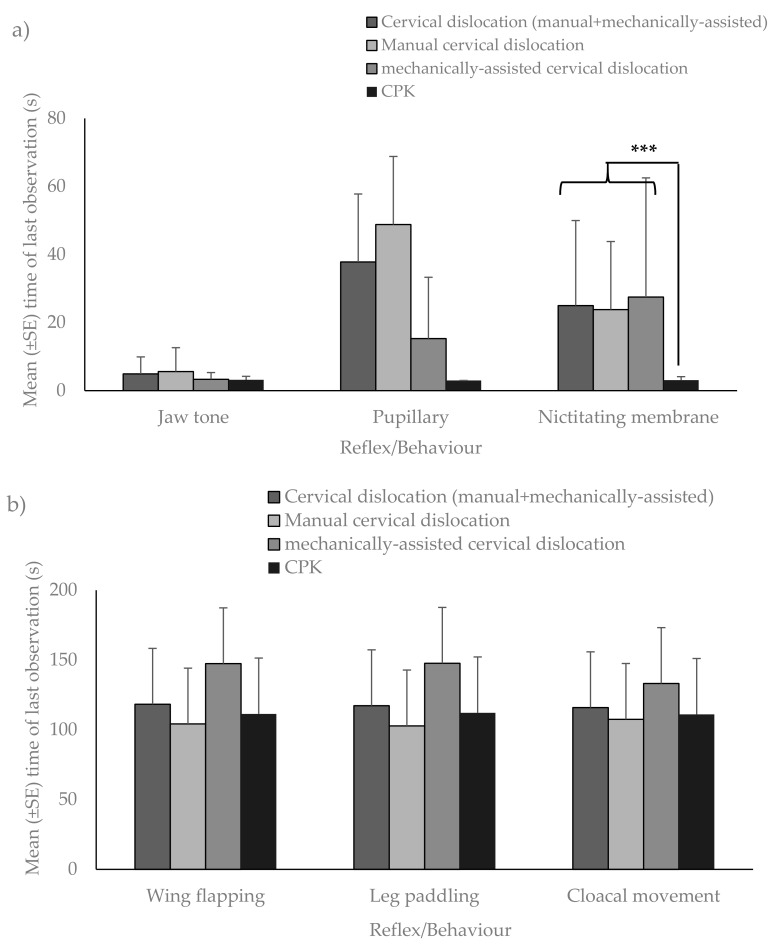
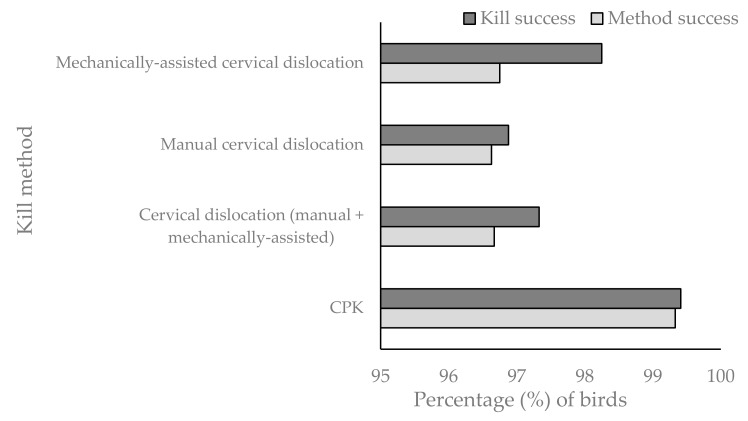
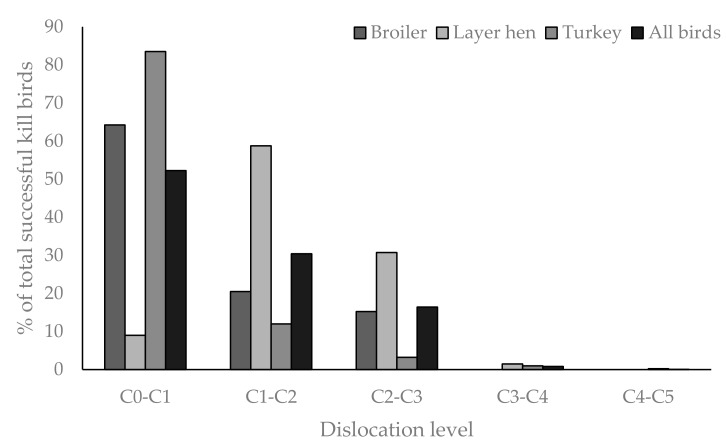
Council Regulation (EC) no. 1099/2009 on the protection of animals at the time of killing restricts the use of manual cervical dislocation in poultry on farms in the European Union (EU) to birds weighing up to 3 kg and 70 birds per person per day. However, few studies have examined whether repeated application of manual cervical dislocation has welfare implications and whether these are dependent on individual operator skill or susceptibility to fatigue. We investigated the effects of repeated application (100 birds at a fixed killing rate of 1 bird per 2 min) and multiple operators on two methods of killing of broilers, laying hens, and turkeys in commercial settings. We compared the efficacy and welfare impact of repeated application of cervical dislocation and a percussive killer (Cash Poultry Killer, CPK), using 12 male stockworkers on three farms (one farm per bird type). Both methods achieved over 96% kill success at the first attempt. The killing methods were equally effective for each bird type and there was no evidence of reduced performance with time and/or bird number. Both methods of killing caused a rapid loss of reflexes, indicating loss of brain function. There was more variation in reflex durations and post-mortem damage in birds killed by cervical dislocation than that found using CPK. High neck dislocation was associated with improved kill success and more rapid loss of reflexes. The CPK caused damage to multiple brain areas with little variation. Overall, the CPK was associated with faster abolition of reflexes, with fewer birds exhibiting them at all, suggestive of better welfare outcomes. However, technical difficulties with the CPK highlighted the advantages of cervical dislocation, which can be performed immediately with no equipment. At the killing rates tested, we did not find evidence to justify the current EU limit on the number of birds that one operator can kill on-farm by manual cervical dislocation.
欧盟理事会第1099/2009号关于宰杀动物时动物保护的条例,将欧盟各农场对家禽实施的手动颈椎脱臼法的适用范围限制为体重不超过3千克的禽类,且每人每天宰杀70只。然而,很少有研究探讨重复实施手动颈椎脱臼法是否会对动物福利产生影响,以及这些影响是否取决于个体操作人员的技能或疲劳易感性。我们调查了在商业环境中对肉鸡、蛋鸡和火鸡重复实施(以每分钟1只的固定宰杀速度宰杀100只)以及由多名操作人员使用两种宰杀方法的效果。我们比较了重复实施颈椎脱臼法和一种冲击式宰杀器(Cash家禽宰杀器,CPK)的效果及对动物福利的影响,在三个农场(每种禽类一个农场)安排了12名男性饲养员进行操作。两种方法在首次尝试时的宰杀成功率均超过96%。每种禽类的两种宰杀方法效果相同,没有证据表明随着时间推移和/或禽类数量增加宰杀效果会降低。两种宰杀方法均导致反射迅速消失,表明脑功能丧失。与使用CPK宰杀的禽类相比,颈椎脱臼法宰杀的禽类反射持续时间和死后损伤的差异更大。高位颈椎脱臼与更高的宰杀成功率和更快的反射消失相关。CPK会对多个脑区造成损伤,且差异较小。总体而言,CPK与反射更快消失相关,表现出反射的禽类更少,这表明动物福利结果更好。然而,CPK的技术难题凸显了颈椎脱臼法的优势,即无需设备即可立即进行操作。在所测试的宰杀速度下,我们没有找到证据支持欧盟目前对操作人员在农场通过手动颈椎脱臼法宰杀禽类数量的限制。