Zha Tianzhou, Wu Haorong
Department of General Surgery, The Second Affiliated Hospital of Soochow University, Suzhou, Jiangsu 215004, P.R. China.
Department of General Surgery, The Affiliated Yixing Hospital of Jiangsu University, Yixing, Jiangsu 214200, P.R. China.
Exp Ther Med. 2018 Apr;15(4):3357-3361. doi: 10.3892/etm.2018.5859. Epub 2018 Feb 12.
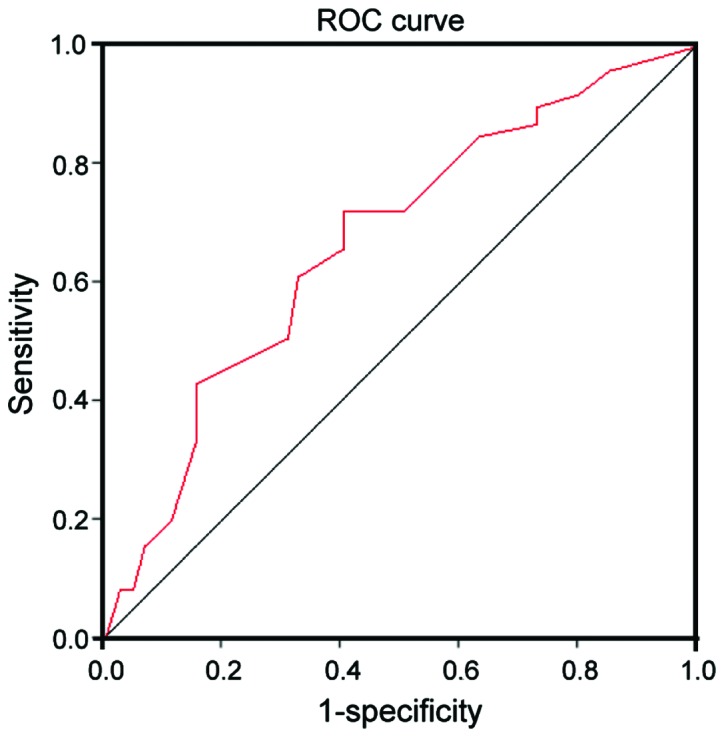
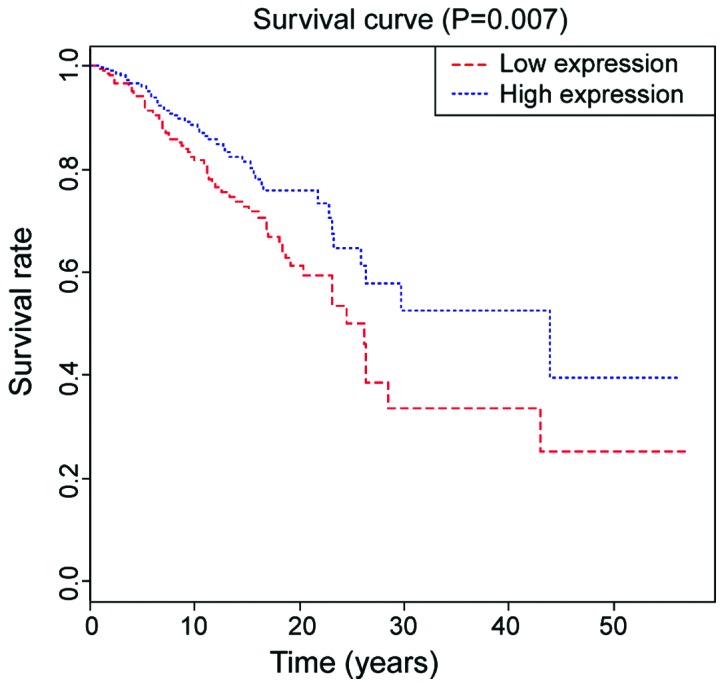
This study investigated the expression of adenosine monophosphate deaminase 1 (AMPD1) in serum of patients with papillary thyroid carcinoma (PTC) and its clinical significance. The expression levels of AMPD1 mRNA in serum of 157 patients with PTC and 100 normal controls were detected by real-time fluorescent quantitative polymerase chain reaction (PCR), and the relationships between expression level of AMPD1 in serum of PTC patients and clinicopathological factors as well as prognosis were analyzed. The results of real-time fluorescent quantitative PCR showed that the expression of AMPD1 mRNA in serum of PTC patients was lower than that in normal human serum (P<0.01). The expression of AMPD1 in serum of PTC patients was not significantly different from the clinicopathological features such as sex, age, lymph node metastasis and the number of lesions (P>0.05); there were distinct differences between its expression and tumor-node-metastasis (TNM) staging and tumor diameter (P<0.05). The single factor Cox analysis revealed that sex, age, number of lesions, TNM staging and the occurrence of lymph node metastasis were significantly correlated with the prognosis of patients (P<0.05). Multivariate Cox analysis showed that TNM staging hazard ratio (HR)=2.93, 95% confidence interval (CI): 1.52-7.04, P=0.015 was an independent prognostic factor in PTC patients. Survival analysis indicated that there was a statistically significant difference in the 5-year overall survival rate between patients with high expression of AMPD1 and those with low expression (P=0.007). In conclusion, the expression of AMPD1 in serum of patients with PTC is closely related to the malignant evolution of PTC and clinical prognosis of patients. AMPD1 is expected to become an important molecule in judging the clinical prognosis of PTC patients, and may become a new target for molecular targeted therapy of PTC.
本研究探讨了甲状腺乳头状癌(PTC)患者血清中腺苷单磷酸脱氨酶1(AMPD1)的表达及其临床意义。采用实时荧光定量聚合酶链反应(PCR)检测157例PTC患者和100例正常对照者血清中AMPD1 mRNA的表达水平,并分析PTC患者血清中AMPD1表达水平与临床病理因素及预后的关系。实时荧光定量PCR结果显示,PTC患者血清中AMPD1 mRNA的表达低于正常人血清(P<0.01)。PTC患者血清中AMPD1的表达与性别、年龄、淋巴结转移及病灶数量等临床病理特征无明显差异(P>0.05);其表达与肿瘤-淋巴结-转移(TNM)分期及肿瘤直径有明显差异(P<0.05)。单因素Cox分析显示,性别、年龄、病灶数量、TNM分期及淋巴结转移的发生与患者预后显著相关(P<0.05)。多因素Cox分析显示,TNM分期风险比(HR)=2.93,95%置信区间(CI):1.52-7.04,P=0.015是PTC患者的独立预后因素。生存分析表明,AMPD1高表达患者与低表达患者的5年总生存率差异有统计学意义(P=0.007)。综上所述,PTC患者血清中AMPD1的表达与PTC的恶性进展及患者的临床预后密切相关。AMPD1有望成为判断PTC患者临床预后的重要分子,并可能成为PTC分子靶向治疗的新靶点。