1 Faculty of Dentistry, 5620 McGill University , Montreal, QC, Canada.
2 The Alan Edwards Centre for Research on Pain, 5620 McGill University , Montreal, QC, Canada.
Mol Pain. 2018 Jan-Dec;14:1744806918764979. doi: 10.1177/1744806918764979.
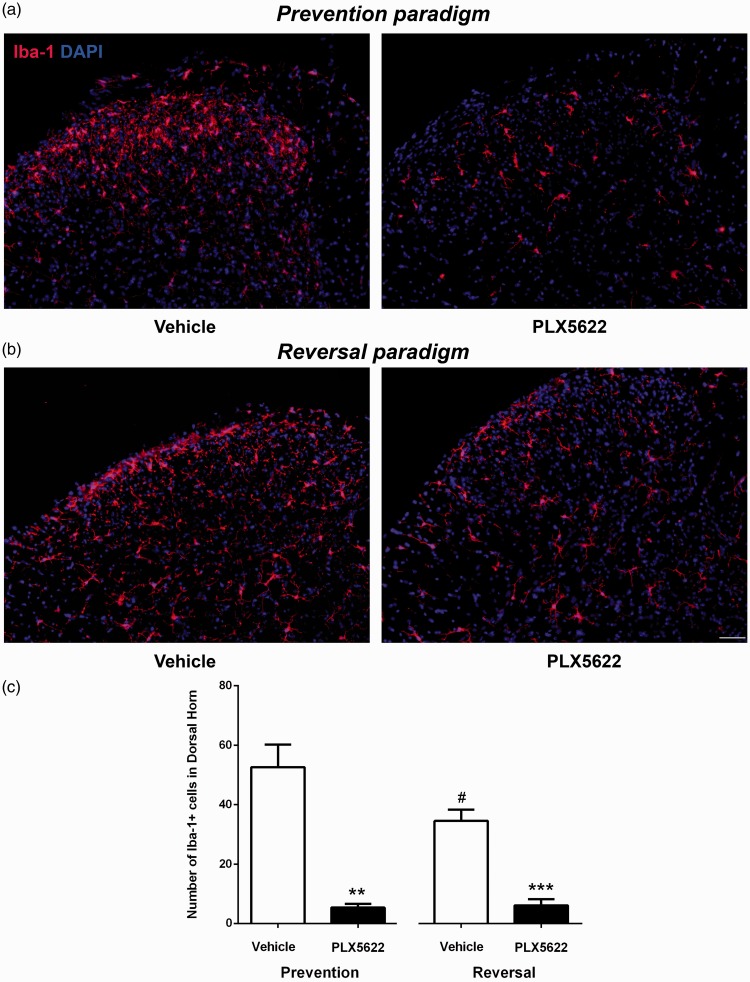
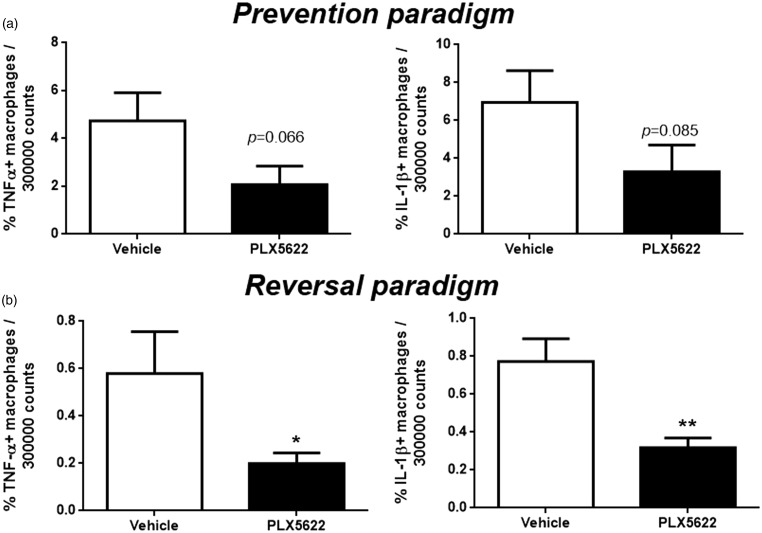
Introduction Neuropathic pain is a debilitating condition. The importance of neuroimmune interactions in neuropathic pain has been evidenced by the involvement of different immune cells in peripheral and central sensitization of pathological pain. Macrophages and microglia are the most abundant immune cells activated in injured nerves and spinal cord, respectively. Several lines of evidence showed that macrophage/microglia survival, activation, proliferation, and differentiation require the involvement of macrophage-colony stimulating factor. In this study, we investigated whether blocking macrophage-colony stimulating factor/colony stimulating factor 1 receptor signaling can be effective in relieving neuropathic pain. Materials and methods Partial sciatic nerve ligation was performed in mice to induce neuropathic pain behavior. Mice were orally treated with a selective colony stimulating factor 1 receptor inhibitor, PLX5622, daily in both preventive (two days prior to surgery until D14 post-partial sciatic nerve ligation) and reversal paradigms (D28-D33 post-partial sciatic nerve ligation). Animal neuropathic pain behavior was monitored using von Frey hairs and acetone application. Phenotype of macrophages in injured nerves was analyzed at D3 and D33 post-injury using flow cytometry analysis. The effect of PLX5622 on microglia activation in lumbar spinal cord was further examined by immunohistochemistry using Iba-1 antibody. Results Significant alleviation of both mechanical and cold allodynia was observed in PLX5622-treated animals, both in preventive and reversal paradigms. PLX5622 treatment reduced the total number of macrophages in injured nerves, it appears colony stimulating factor 1 receptor inhibition affected more specifically CD86 (M1 like) macrophages. Consequently, the expression of various pro-inflammatory cytokines (TNF-α, IL-1β) was reduced. Microglia activation in dorsal horn of lumbar spinal cord following partial sciatic nerve ligation was significantly inhibited with PLX5622 treatment in both preventive and reversal paradigms. Conclusion Macrophages in peripheral nerve and microglia in the spinal cord are required in the generation and maintenance of injury-associated neuropathic pain. Blocking macrophage-colony stimulating factor/colony stimulating factor 1 receptor signaling on these myeloid cells along the pain transmission pathway is an effective strategy to alleviate neuropathic pain.
介绍
神经病理性疼痛是一种使人虚弱的疾病。神经免疫相互作用在神经病理性疼痛中的重要性已被不同的免疫细胞参与病理性疼痛的外周和中枢敏化所证明。小胶质细胞和巨噬细胞分别是受伤神经和脊髓中最丰富的激活免疫细胞。有几条证据表明,巨噬细胞/小胶质细胞的存活、激活、增殖和分化需要巨噬细胞集落刺激因子的参与。在这项研究中,我们研究了阻断巨噬细胞集落刺激因子/集落刺激因子 1 受体信号是否能有效缓解神经病理性疼痛。
材料和方法
在小鼠中进行部分坐骨神经结扎以诱导神经病理性疼痛行为。小鼠每天口服选择性集落刺激因子 1 受体抑制剂 PLX5622,在预防性(手术前两天至部分坐骨神经结扎后 14 天)和逆转范式(部分坐骨神经结扎后 28-33 天)中进行。使用 von Frey 毛发和丙酮应用监测动物的神经病理性疼痛行为。在损伤后第 3 天和第 33 天,使用流式细胞术分析损伤神经中的巨噬细胞表型。使用 Iba-1 抗体通过免疫组织化学进一步检查 PLX5622 对腰椎脊髓中小胶质细胞激活的影响。
结果
在预防性和逆转范式中,PLX5622 治疗的动物均观察到机械性和冷感觉过敏的显著缓解。PLX5622 治疗减少了损伤神经中的巨噬细胞总数,似乎集落刺激因子 1 受体抑制更特异性地影响 CD86(M1 样)巨噬细胞。因此,各种促炎细胞因子(TNF-α,IL-1β)的表达减少。在预防性和逆转范式中,PLX5622 治疗显著抑制了部分坐骨神经结扎后腰椎脊髓背角的小胶质细胞激活。
结论
外周神经中的巨噬细胞和脊髓中的小胶质细胞参与了与损伤相关的神经病理性疼痛的产生和维持。阻断疼痛传递途径中这些髓样细胞上的巨噬细胞集落刺激因子/集落刺激因子 1 受体信号是缓解神经病理性疼痛的有效策略。