Department of Epidemiology and Health Statistics, School of Public Health, Xi'an Jiaotong University Health Science Center, Xi'an, China.
Clinical Trial Service Unit and Epidemiological Studies Unit, Nuffield Department of Population Health, University of Oxford, Oxford, UK.
Lancet Public Health. 2018 Apr;3(4):e167-e176. doi: 10.1016/S2468-2667(18)30026-4. Epub 2018 Mar 13.
In developed countries, smoking is associated with increased risk of diabetes. Little is known about the association in China, where cigarette consumption has increased (first in urban, then in rural areas) relatively recently. Moreover, uncertainty remains about the effect of smoking cessation on diabetes in China and elsewhere. We aimed to assess the associations of smoking and smoking cessation with risk of incident diabetes among Chinese adults.
The prospective China Kadoorie Biobank enrolled 512 891 adults (59% women) aged 30-79 years during 2004-08 from ten diverse areas (five urban and five rural) across China. Participants were interviewed at study assessment clinics, underwent physical measurements, and had a non-fasting blood sample taken. Participants were separated into four categories according to smoking history: never-smokers, ever-regular smokers, ex-smokers, and occasional smokers. Incident diabetes cases were identified through linkage with diabetes surveillance systems, the national health insurance system, and death registries. All analyses were done separately in men and women and Cox regression was used to yield adjusted hazards ratios (HRs) for diabetes associated with smoking.
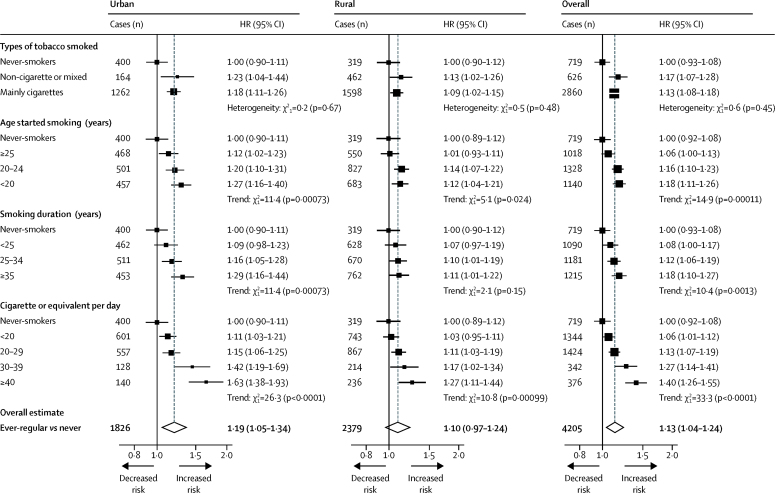
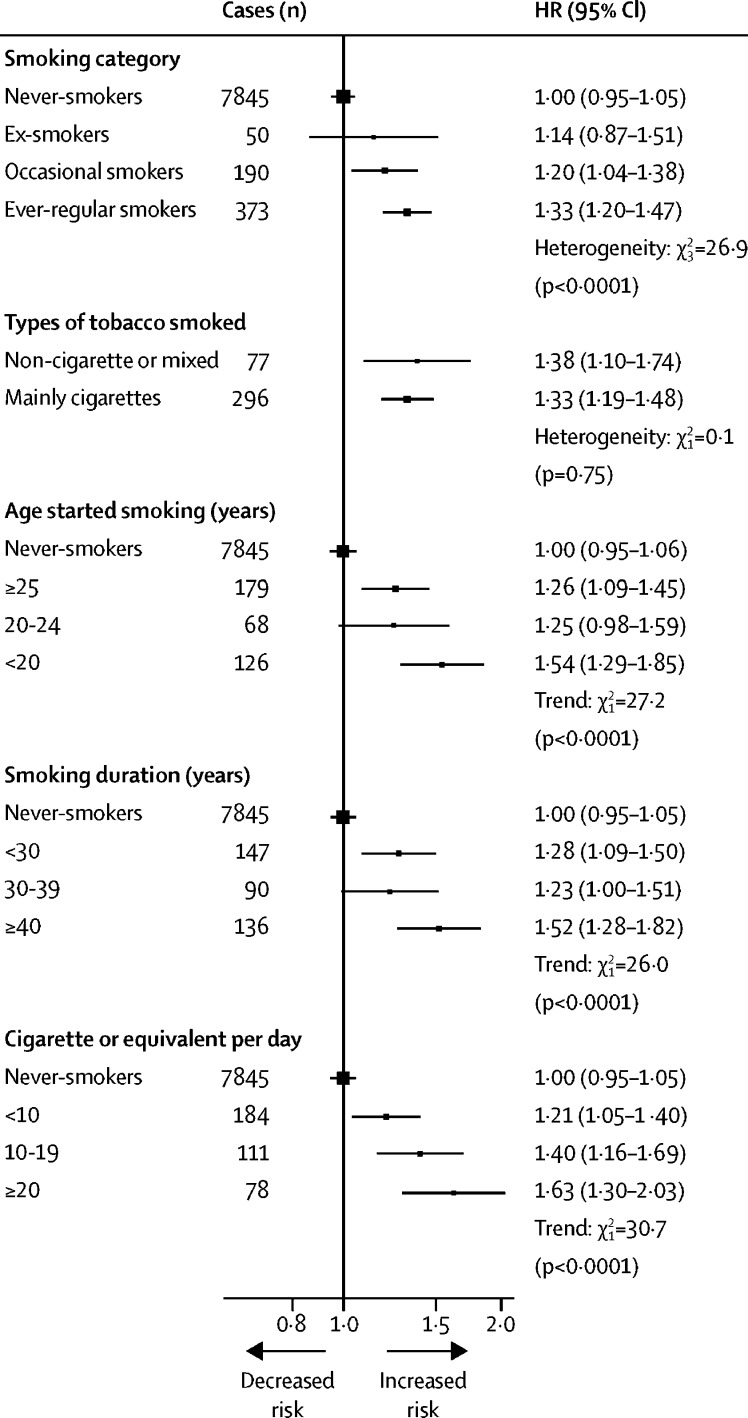
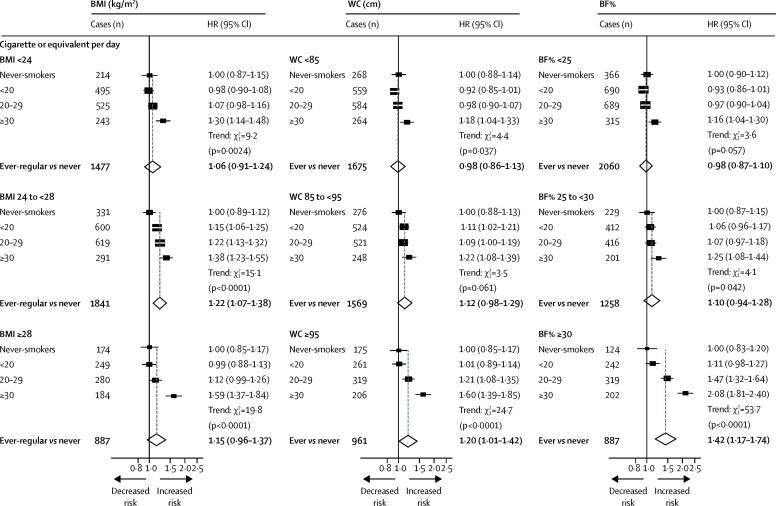
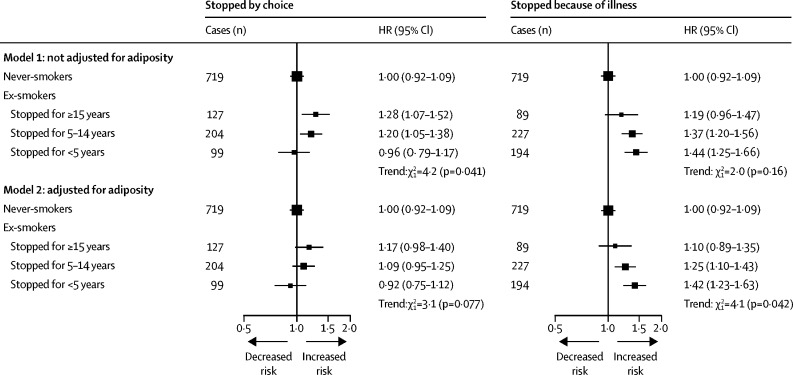
68% (n=134 975) of men ever smoked regularly compared with 3% (n=7811) of women. During 9 years' follow-up, 13 652 new-onset diabetes cases were recorded among 482 589 participants without previous diabetes. Among urban men, smokers had an adjusted HR of 1·18 (95% CI 1·12-1·25) for diabetes. HRs increased with younger age at first smoking regularly (1·12, 1·20, and 1·27 at ≥25 years, 20-24 years, and <20 years, respectively; p for trend=0·00073) and with greater amount smoked (1·11, 1·15, 1·42, and 1·63 for <20, 20-29, 30-39 and ≥40 cigarettes per day; p for trend<0·0001). Among rural men, similar, albeit more modest, associations were seen. Overall, HRs were more extreme at higher levels of adiposity. Among men who stopped by choice, there was no excess risk within 5 years of cessation, contrasting with those who stopped because of illness (0·92 [0·75-1·12] vs 1·42 [1·23-1·63]). Among the few women who ever smoked regularly, the excess risk of diabetes was significant (1·33 [1·20-1·47]).
Among Chinese adults, smoking was associated with increased risk of diabetes, with no significant excess risk following voluntary smoking cessation.
Wellcome Trust, Medical Research Council, British Heart Foundation, Cancer Research UK, Kadoorie Charitable Foundation, Ministry of Science and Technology, National Natural Science Foundation of China, and China Scholarship Council.
在发达国家,吸烟与糖尿病风险增加有关。在中国,吸烟与糖尿病风险的关联鲜为人知,中国的香烟消费相对较新(首先在城市,然后在农村)。此外,在中国和其他地方,戒烟对糖尿病的影响仍存在不确定性。我们旨在评估中国成年人吸烟和戒烟与糖尿病发病风险的关系。
前瞻性的中国慢性病前瞻性研究(CKB)于 2004 年 8 月期间,从中国十个不同地区(五个城市和五个农村)招募了 512891 名 30-79 岁的成年人(59%为女性)。参与者在研究评估诊所接受了采访、进行了体格测量,并采集了非空腹血样。参与者根据吸烟史分为四组:从不吸烟者、曾经规律吸烟者、戒烟者和偶尔吸烟者。通过与糖尿病监测系统、国家医疗保险系统和死亡登记处的联系,确定新发糖尿病病例。所有分析均在男性和女性中分别进行,Cox 回归用于得出与吸烟相关的糖尿病调整后风险比(HRs)。
与女性(3%,n=7811)相比,男性中(n=134975)有 68%(n=134975)曾经有规律地吸烟。在 9 年的随访期间,在没有糖尿病病史的 482589 名参与者中,有 13652 例新诊断的糖尿病病例。在城市男性中,吸烟者的糖尿病调整后 HR 为 1.18(95%CI 1.12-1.25)。HRs 随着首次规律吸烟的年龄越小而增加(≥25 岁、20-24 岁和<20 岁时分别为 1.12、1.20 和 1.27;趋势检验 p=0.00073),与吸烟量越大有关(<20、20-29、30-39 和≥40 支/日时分别为 1.11、1.15、1.42 和 1.63;趋势检验 p<0.0001)。在农村男性中,也观察到了类似的,但更温和的关联。总体而言,在更高的肥胖水平下,HRs 更为极端。在选择戒烟的男性中,戒烟后 5 年内没有过度的风险,与因疾病而戒烟的男性形成对比(0.92[0.75-1.12] vs 1.42[1.23-1.63])。在那些曾经有规律吸烟的女性中,糖尿病的风险增加是显著的(1.33[1.20-1.47])。
在中国成年人中,吸烟与糖尿病风险增加有关,戒烟后没有明显的超额风险。
威康信托基金会、医学研究理事会、英国心脏基金会、英国癌症研究中心、凯德基金会、科学技术部、国家自然科学基金委员会和中国国家留学基金管理委员会。