Sonnemans Lianne J P, Kubat Bela, Prokop Mathias, Klein Willemijn M
Department of Radiology and Nuclear Medicine, Radboudumc, Nijmegen, The Netherlands.
Department of Pathology, Netherlands Forensic Institute, Hague, The Netherlands.
BMJ Open. 2018 Mar 16;8(3):e018834. doi: 10.1136/bmjopen-2017-018834.
To investigate whether virtual autopsy with postmortem CT (PMCT) improves clinical diagnosis of the immediate cause of death.
Retrospective observational cohort study.
inhospital and out-of-hospital deaths over the age of 1 year in whom virtual autopsy with PMCT and conventional autopsy were performed.
forensic cases, postmortal organ donors and cases with incomplete scanning procedures. Cadavers were examined by virtual autopsy with PMCT prior to conventional autopsy. The clinically determined cause of death was recorded before virtual autopsy and was then adjusted with the findings of virtual autopsy. Using conventional autopsy as reference standard, we investigated the increase in sensitivity for immediate cause of death, type of pathology and anatomical system involved before and after virtual autopsy.
Tertiary referral centre.
86 cadavers that underwent conventional and virtual autopsy between July 2012 and June 2016.
PMCT consisted of brain, cervical spine and chest-abdomen-pelvis imaging. Conventional autopsy consisted of thoracoabdominal examination with/without brain autopsy.
Increase in sensitivity for the immediate cause of death, type of pathology (infection, haemorrhage, perfusion disorder, other or not assigned) and anatomical system (pulmonary, cardiovascular, gastrointestinal, other or not assigned) involved, before and after virtual autopsy.
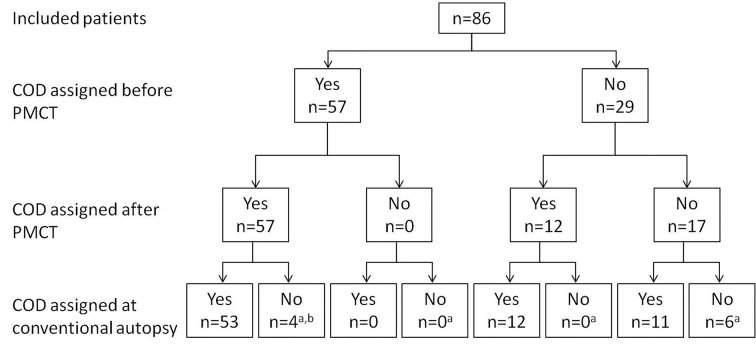
Using PMCT, the sensitivity for immediate cause of death increased with 12% (95% CI 2% to 22%) from 53% (41% to 64%) to 64% (53% to 75%), with 18% (9% to 27%) from 65% (54% to 76%) to 83% (73% to 91%) for type of pathology and with 19% (9% to 30%) from 65% (54% to 76%) to 85% (75% to 92%) for anatomical system.
While unenhanced PMCT is an insufficient substitute for conventional autopsy, it can improve diagnosis of cause of death over clinical diagnosis alone and should therefore be considered whenever autopsy is not performed.
研究尸检CT(PMCT)虚拟尸检是否能改善直接死因的临床诊断。
回顾性观察队列研究。
年龄超过1岁的院内和院外死亡病例,且进行了PMCT虚拟尸检和传统尸检。
法医案件、死后器官捐献者以及扫描程序不完整的病例。在传统尸检之前,先通过PMCT对尸体进行虚拟尸检。在虚拟尸检前记录临床确定的死因,然后根据虚拟尸检结果进行调整。以传统尸检作为参考标准,我们研究了虚拟尸检前后直接死因的敏感性增加情况、所涉及的病理类型和解剖系统。
三级转诊中心。
2012年7月至2016年6月期间接受传统尸检和虚拟尸检的86具尸体。
PMCT包括脑部、颈椎和胸腹盆腔成像。传统尸检包括有或无脑部尸检的胸腹检查。
虚拟尸检前后直接死因的敏感性增加情况、所涉及的病理类型(感染、出血、灌注障碍、其他或未分类)和解剖系统(肺部、心血管、胃肠道、其他或未分类)。
使用PMCT时,直接死因的敏感性从53%(41%至64%)提高了12%(95%CI 2%至22%)至64%(53%至75%),病理类型的敏感性从65%(54%至76%)提高了18%(9%至27%)至83%(73%至91%),解剖系统的敏感性从65%(54%至76%)提高了19%(9%至30%)至85%(75%至92%)。
虽然未增强的PMCT不足以替代传统尸检,但它可以改善死因诊断,优于单独的临床诊断,因此在不进行尸检时应考虑使用。