Instituto Carlos Chagas, Fiocruz-Paraná. Rua Professor Algacyr Munhoz Mader, 3775, Curitiba, PR, 81350-010, Brazil.
Unidad de Bioinformática, Institut Pasteur Montevideo. Mataojo 2020, Montevideo, 11400, Uruguay.
Sci Rep. 2018 Mar 16;8(1):4739. doi: 10.1038/s41598-018-22991-6.
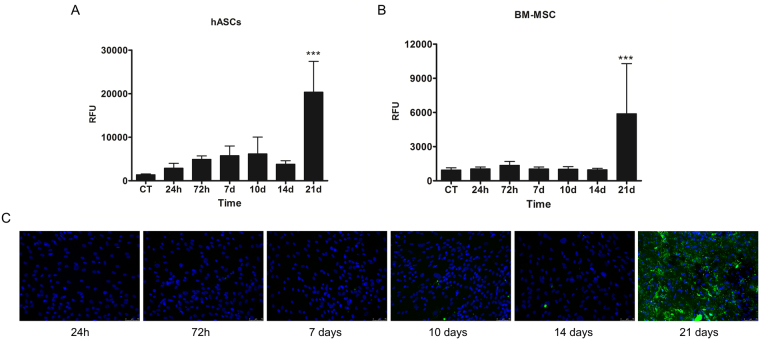
Mesenchymal stem cells (MSCs) have been widely studied with regard to their potential use in cell therapy protocols and regenerative medicine. However, a better comprehension about the factors and molecular mechanisms driving cell differentiation is now mandatory to improve our chance to manipulate MSC behavior and to benefit future applications. In this work, we aimed to study gene regulatory networks at an early step of osteogenic differentiation. Therefore, we analyzed both the total mRNA and the mRNA fraction associated with polysomes on human adipose tissue-derived stem cells (hASCs) at 24 h of osteogenesis induction. The RNA-seq results evidenced that hASC fate is not compromised with osteogenesis at this time and that 21 days of continuous cell culture stimuli are necessary for full osteogenic differentiation of hASCs. Furthermore, early stages of osteogenesis induction involved gene regulation that was linked to the management of cell behavior in culture, such as the control of cell adhesion and proliferation. In conclusion, although discrete initial gene regulation related to osteogenesis occur, the first 24 h of induction is not sufficient to trigger and drive in vitro osteogenic differentiation of hASCs.
间充质干细胞 (MSCs) 因其在细胞治疗方案和再生医学中的潜在应用而受到广泛研究。然而,为了提高我们操纵 MSC 行为和受益于未来应用的机会,现在必须更好地理解驱动细胞分化的因素和分子机制。在这项工作中,我们旨在研究成骨分化早期的基因调控网络。因此,我们在诱导成骨 24 小时时分析了人脂肪组织来源的干细胞 (hASC) 中的总 mRNA 和与多核糖体相关的 mRNA 部分。RNA-seq 结果表明,此时 hASC 命运不会因成骨而受损,并且需要 21 天的连续细胞培养刺激才能实现 hASC 的完全成骨分化。此外,成骨诱导的早期阶段涉及与细胞在培养中行为管理相关的基因调控,例如细胞黏附和增殖的控制。总之,尽管存在与成骨相关的离散初始基因调控,但诱导的前 24 小时不足以触发和驱动 hASC 的体外成骨分化。