
人乳头瘤病毒在10575例浸润性宫颈癌神经内分泌肿瘤中的作用
Contribution of Human papillomavirus in neuroendocrine tumors from a series of 10,575 invasive cervical cancer cases.
作者信息
Alejo Maria, Alemany Laia, Clavero Omar, Quiros Beatriz, Vighi Susana, Seoud Muhieddine, Cheng-Yang Chou, Garland Suzanne M, Juanpere Nuria, Lloreta Josep, Tous Sara, Klaustermeier Jo Ellen, Quint Wim, Bosch F Xavier, de Sanjosé Silvia, Lloveras Belen
机构信息
Hospital General de l'Hospitalet, Consorci Sanitari Integral, L'Hospitalet de Llobregat, Barcelona, Spain.
Infections and Cancer Unit, Cancer Epidemiology Research Program, IDIBELL, Institut Català d'Oncologia (ICO)-IDIBELL, CIBERESP, L'Hospitalet de Llobregat, Catalonia, Barcelona, Spain; Centro de Investigación Biomédica en Red de Cáncer (CIBERESP), Madrid, Spain.
出版信息
Papillomavirus Res. 2018 Jun;5:134-142. doi: 10.1016/j.pvr.2018.03.005. Epub 2018 Mar 17.
AIMS
Neuroendocrine tumors (NET) of the cervix are rare tumors with a very aggressive course. The human papillomavirus (HPV) has been linked to its etiology. The objective of this study is to describe HPV prevalence and genotype distribution of NET.
METHODS AND RESULTS
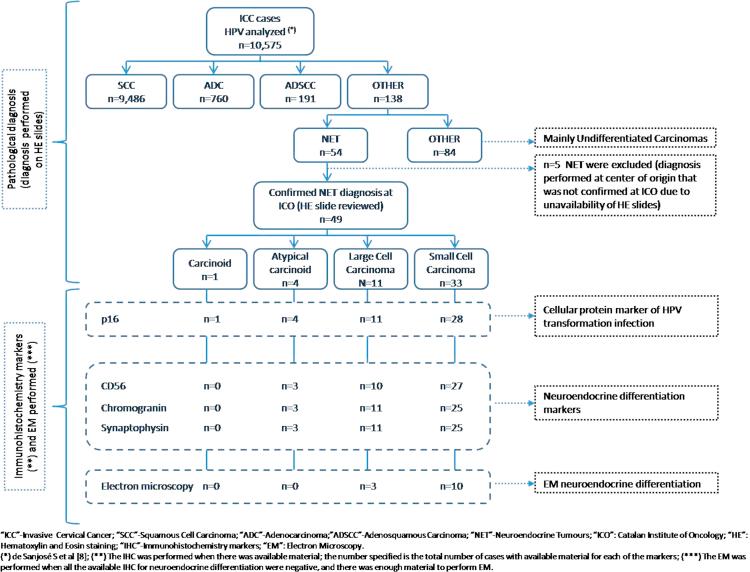
Forty-nine tumors with histological neuroendocrine features were identified among 10,575 invasive cervical cancer (ICC) cases from an international study. HPV DNA detection was done using SPF10/DEIA /LiPA system. Immunohistochemical (IHC) staining for neuroendocrine markers (chromogranin A, synaptophysin, CD56) and for p16 as a surrogate for HPV transforming infection was performed. In 13 samples with negative IHC for all 3 neuroendocrine markers studied, it was possible to conduct electron microscopy (EM). NET represented 0.5% of the total ICC series and HPV was detected in 42 out of 49 samples (85.7%, 95%CI:72.8%,94.1%). HPV16 was the predominant type (54.8%), followed by HPV18 (40.5%). p16 overexpression was observed in 38/44 cases (86.4%). Neuroendocrine IHC markers could be demonstrated in 24/37 (64.9%) cases. EM identified neuroendocrine granules in 8 samples with negative IHC markers.
CONCLUSIONS
Our data confirms the association of cervical NET with HPV and p16 overexpression. Specifically, HPV16 and 18 accounted together for over 95% of the HPV positive cases. Current HPV vaccines could largely prevent these aggressive tumors.
目的
宫颈神经内分泌肿瘤(NET)是一种罕见且病程极具侵袭性的肿瘤。人乳头瘤病毒(HPV)与该肿瘤的病因相关。本研究的目的是描述宫颈NET的HPV感染率及基因型分布。
方法与结果
在一项国际研究的10575例浸润性宫颈癌(ICC)病例中,确定了49例具有组织学神经内分泌特征的肿瘤。使用SPF10/DEIA/LiPA系统进行HPV DNA检测。对神经内分泌标志物(嗜铬粒蛋白A、突触素、CD56)以及作为HPV转化感染替代指标的p16进行免疫组织化学(IHC)染色。在13例对所有3种研究的神经内分泌标志物IHC染色均为阴性的样本中,可行电子显微镜(EM)检查。NET占整个ICC系列的0.5%,49例样本中有42例检测到HPV(85.7%,95%CI:72.8%,94.1%)。HPV16是主要类型(54.8%),其次是HPV18(40.5%)。38/44例(86.4%)观察到p16过表达。24/37例(64.9%)可检测到神经内分泌IHC标志物。EM在8例IHC标志物阴性的样本中鉴定出神经内分泌颗粒。
结论
我们的数据证实了宫颈NET与HPV及p16过表达之间的关联。具体而言,HPV16和18共占HPV阳性病例的95%以上。目前的HPV疫苗在很大程度上可预防这些侵袭性肿瘤。


 Zotero 插件