Liu Jiawei, Zu Mian, Chen Kaotan, Gao Li, Min Huan, Zhuo Weiling, Chen Weiwen, Liu Ailin
Ministry of Education Key Laboratory of Chinese Medicinal Resource from Lingnan, Research Center of Medicinal Plants Resource Science and Engineering, Guangzhou University of Chinese Medicine, 232 Waihuandong Road, Higher Education Mega Center, Guangzhou, 510006, People's Republic of China.
Beijing Key Laboratory of Drug Target Research and Drug Screening, Institute of Material Medica, Chinese Academy Sciences and Peking Union Medical College, 1 Xian Nong Tan Street, Xicheng District, Beijing, 100050, People's Republic of China.
BMC Complement Altern Med. 2018 Mar 20;18(1):102. doi: 10.1186/s12906-018-2173-1.
Neuraminidase (NA) is one of the key surface protein of the influenza virus, and has been established as a primary drug target for anti-influenza therapies. This study aimed to screen bioactive herbal extracts from some medicinal plants traditionally used in Lingnan Chinese Medicines by NA activity high-throughput screening assay.
One hundred ninety herbal extracts from 95 medicinal plants collected in Guangzhou were screened for their potential inhibitory activities against A (H1N1) influenza neuraminidase, and the most active extracts were further evaluated for their anti-influenza virus activities using virus-induced cytopathic effect (CPE).
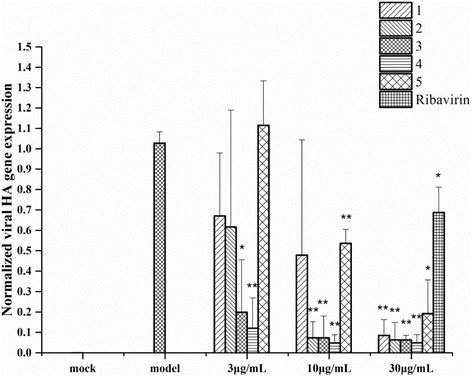
Among the tested 190 herbal extracts, 14 extracts inhibited significantly NA activity (IC < 40 μg/mL), and the extracts 1-5, which were obtained from Amomurn villosum Lour, Melaphis chinensis (Bell) Baker, Sanguisorba officinalis and Flos Caryophylli, showed potent inhibitory activity against NA with IC values ranging from 4.1 to 9.6 μg/mL. Moreover, the most bioactive extracts 1-5 were found to protect MDCK cells from A (H1N1) influenza virus infection with very low cytotoxicity to the host cells (EC values ranged from 1.8 to 14.1 μg/mL, CC values ranged from 97.0 to 779.2 μg/mL, SI values ranged from 14 to 438). In addition, quantitative RT-PCR analysis showed that the extracts 1-5 inhibited viral RNA synthesis in a dose-dependent manner.
We performed in vitro screening of anti-neuraminidase activities of herbal extracts from medicinal plants used in Lingnan Chinese Medicines, and the results indicate that some bioactive extracts are worth further studies to identify the bioactive components responsible for anti-influenza virus activities, to elucidate their modes of action and finally determine their clinical potentials.
神经氨酸酶(NA)是流感病毒关键的表面蛋白之一,已被确立为抗流感治疗的主要药物靶点。本研究旨在通过NA活性高通量筛选试验,从一些岭南中药传统使用的药用植物中筛选具有生物活性的草药提取物。
对采集自广州的95种药用植物的190种草药提取物进行筛选,检测其对甲型(H1N1)流感神经氨酸酶的潜在抑制活性,并使用病毒诱导的细胞病变效应(CPE)对活性最强的提取物进一步评估其抗流感病毒活性。
在测试的190种草药提取物中,有14种提取物显著抑制NA活性(IC<40μg/mL),从阳春砂、五倍子、地榆和丁香中获得的提取物1-5对NA表现出强效抑制活性,IC值范围为4.1至9.6μg/mL。此外,发现活性最强的提取物1-5能保护MDCK细胞免受甲型(H1N1)流感病毒感染,对宿主细胞的细胞毒性极低(EC值范围为1.8至14.1μg/mL,CC值范围为97.0至779.2μg/mL,SI值范围为14至438)。此外,定量逆转录聚合酶链反应分析表明,提取物1-5以剂量依赖方式抑制病毒RNA合成。
我们对岭南中药所用药用植物的草药提取物进行了抗神经氨酸酶活性的体外筛选,结果表明一些具有生物活性的提取物值得进一步研究,以鉴定负责抗流感病毒活性的生物活性成分,阐明其作用模式并最终确定其临床潜力。